
Is your dental practice spending more time chasing unpaid claims than treating patients? You are not alone. Dental practices across the United States write off significant collectible revenue every year, not because they fail to render services, but because a broken, delayed, or understaffed billing process causes it. Dental billing outsourcing exists because CDT coding standards, payer-specific documentation rules, and insurance verification requirements make dental revenue cycle management genuinely complex—something most in-house front desk teams were never trained to manage.
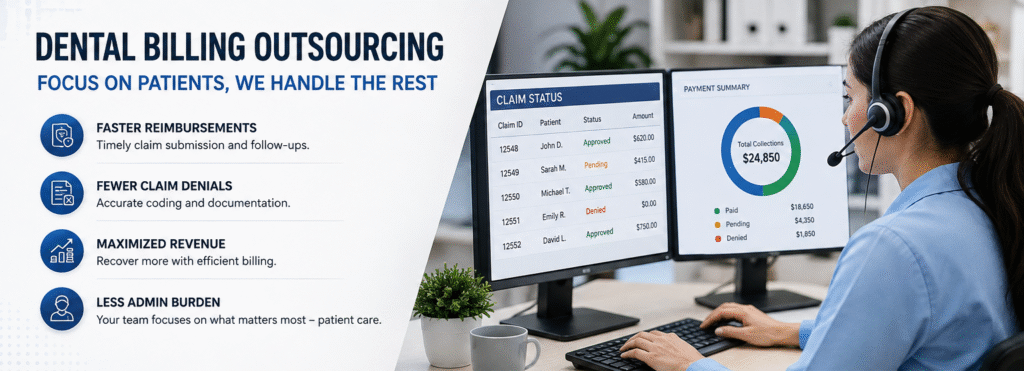
Dental billing outsourcing offers the most effective solutions for practices of every size, ensuring faster reimbursements, fewer claim denials, and a billing operation that runs without constant management oversight.
According to the Ontario Academy of General Dentistry, claim denial rates in dental billing are around 12%, resulting in $262 billion lost revenue every year. The good news? Most of those denials are preventable with the proper billing outsourcing services.
A right dental billing outsourcing company can help recover that revenue, reduce the administrative burden, and give your team the time to focus on patient care.
What Is Dental Billing Outsourcing and How Is It Different from In-House Billing?
Dental billing outsourcing means handing your entire revenue cycle or specific parts of it to an external specialist team. It involves contracting with a third-party company to manage the billing, coding, claim submission, and collections functions of a dental practice’s revenue cycle.
On the other hand, in in-house billing, the practice hires and manages its own billing staff. Although with this process you can gain complete control over your billing services, you might also observe increased overhead costs and an increased risk of manual errors.
In outsourcing, you can transfer those responsibilities to a team of billing specialists who work remotely on behalf of your practice.
Here are some key differences:
| Area | In-House Billing | Outsourced Billing |
| Who Handles It | Your own staff, hired and managed by you | An outside company takes care of all billing |
| What It Costs | Fixed salaries, benefits, and training fees | A flexible fee based on what gets collected |
| Skill Level | Depends on your staff’s personal knowledge | Trained experts who work only in dental billing |
| Growth Friendly | You must hire more people as you grow | Grows with your practice — no extra hiring needed |
| Rejected Claims | Often slow to act, handled as issues come up | Tackled quickly with a clear process and set timelines |
| Software | The practice buys and manages its own tools | They link up with the software you already use |
Who Needs Dental Billing Outsourcing Services?
Dental billing outsourcing can be useful for different types of practices, such as :
Solo Dental Practices
Solo practitioners are responsible for treatment planning, patient communication, and overseeing a small front desk team. In the end, billing accuracy and follow-up are the first things that go unnoticed. Outsourced dental billing gives solo practices access to the same level of billing expertise as larger groups, without the overhead costs.
Multi-Location Dental Clinics
Multi-location groups have to handle different payer mixes across locations, inconsistent coding practices between offices, and billing staff who might not share knowledge. An outsourced team creates a single billing operation across all locations, with unified reporting practices.
Dental Support Organisations (DSOs)
DSOs managing dozens or hundreds of affiliated practices that grow without adding headcount. A specialist dental billing outsourcing company provides the centralized expertise and technology to handle high claim volumes while maintaining compliance for every affiliated location.
How Dental Billing Outsourcing Works in a Real Practice Setting
Every stage of the revenue cycle follows a defined action and timeline. Here’s how it works in real settings:
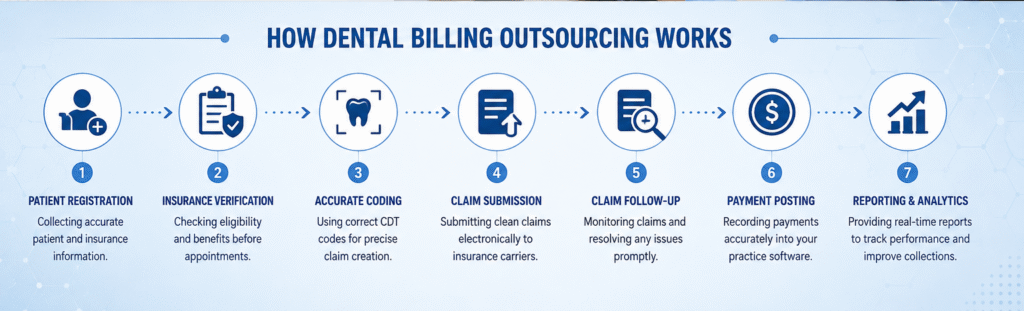
Patient Registration and Insurance Information Gathering
The dental billing outsourcing team collaborates with the administration team to obtain vital information, such as group numbers, patient IDs, and benefit coordination, before the appointment.
Insurance Validation and Eligibility Review
The team carries out eligibility validation 24 to 48 hours before each appointment date to confirm active coverage and identify any approval requirements.
Accurate Coding Using CDT Codes
The dental claims include CDT codes developed by the American Dental Association. The billing professionals keep track of changes in these codes and also in each payer’s guidelines to minimize errors before filing claims.
Claim Submission and Clearinghouse Processing
Both a software system and a human reviewer check each claim before it is filed. Moreover, the team files clean claims within one to two business days following the visit. The team follows daily reports on clearinghouse activity and handles rejected claims right away.
Payment Posting and Reconciliation
The billing team enters each payment received from payers and reconciles it to its respective claim. This guarantees accuracy in posting while making it easier to detect underpayments and adjustments.
Accounts Receivable (AR) Follow-Up and Denial Management
The team analyzes and categorizes the unpaid and denied claims based on their cause and then refiles these claims within a specified time limit. A monthly analysis of denials allows us to find recurring denial types and address the root cause rather than repeat the same procedure again and again.
Key Benefits of Dental Billing Outsourcing
Here’s how dental billing outsourcing has a direct impact on the bottom line of your practice:
More Efficient Claims Processing & Reimbursements
The dental billing outsourcing company sends your claims one or two days after your visits, and sorts denials the same day. Payment cycles become faster, and you can see reductions in your accounts receivable days within the first three months.
Fewer Claim Denials & Mistakes
Coverage verification, code verification, and claim review eliminate the most common causes of denials even before you send out the claims. Once you track denials, you can easily pinpoint the root cause of the mistake and prevent it from recurring.
Lower Operational and Staffing Costs
If you bill your insurance in-house, you need to pay salaries and other benefits associated with billing employees. Outsourced billing usually costs less than one full-time billing employee while delivering better results.
Access to Experienced Billing Specialists
With sole focus, the outsourced staff will be more familiar with dental billing and CDT codes and policies than any internal employees who have other responsibilities.
Improved Cash Flow and Revenue Visibility
The smooth operation of regular billing processes and quick reimbursements from insurance companies ensures a steady cash flow. At the same time, detailed reports allow tracking revenue performance.
Common Concerns About Outsourcing Dental Billing Services
You Keep Visibility, Not Paperwork
Outsourcing doesn’t mean losing sight of your own billing. A properly run partner gives you more visibility, not less: regular reports on AR aging, denial rates, and collections, plus a direct line to your billing team. The practice stays yours. Only the paperwork moves.
The Switch Takes Weeks, Not Months
Most practices complete the transition in 2 to 4 weeks, with measurable results by the 60 to 90 day mark. The outsourced team reviews your current setup, gets system access, and runs alongside your existing workflow before taking over fully. Patients typically notice nothing beyond faster answers to billing questions.
Dental Experience Isn’t Optional
A billing company built around medical claims, with dental handled as an afterthought, won’t know CDT codes, dental-specific payer rules, or coordination of benefits the way a dental-focused team does. That distinction matters more than price when picking a partner.
How Much Does Dental Billing Outsourcing Cost?
The pricing for dental billing outsourcing differs based on the model. You can choose the right model depending on your practice’s volume and preferences. Here is a brief look at some of these models.
Percentage-Based Pricing Model
The provider will take a certain percentage (usually around 4-10%) of the collections based on the size of the practice, number of claims, and service types offered.
Flat Monthly Pricing Model
Some providers offer flat rates per month. This pricing model is ideal for practices that process large numbers of claims and are therefore expensive under the percentage-based pricing model.
Per-Claim Fee Structure
The billing company charges a flat rate per claim. Smaller practices or those that outsource certain revenue cycle functions generally adopt this structure.
Some Factors that Influence the Price of Dental Outsourcing Include the Following:
- Volume of claims: The more the volume, the lower the per-claim/percentage fee.
- Types of services offered: Total cycle services, such as account receivable collections and denial handling, are more expensive than just claims submissions.
- Complexity of practice: Larger practices, multiple offices, DSOs, and complicated payer mixes have increased the costs of services.
- Software compatibility: If the vendor integrates with your practice management software, you may incur set-up fees.
What Outsourced Dental Billing Actually Costs
Pricing for outsourced dental billing services varies by model, but as a reference point, a full-time remote billing role through an outsourced provider typically runs around $1,650 a month, or roughly $19,800 a year, as a flat, all-inclusive rate rather than a percentage of collections. This compares against the fully loaded cost of an in-house hire, which includes salary, benefits, training, software licenses, and the ramp-up time before a new hire is fully productive. Actual pricing shifts with claim volume and practice size, which is why dental RCM costs tend to vary more between a solo practice and a multi-location group than the flat monthly figure alone suggests.
When Should You Consider Outsourcing Dental Billing?
If any of the following match your current situation, it is time to sign up for outsourcing.
- When your denial rate is climbing: Each month of inaction adds to the volume of unresolved claims and lost revenue, and no one on the team has an idea about the root cause.
- When a billing team member leaves your team: The time required to recruit, hire, and train a replacement often takes months or years to recover.
If your days in AR are consistently above 45 despite internal effort: An outsourced team with defined follow-up workflows addresses the root cause.
How to Choose the Right Dental Billing Company
Let’s take a look at the factors to keep in mind when choosing the right dental billing company:
Industry Experience and Expertise
To outsource dental billing, partner with a company that has experience in dental billing and not just medical billing.
Compliance and Data Security Standards
Make sure the vendor signs a Business Associate Agreement (BAA) and follows HIPAA data handling rules.
Reporting and Transparency
A good partner shares regular reports on AR ageing, denial rates, and collection performance.
Technology and Software Compatibility
Confirm the vendor works with your existing software. Manual data transfers cause errors and slow down the process.
How CEComputech Supports Dental Billing Efficiency
At CEC, we design our dental billing outsourcing services around one objective: To collect every dollar your practice has legitimately earned as quickly as possible.
Here’s why we stand out:
- Complete outsourced dental billing services for DSOs and offices.
- Real-time insurance eligibility and benefit verification.
- Professional-grade AR follow-ups and credentialing.
- Secured payment links, QR codes, and personalized statements.
- Accurate claim submission and denial management to expedite claim processing.
- Reliable services that are HIPAA-compliant and secured.
Get a Free Billing Efficiency Assessment
Find out how much revenue your practice is losing to denials, slow AR cycles, and billing gaps. Our experts will review your current billing setup and show you exactly what outsourcing could recover for your practice.
Get a Free Billing Efficiency Assessment →Conclusion
Running a dental practice in the United States has always involved two parallel responsibilities: delivering quality patient care and keeping the financial operation healthy enough to sustain it. Dental billing outsourcing is a structural decision that changes how your revenue cycle operates. It decides how consistently your practice collects what it earns.
If your dental practice is dealing with rising denials, slow AR cycles, or billing staff instability, make sure to outsource the billing services for a systematic and accountable process. The right dental billing outsourcing company will manage your entire revenue cycle with rich expertise, technology, and follow-ups, which most in-house operations cannot match at the same cost.
Want to give your dental clinical team the time and focus they need to deliver exceptional patient care? Contact CEC to discuss how our outsourced dental billing services can reduce your denial rate and shorten your collection cycle.
FAQs
Q1. What is dental billing outsourcing?
Dental billing outsourcing is the process of contracting a third-party company to manage your practice’s billing, coding, claim submission, and AR follow-up functions. A specialist external team will replace or support in-house billing staff within your existing management software.
Q2. How much does it cost to outsource dental billing?
The scope and challenges of your project determine the price for a dental billing outsourcing company. However, the total cost is lower than maintaining a dedicated in-house team, including the salary, benefits, and training.
Q3. Is outsourced dental billing HIPAA compliant?
Yes. A reputable outsourced dental billing company follows the same HIPAA requirements as the dental practice itself. Ensure they sign a Business Associate Agreement (BAA) and verify their data security standards before entering into any agreement.