
The missing tooth clause is one of the most misunderstood exclusions in dental insurance. When a patient’s tooth is lost before their current policy begins, many insurers refuse to cover its replacement, even if the procedure itself is a listed benefit. For dental practices, this means a bridge or implant case can be denied at the claim stage after treatment is already complete.
This is because this clause is buried in the fine print of many insurance plans. It means it can block coverage for prosthetic treatments entirely, regardless of the patient’s current benefits. Verifying the dental insurance missing-tooth clause before treatment starts can save your practice from denials, payment delays, and frustrated patients.
So, how to screen for it during dental insurance verification? Keep on scrolling to find out!
What Is the Missing Tooth Clause in Dental Insurance?
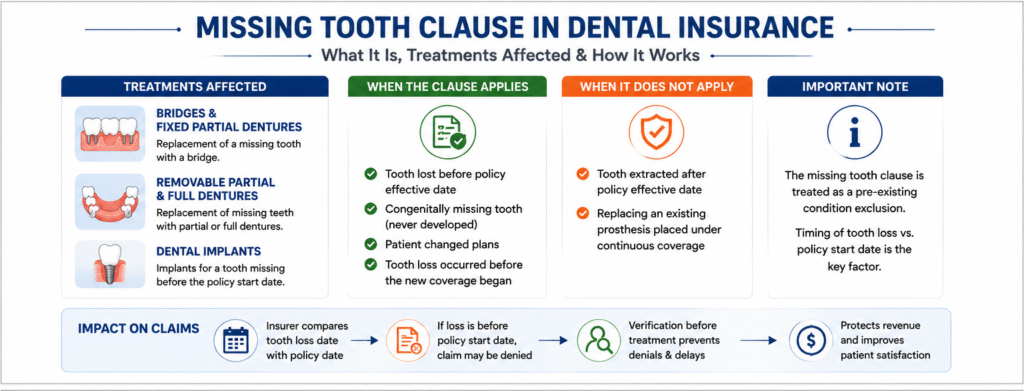
The missing tooth clause (MTC) is a provision in many dental insurance plans that limits or excludes coverage for replacing a tooth that was already missing before the patient’s current policy took effect. Even if the patient’s plan includes benefits for bridges, dentures, or implants, the clause can override that coverage entirely if the tooth loss pre-dates the policy start date.
The insurance company will not pay to replace a tooth they were never insured. This is framed as a pre-existing condition exclusion, similar to the rules found in medical insurance. The key detail is always timing: when the tooth was lost versus when the coverage began.
Why Does the Missing Tooth Clause Exist?
Insurers use the missing-tooth clause to mitigate their risk by ensuring they will not be responsible for any condition present before their policy. They mention that a plan is designed to cover future dental needs, not pre-existing ones. If a patient enrolled specifically to get a bridge or implant they already needed, the insurer would be paying for a loss they never assumed risk for.
From a practice perspective, the clause exists regardless of intent. A patient who lost a tooth years ago and never had coverage is treated the same as one who timed their enrollment to access benefits. The clause doesn’t account for circumstances, only dates.
Which Dental Treatments Are Affected by the Missing Tooth Clause?
The MTC applies to any prosthetic treatment that replaces a missing tooth. If a patient’s plan includes this clause and the tooth was lost before coverage started, the policy might deny it. Some treatments covered in this point are:
Bridges and Fixed Partial Dentures
Bridges are the most commonly affected treatment. In the case of a three-unit bridge to replace a tooth that was extracted before the plan became valid, the entire treatment will most likely not be covered, despite the plan’s coverage of the prosthetic benefit.
Removable Partial and Full Dentures
Partial and full dentures are also affected by MTC. If even one of the teeth being replaced was missing before coverage started, the entire prosthesis may be denied. Insurers often apply the clause to the full case, not just the specific tooth, making this particularly impactful for full-arch cases.
Dental Implants
If an implant is planned for a tooth that was lost before the policy began, the claim will be denied under the missing tooth clause. It happens even if implants are listed as a covered service under the patient’s current plan.
However, keep in mind that congenitally missing teeth, which have never existed, are considered just like extracted teeth according to most MTC clauses. If the tooth was never there when the coverage began, then the clause applies.
How the Missing Tooth Clause Affects Insurance Claims
When a claim is submitted for prosthetic work, the date of tooth loss will be compared to the policy date by the insurers. The process occurs while claims processing is underway. That is why some dentistry practices having not screened for the MTC during dental insurance verification often struggle with the problem after treatment is complete.
| Scenario | MTC Applies? |
|---|---|
| Tooth lost before policy effective date | Yes (claim may be denied) |
| Tooth lost after policy effective date | No (billed as normal) |
| Congenitally missing tooth (never developed) | Yes (same as pre-existing loss) |
| Replacing an existing prosthesis (same tooth) | No |
When the Clause Applies vs When It Does Not
The clause applies when:
- The tooth had been lost before the start of the policy period.
- The tooth has never developed.
- The patient changes their plan.
- Tooth loss happened before the commencement of the new coverage.
It typically does not apply when
- The tooth has been extracted after starting the coverage period
- The patient is replacing an existing prosthesis placed during a prior covered period.
What Happens When a Replacement Prosthesis Is Being Replaced
If a patient is replacing an old bridge or denture and the original prosthesis was placed with continuous coverage, the missing tooth clause usually does not apply. However, other plan limitations often do. Frequency restrictions commonly require that 5 to 10 years have passed since the original placement before a replacement is covered.
The claim should include the proper documents for
- prior placement date
- reason for replacement (fracture, decay, poor fit)
- clinical narrative
- supporting x-rays or photos.
Without these documents, the claim may be denied even if the patient is legitimately entitled to coverage.
How to Handle Claims When the Tooth Loss Date Is Unknown
When a patient doesn’t know when a tooth was extracted or when records aren’t available, the safest approach is to submit with a written narrative explaining the situation and request a preauthorization before treatment begins.
Some payers will review available records and issue a determination. Others will require the tooth loss date before processing. Submitting blindly without this information increases the risk for claim denial.
The Role of Dental Insurance Verification in Preventing MTC Denials
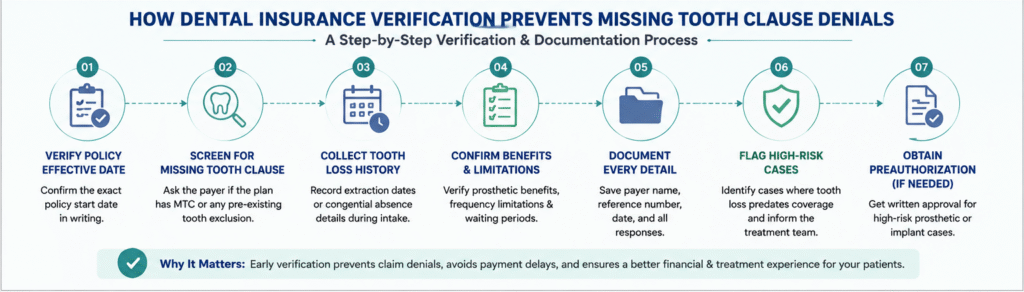
Proper dental insurance verification is the most effective way to catch the missing tooth clause before it causes a denial. Instead of verifying general benefits, you need to specifically ask about MTC provisions, like policy effective dates, and prosthetic history during every verification call for prosthetic cases.
Key Questions to Ask During Insurance Verification
When calling payers to verify benefits for prosthetic treatments, include these questions:
- Does the plan include a missing tooth clause or a pre-existing tooth exclusion?
- What is the patient’s policy effective date?
- Does the plan differentiate between teeth lost before and after the policy started?
- Are replacement prosthetics covered if the original was placed under a prior plan?
- What documentation is required to support a claim for prosthetic replacement?
How to Screen for the Missing Tooth Clause at Patient Intake
At intake, collect the patient’s full dental history, including any extractions with approximate dates. Compare this against the policy effective date obtained during verification. If any extraction happens before coverage, then the case will be flagged before treatment planning begins/
Documentation Required Before Submitting a Claim
For prosthetic claims with MTC risk, gather the following before submission:
- Patient’s policy effective date confirmed in writing
- Tooth loss or extraction date, from records or patient history
- Clinical narrative explaining the need for treatment
- Supporting x-rays, photos, or prior records, where applicable
- Preauthorization response if submitted
Common Billing Mistakes Related to the Missing Tooth Clause
Most MTC-related denials are preventable. Here are some common billing mistakes in prosthetic billing and how to fix them:
Assuming Coverage Without Verifying the Policy Effective Date
If you skip dental insurance verification services and proceed to treatment planning based on stated benefits, there will be a high risk of MTC denials. The policy effective date is non-negotiable information for any prosthesis case.
Missing the Fine Print on Prosthetic Replacement Policies
Even when the MTC doesn’t apply, frequency limitations and replacement restrictions may block coverage. If you fail to read the full prosthetic section of the explanation of benefits will result in expensive mistakes. It particularly matters in replacement cases where the original prosthesis was placed years earlier under a different plan.
Skipping Preauthorization for High-Risk Cases
It is recommended that you get pre-authorization for prosthetic procedures, especially when MTC is suspected or there is doubt regarding the loss of teeth. The reason is that pre-authorization guarantees the existence or lack of insurance coverage before you proceed.
How to Appeal a Claim Denied?
The appeal for the dental insurance missing tooth clause should have:
- Documentation to prove that the tooth is missing within the period specified
- Extraction certification as evidence that the tooth is missing within the period the policy is in effect
- Continuous insurance documentation (in case of switching insurance companies)
- Report for the health condition that required the procedure to be done
- Original claim letter
- EOB denial
Which Insurance Plans Exclude the Missing Tooth Clause?
There are certain dental insurances that lack the inclusion of the missing teeth clause. These dental insurances include those that come as a package by some employers, Medicaid dental plans of various states, and the ‘no waiting period, no exclusions’ insurance plan that lacks the inclusion or has limited the scope of the clause.
Insurance plans that are highly unlikely to include MTC are the DHMO (Dental Health Maintenance Organisation). They will opt for a PPO with comprehensive prosthetic dental care and veteran affairs dental plans.
The best way is to always inquire with the payer regarding their dental insurance verification services every time to confirm the availability of the clause.
How do outsourced dental insurance verification services handle the missing tooth clause?
Professional dental insurance verification services include MTC screening as part of their standard verification process. Instead of relying on the front desk staff to remember the right questions under pressure, a dedicated verification team works from a structured checklist.
It is particularly important for prosthetic-heavy practices: implant centres, prosthodontic offices, and general practices with high denture and bridge volume. Outsourced verification also reduces the administrative load on front desk staff and turnaround times.
How does CEC handle dental insurance verification for practices?
CEC’s verification process prevents denials before they happen. For every prosthetic case, our team confirms the patient’s policy effective date, screens specifically for the missing tooth clause, and documents all findings in a proper format so your team can act on them immediately.
Here’s what you will get from our services:
- Same-day or next-day benefit verification turnaround
- MTC-specific screening on all prosthetic and implant cases
- Documented verification records formatted for your practice management system
- Clear flagging of high-risk cases before treatment planning begins
- Support for preauthorization submissions on complex or MTC-exposed cases
Get a Free Prosthetic Case Verification Review
Find out if your bridge, denture, and implant cases are being screened for the missing tooth clause before treatment starts. Our experts will review your verification process and flag high-risk prosthetic cases before they turn into denials.
Get a Free Prosthetic Case Verification Review →Conclusion
The missing tooth clause is a manageable issue, but only you know how to look for it. If you miss the clause during verification and discover the problem after treatment, your options are limited, and you have to deal with frustrated patients.
Include a dental insurance missing tooth clause screening in every prosthetic verification call, collect extraction dates at intake, and work with experienced dental insurance verification services to prevent the MTC-related denials.
CEC’s team handles this process for your practice thoroughly, consistently, and without adding to your front desk workload, so your team can focus on patient care, not policy fines. Contact us today!
FAQs
1. What is the missing tooth clause in simple terms?
It’s a rule in many dental plans that prevents coverage for replacing a tooth that was already gone before the patient’s current policy started. Even if the plan covers bridges or implants, the clause blocks the benefit for pre-existing tooth loss.
2. Can a patient appeal a claim denied under the missing tooth clause?
Yes. Appeals are possible, especially when the denial resulted from missing documentation rather than a valid clause application. Strong appeals include extraction records, continuity of coverage evidence, and a clear clinical narrative.
3. Does the missing tooth clause apply to congenitally missing teeth?
Yes. Most insurers treat a tooth that never developed the same as one that was extracted before coverage began. The clause applies based on absence at the time coverage started.
4. How do I know if my patient’s plan has a missing tooth clause?
Consult the payer when verifying the benefits. Confirm the MTC benefit, the policy inception date, and how prosthetic coverage is considered for tooth loss that existed before the date of coverage.
5. Does the missing tooth clause affect replacement dentures or bridges?
Not usually; especially if the original prosthesis was implanted under the current insurance coverage plan, frequency limits will probably apply in replacement scenarios. Include information regarding previous placements when submitting the insurance claim.