
Denial rates are up. Billing staff are stretched thinner than they were two years ago. And patients, used to knowing exactly what they owe on every other purchase they make, are starting to expect the same from their medical bill. None of this is news to anyone running a practice right now, but it’s worth naming, because it’s exactly what’s pushing healthcare revenue cycle management to change faster than it has in a long time.
Most conversations about healthcare revenue cycle management trends in 2026 are aimed at hospitals and large health systems, and honestly, that’s a problem. A solo dental office or a five-provider medical group is dealing with a lot of the same pressure without any of the same resources. So this piece is written for that side of the industry: what’s actually changing, what’s overhyped, and what a smaller practice can realistically do about it.
Why Things Are Moving So Fast Right Now
Revenue cycle management, at its core, is everything between a patient booking an appointment and a claim finally getting paid: registration, eligibility, coding, submission, follow-up, and collections. None of that is new. What’s changed is how much pressure sits on each of those steps.
Payers keep tightening prior authorization rules. Patients, thanks to high-deductible health plans, now owe a bigger chunk of the bill directly, which means collecting from them isn’t a side task anymore. And AI-based tools have gotten good enough that they’re catching real errors before a claim goes out, not just flagging them after the fact for a biller to sort through later.
The result: RCM has stopped being a back-office job nobody thinks about. It’s become one of the clearer signals of whether a practice is actually healthy.
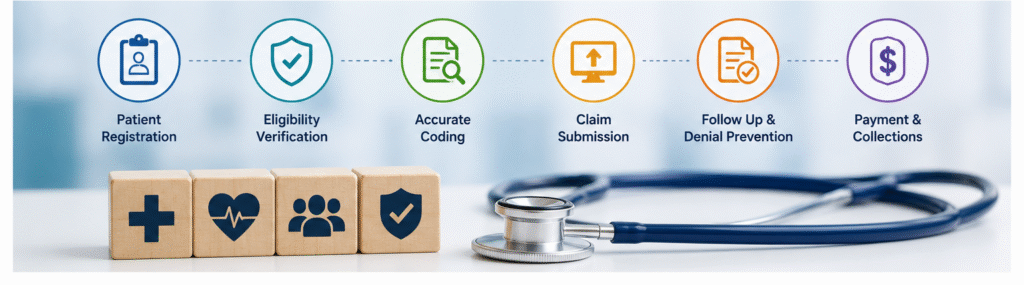
Top Healthcare Revenue Cycle Management Trends to Watch in 2026
1. Automation Is Doing More Than Eligibility Checks Now
A few years ago, “automation” in billing basically meant checking insurance eligibility automatically. That’s table stakes now. Current tools flag likely coding errors, predict which claims are at risk of denial before submission, and pull together documentation without requiring manual assembly. If your practice is still keying most of this in by hand, this is probably the single revenue cycle management trend worth acting on first, since fewer manual touches usually means a better clean claim rate almost immediately.
2. Prevention Is Winning Over Cleanup
The old model: submit the claim, wait, fix whatever comes back denied. That’s backwards now. Real-time eligibility checks, pre-claim validation, and tighter documentation at the point of care these all happen before the claim ever leaves the building. Call it denial prevention if you want the industry term for it. Either way, it’s cheaper and faster than fixing a denial after the fact, which is really the whole argument for it.
3. Patients Want Their Medical Bill to Feel Like an Online Order
This one’s less technical and more about expectations. Patients compare their statement to whatever else they paid for that week, not to a hospital bill from a decade ago. Upfront estimates. A payment link that actually works on a phone. Some flexibility if they can’t pay it all at once. Practices that get the insurance side right but ignore this piece of healthcare revenue cycle management trends still end up with slow patient collections and a lot of confused phone calls.
4. More Practices, Not Just Hospitals, Are Outsourcing
Staffing is hard to find and harder to keep, and that’s pushing smaller practices toward outsourced healthcare revenue cycle management services in a way that wasn’t as common five years ago. The appeal isn’t complicated: dedicated coders, someone actually following up on aging claims every week, and a cost you can predict instead of a hiring cycle you have to keep repeating.
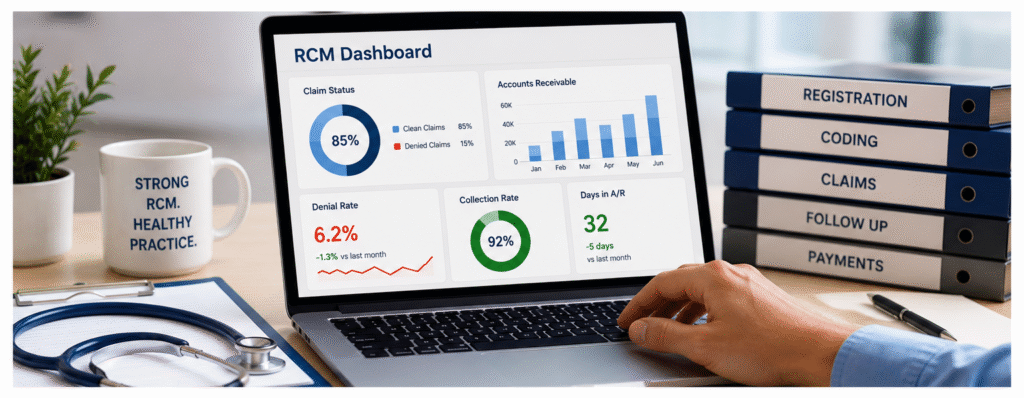
5. Practices Finally Have Real Numbers to Look At
Days in accounts receivable, denial rate by payer, collection rate, these used to be dashboards only a hospital’s finance team had access to. Now a mid-sized practice can see the same thing, which means catching a problem while it’s small instead of noticing it three months later when the bank account tells you.
6. Compliance and Security Aren’t a Line Item Anymore
Billing systems hold exactly the kind of data cybercriminals want, and payer audits aren’t getting rarer. HIPAA compliance, secure handling of patient data, and documentation that would hold up under review these belong at the center of how a practice runs its revenue cycle management, not tacked on afterward because someone mentioned it in a meeting.
7. Value-Based Contracts Are Changing What Counts as “Accurate”
As more payer contracts tie reimbursement to outcomes instead of volume, documentation has to prove something beyond “this happened.” It has to support a quality metric. That’s pushing healthcare RCM to get more data-driven every year, whether a practice is ready for it or not.
What Most 2026 RCM Reports Get Wrong for Smaller Practices
Here’s the thing most trend reports skip: they’re written assuming you have a compliance department, a six-figure automation budget, and maybe an offshore team already in place. Useful if you’re a 400-bed hospital. Not so useful if you’re a dental practice with two billers and a front desk that’s already juggling three other jobs. That’s exactly the gap CEC’s dental RCM services are built to close.
The realistic move for a smaller practice in 2026 isn’t a full technology overhaul. It’s picking two or three things, proactive eligibility checks, clearer patient payment options, actually following up on aging AR, and doing them consistently. That’s usually where working with a healthcare revenue cycle management services partner who understands practice-level operations, not just hospital-scale RCM, actually pays off.
How CEC Helps Practices To Stay Ahead Of Trends?
We work with dental and medical practices on exactly this: eligibility verification before the visit happens, coding checks that catch mistakes before submission, billing support patients can actually understand, and reporting that tells you where your revenue stands without needing a finance degree to read it.
There’s no template package. Our approach to healthcare RCM gets built around a practice’s actual denial patterns and payer mix, so you get something closer to enterprise-level revenue cycle management without losing the kind of service a smaller practice actually needs.
See Where Your Practice Stands on 2026 RCM Trends
Find out which one or two changes would move the needle most for your practice, without a hospital-scale budget or a full technology overhaul. Our experts will review your denial patterns, payer mix, and current workflow, then show you exactly where to start.
Talk to CEC About Your Practice →Final Thoughts
Automation, denial prevention, patient-friendly billing, more outsourcing these aren’t just talking points for 2026. They’re the difference between a practice that’s constantly chasing cash flow and one that isn’t. You don’t need to fix everything this quarter. Pick what’s hurting most right now and start there. If you want to see what proactive healthcare revenue cycle management actually looks like day to day, CEC can walk you through it.
FAQs
1. What is healthcare revenue cycle management?
It’s the full process behind getting a provider paid, starting at scheduling and eligibility verification and running through coding, claims submission, and final payment.
2. What are the biggest healthcare revenue cycle management trends for 2026?
AI-driven automation, denial prevention over denial cleanup, patient-friendly billing, more practices outsourcing RCM, better use of data, and tighter compliance and security standards.
3. Do RCM trends built for hospitals actually apply to smaller practices?
Partly. The pressures are similar, denials, staffing, patient payment expectations, but the fix looks different. Smaller practices need a few focused changes, not an enterprise-wide overhaul.
4. What’s the actual benefit of outsourcing healthcare revenue cycle management services?
Access to coders and billers who do this full-time, consistent follow-up on claims that would otherwise sit, and a predictable cost instead of a constant hiring problem.
5. What’s the real difference between denial management and denial prevention?
Denial management deals with a claim after it’s already been rejected. Denial prevention catches the issue before submission, through eligibility checks and documentation review, so there’s nothing to clean up later.
6. How does CEC actually help with healthcare RCM?
Eligibility verification, coding accuracy checks, patient billing support, and reporting built around each practice’s specific payer mix and claim history, aimed at fewer denials and steadier cash flow.