
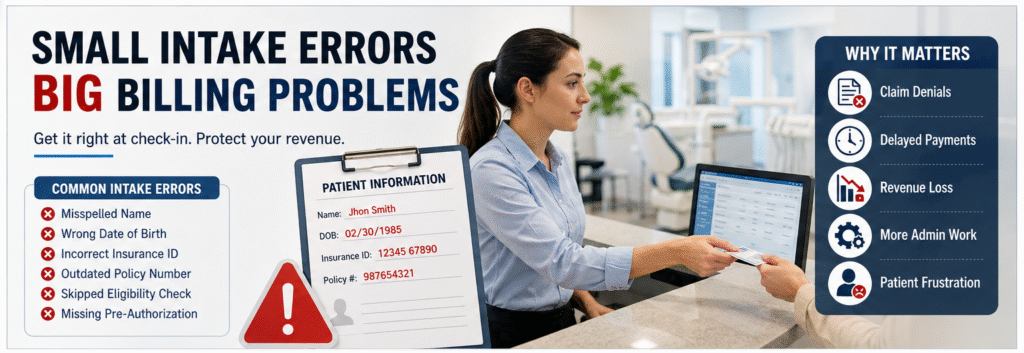
Nearly 1 in 5 dental claim denials trace back to administrative errors. A misspelled name. A wrong date of birth. An outdated policy number, entered at check-in, nowhere near a dental chair. By the time that denial lands on a billing team’s desk six weeks later, someone’s usually blaming the payer, or the coding, or “the system.” Almost nobody traces it back to what it actually was: a ten-second data entry mistake at intake.
The Front Desk Runs the Whole Cycle, Whether Anyone Admits It or Not
People talk about the front desk and billing like they’re two departments. One greets patients and runs the schedule. The other chases claims and yells at insurance companies on hold. But every claim your billing team submits is built entirely on what got typed in at check-in: name, birthdate, insurance ID, plan details, coordination of benefits. Both sit inside the same revenue cycle management process, whether your org chart says so or not. Get that first data point wrong, and billing candetails, andthe claim all they want. They can’t fix what’s already broken underneath it.
The Mistake Almost Everyone Makes: Verifying Too Late
Ask a handful of people who’ve worked in dental billing for a while what the biggest recurring problem is, and you’ll hear a version of the same answer more than once: insurance verification, done at the last minute, or skipped outright. It’s not because staff are lazy. Verification takes real time between patients, and it’s easy enough to assume coverage checked three visits ago is still good. Then the patient leaves after treatment, and if that plan had lapsed or changed, that revenue might be gone for good.
The fix here isn’t complicated. Confirm coverage at least two days before the appointment, not the morning of, definitely not once the patient’s already sitting in the chair. Two days gives someone enough runway to catch a lapsed policy and actually talk to the patient about it before the drill starts, not after the claim bounces.
Where the Damage Actually Comes From
Typos in the basics. A misspelled name, a transposed birthdate, a wrong digit in a member ID. Small stuff. Enough on its own to bounce an otherwise clean claim before a payer even looks at what was done clinically. Happens most when staff are working off an old intake form or rushing between patients with a waiting room filling up.
Insurance info nobody rechecked. People switch jobs. Plans change. Dependents get added. None of that shows up automatically unless someone asks. A verification from six months back tells you nothing about today.
Guessing at coordination of benefits. Patient hands over two insurance cards, staff bills whichever one’s on top. That’s not how it works, and it’s one of the more common reasons a payment shows up wrong later, or a secondary claim denies for a reason nobody in the office can immediately explain.
Skipped pre-authorization. Some procedures need payer sign-off first. Miss that step at intake, and the claim gets denied regardless of how good the clinical notes are.
Half-filled new patient forms. A missing signature, a skipped medical history question. Small gaps that turn into real delays once a claim needs supporting documentation.
Six Weeks Later, Nobody Remembers Where It Started
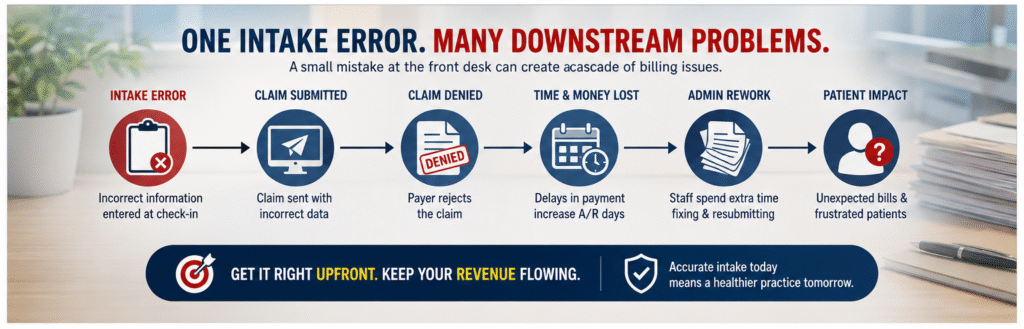
A wrong field at intake doesn’t usually stay one problem. It moves. An unverified COB question becomes a claim billed to the wrong primary insurer weeks later. A missed plan change becomes a denial that shows up long after the appointment’s forgotten. A skipped eligibility check becomes a payment that simply never arrives, because coverage had already lapsed by the time anyone submitted anything.
Whoever ends up untangling that isn’t the person who made the original call at the front desk. They’re reconstructing a ten-second decision from six weeks ago with a fraction of the information the front desk actually had, sitting right there with the patient.
The Cost Isn’t Just the Denied Claim
Days in A/R go up, because a rejected claim has to be corrected and resubmitted, and that resubmission cycle adds weeks a clean claim wouldn’t have needed. Cash flow gets harder to plan around, since a practice can’t predict its own collections well when a chunk of claims keep getting kicked back for reasons that were preventable in the first place. Staff time gets eaten by rework instead of anything new.
And then there’s the patient side of it. Someone gets an unexpected bill because their coverage wasn’t checked properly, and that damages trust more than the dollar amount alone would suggest. Patients don’t parse the difference between “your insurance denied this” and “we didn’t verify your coverage correctly.” They just remember the surprise bill.
What Actually Fixes This
A checklist that doesn’t rely on memory. Verification, demographic confirmation, COB question, pre-auth flag, run the same way for every single patient, so it’s not riding on whoever happens to be at the front desk that day.
Real-time eligibility checks instead of trusting last visit’s notes. Coverage changes more than practices want to believe.
A direct COB question asked out loud, not an assumption based on which card came out of the wallet first.
Verification software that flags problems before a claim goes out the door, rather than catching them after a denial comes back. A lot of practice management systems already have this built in and just aren’t configured to use it.
And a feedback loop that actually goes somewhere. When billing sees the same type of denial three times in a month, that needs to get back to the front desk fast, specific, no finger-pointing, or it just keeps happening to new patients.
Why This Post Sits at the Start of Everything Else
A lot of what looks like a separate, unrelated billing problem traces back to this exact starting point. Coordination of benefits sequencing mistakes, the kind that end with a claim going to the wrong primary insurer, almost always start with a COB question that never got asked clearly at check-in. Payments that arrive and get misapplied, creating hidden accounts receivable nobody can see on a report, often trace back to demographic details that were wrong from day one. Fix intake, and you’re not just cutting denials. You’re cutting the raw material for half the problems that show up disguised as something else three steps later.
Where CEC Fits
Most practices don’t struggle with intake because their front desk doesn’t care. They struggle because the same person answering phones, running the schedule, and greeting the next patient is also expected to catch an insurance change nobody mentioned. CEC’s Dental Insurance Billing and Verification Solutions sit right at that hand-off, verifying eligibility and coordination of benefits before treatment instead of after a claim comes back wrong, confirming demographic details against the actual ID, flagging pre-auth requirements before they turn into a denial reason.
This isn’t a side task bolted onto billing. It’s one of the highest-leverage points in a practice’s broader dental RCM strategy, precisely because it sits upstream of so much of what goes wrong later.
Get a Free Front Desk Intake Review
Find out how many of your denials actually started at check-in. Our experts will review your intake process, eligibility timing, and COB questions, then show you exactly where a checklist could stop denials before they ever happen.
Get a Free Front Desk Intake Review →Bottom Line
Most of the billing headaches that look complicated by the time someone’s untangling them started as a small, forgettable decision at check-in. Fix intake, real verification timing, an actual COB question, a checklist that doesn’t depend on memory, and a lot of downstream mess simply never happens. Contact CEC to take a look at how intake is actually running at your front desk right now.
FAQs
How many dental claim denials really come from front-desk mistakes?
Roughly 1 in 5, based on industry data on administrative errors like incorrect names, birthdates, and insurance IDs. Not clinical issues. Data entry issues, made at intake.
How early should insurance actually get verified before an appointment?
At least two days out. Not the morning of. That gap gives someone time to catch a lapsed policy and talk to the patient before treatment starts, not after a claim’s already bounced.
Why does something this small turn into such a big billing headache?
Because the claim is only as good as what got typed in at check-in. A small mistake there doesn’t stay small, it rides along into the claim, gets submitted, and usually doesn’t surface until weeks later as a denial or a payment that never shows up. By then it’s hard to trace back to where it actually started.
Will just training the front desk better solve this?
Helps, but usually isn’t enough on its own. The front desk is juggling phones, scheduling, and check-in with real time pressure. Pair training with a checklist and an actual feedback loop from billing, and it holds up a lot better than training alone ever does.
How often should insurance really be reverified?
Every visit. Not just new patients, not once a year. Coverage changes more than people assume, and skipping the recheck means some percentage of visits get billed against information that’s already out of date.