
A $1,200 crown gets billed. The PPO contract says $850 is the real number. That $350 gap disappears from the books as a contractual adjustment, and it should. Nobody’s arguing that one. The problem shows up somewhere else entirely: in the account that got zeroed out last month because nobody had time to figure out why it was never paid.
Contractual Adjustments vs. Bad Debt vs. Courtesy Write-Offs: What’s the Difference?
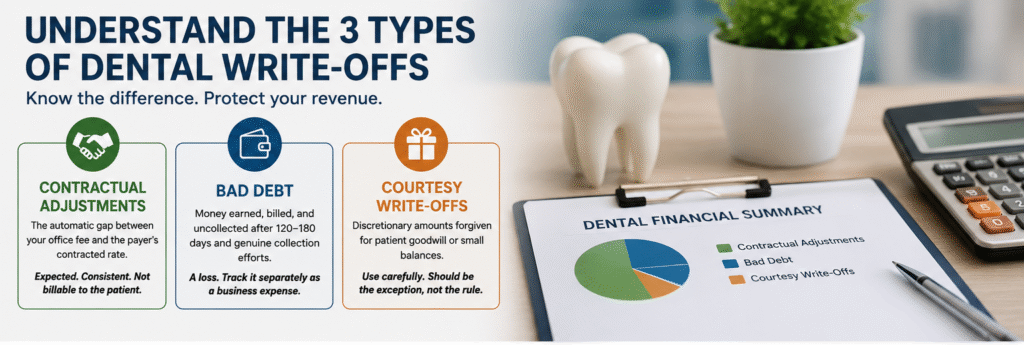
Most practices talk about “write-offs” like they’re a single thing. They’re not. There are three, and mixing them up is where the real money leaks out.
Contractual adjustments are the automatic, expected gap between your office fee and whatever rate you agreed to with an in-network payer. On that $1,200 crown, the $350 difference isn’t optional, you signed a contract that says so. It should post every single time, consistently, for every claim with that payer.
Bad debt is different. It’s money you earned, billed, tried to collect, and never got. A patient balance that sits past 120 to 180 days with no payment, after genuine collection attempts, generally gets classified as bad debt and removed from your books as a loss. In dental specifically, bad debt tends to run somewhere between 1% and 5% of net production. If your practice is running well above that range, something in collections is broken, not just unlucky.
Courtesy write-offs are the third category, and the one most practices never separate out at all. These are discretionary, a manager deciding to forgive a balance because a patient had a bad experience, or a small residual amount isn’t worth chasing. There’s nothing wrong with using these occasionally. The problem is when they become the default instead of the exception, because every one of them is a dollar that just quietly walked out the door with nobody deciding it should.
How Mixing Write-Off Types Distorts Your Dental Practice’s Financial Reports
Here’s the part that doesn’t get said enough: if your chart of accounts only has one bucket, “Adjustments” or “Write-Offs”, every contractual reduction, every uncollected balance, and every courtesy discount pours into the same number. Once that happens, no report can ever separate them out again. You can’t tell whether your production is shrinking because of normal PPO contracts or because your collections process is failing, because both look identical on paper.
The fix is structural, not procedural. Contractual adjustments should reduce production directly, gross production minus contractual adjustments equals net production, the number your practice actually runs on. Bad debt should never touch that calculation. It belongs in its own expense account, tracked separately, so it shows up on your P&L as a cost of doing business, something you can watch trend over time and investigate the moment it spikes.
What Do CO, PR, OA, and PI Mean on a Dental EOB?
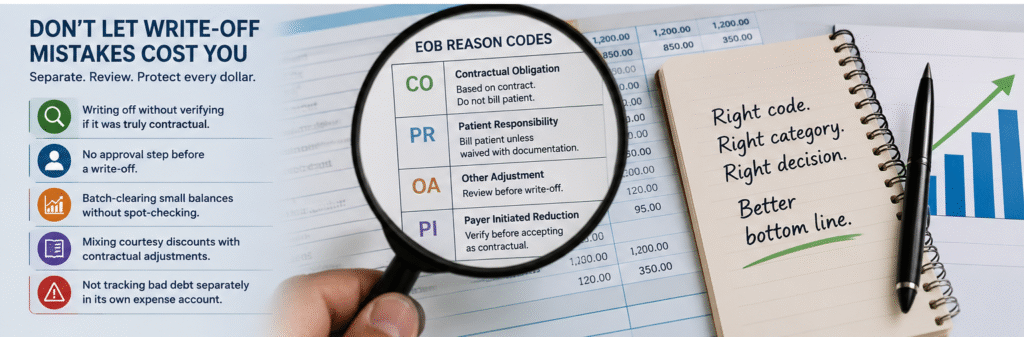
Every adjustment on an EOB carries a reason code, and the one to actually pay attention to is “CO”, Contractual Obligation. That code means the payer is telling you: this reduction is based on your contract, it’s not up for appeal, don’t bill the patient for it. Staff who don’t check the reason code sometimes write off amounts that were never contractual at all, treating a processing error or an underpayment as if it were routine, simply because the number looked like every other adjustment on the page.
CO isn’t the only code that shows up next to a reduced payment, and lumping all of them into “write it off” is where things go wrong. PR means Patient Responsibility, that portion isn’t yours to write off at all, it belongs on the patient’s bill unless your practice has a documented reason to waive it. OA, Other Adjustment, and PI, Payer Initiated Reduction, both signal something worth a second look before assuming they’re routine, since these sometimes indicate a processing decision the payer made unilaterally, not one your contract actually requires. Treating every non-payment on an EOB as an automatic write-off, regardless of which code produced it, is exactly how legitimate patient balances and appealable underpayments both end up disappearing into the same “adjustment” bucket.
This is a distinct problem from an underpayment, worth being precise about. An underpayment is money the payer owes you under the contract and simply paid incorrectly, something to catch and appeal. A contractual write-off is money you never had a claim to in the first place. Confusing the two in either direction costs money, either chasing something you were never owed, or writing off something you actually were.
Common Dental Write-Off Mistakes That Cost Practices Revenue
Writing off a balance without checking whether it was actually contractual, versus something that should have been appealed instead.
No approval step before a write-off. If any staff member can zero out any balance on their own, you’ll never get a consistent number, and you won’t be able to tell later which write-offs were legitimate and which were just convenient.
Batch-clearing small balances at month-end without spot-checking a sample first. Efficient, sure. It also means real errors get cleared right alongside legitimate adjustments, with nobody the wiser.
Courtesy discounts getting logged in the same place as contractual adjustments, rather than tracked on their own. Different animal, different account.
Nobody ever pulling a report of write-offs by payer or by staff member. Without that, a pattern, one biller writing off too readily, one payer whose claims keep getting cleared instead of followed up, stays invisible indefinitely.
Is Waiving Dental Copays and Deductibles Illegal?
Here’s the piece that most write-off advice skips entirely, and it’s the one with the most legal exposure. Routinely waiving a patient’s copay or deductible as a courtesy isn’t just generous, it can be considered insurance fraud. The logic is straightforward once it’s spelled out: if you bill an insurer $850 for a crown but never actually intend to collect the patient’s $170 coinsurance, the $850 you billed doesn’t reflect what you actually charge for that procedure. Federal guidance has treated routine waivers exactly this way for years, and several dental insurers, Delta Dental among them, warn providers directly that waiving deductibles or copayments when a plan requires them counts as a billing practice that can cross into fraud.
This doesn’t mean you can never help a patient. It means the discount has to be handled correctly, not quietly. If you’re genuinely reducing a patient’s fee, whether for financial hardship, a service issue, or simple goodwill, that reduced fee needs to be reflected on the claim itself, not just absorbed on the back end after the insurer already paid based on your full billed amount. The insurer should see the actual, discounted charge and pay their portion of that real number, not the original one. A written, consistent hardship policy applied the same way to every patient in similar circumstances protects you here. A pattern of one-off, undocumented “we’ll waive that for you” courtesy write-offs does the opposite, and it’s exactly the kind of pattern payer audits and Special Investigations Units are trained to look for.
Are Dental Credit Balances the Same as Write-Offs?
One more distinction worth making clearly: a credit balance isn’t a write-off candidate at all. When a payment posts and the account ends up overpaid, whether from a duplicate payment, a COB overlap, or a payer error, that money doesn’t belong to the practice, and it shouldn’t get folded into a general adjustment account to make the balance look clean. Most states have specific timelines for refunding identified overpayments, and treating a credit balance as if it were just another kind of write-off, rather than an actual refund obligation, is its own compliance exposure separate from everything else in this post.
How to Build a Dental Write-Off Approval Policy
Require a specific reason for every write-off logged, not a blank note. That’s what makes patterns visible later.
Set a dollar threshold above which a supervisor has to sign off, rather than letting any staff member clear any amount solo.
Keep contractual adjustments, bad debt, and courtesy write-offs in genuinely separate accounts. This is the single change that fixes the most reporting problems at once.
Review write-offs by payer every month. A payer whose claims get written off constantly is usually a payer underpaying or denying more than your contract allows, and that’s worth escalating, not absorbing quietly.
Audit a sample of write-offs each quarter, checking specifically for anything that should have been an appeal instead of an adjustment.
Why a Write-Off Policy Protects Dental Practice Revenue
A clean write-off process protects two different things at once. It stops real revenue from disappearing through balances that got cleared out of convenience rather than genuine unrecoverability. And it stops contractual write-offs and actual collection failures from blending into one meaningless number that tells you nothing about whether your billing process is actually working.
How CEC Helps Manage Dental Write-Offs and A/R Accuracy
A dental practice’s write-off policy is really just an extension of how well its accounts receivable is being managed day to day. CEC’s Accounts Receivable (A/R) Management Services build this discipline in directly, separating contractual adjustments from bad debt and courtesy write-offs at the point of posting, requiring documented reasons before anything clears, and flagging accounts where a write-off pattern by payer or procedure suggests something worth investigating rather than absorbing.
This connects directly to the underpayment recovery work covered separately: the CO reason code check that stops a legitimate underpayment from being mistaken for a routine contractual write-off is the same discipline that keeps your books honest in both directions.
Get a Free Write-Off Policy Review
Find out if contractual adjustments, bad debt, and courtesy write-offs are actually being tracked separately in your books. Our experts will review your EOB coding practices and write-off patterns by payer, and flag anything that should have been appealed instead of absorbed.
Get a Free Write-Off Policy Review →The Bottom Line on Dental Write-Offs and Adjustments
Contractual adjustments, bad debt, and courtesy write-offs are three different things with three different causes, and treating them as one blended number hides exactly the problem you’d want to see. Separate the accounts, require a reason for every write-off, and check the EOB code before assuming a short payment was ever yours to write off in the first place. Contact CEC to have your current write-off process reviewed.
FAQs
What’s the real difference between a contractual adjustment and a bad debt write-off?
A contractual adjustment is the automatic, agreed-upon gap between your fee and a payer’s contracted rate. It’s expected and it happens on every claim with that payer. Bad debt is money you were owed and genuinely couldn’t collect, usually after 120 to 180 days and real collection attempts. One is routine. The other is a failure somewhere in the process.
How much bad debt is normal for a dental practice?
Somewhere in the 1% to 5% range of net production is typical. Running meaningfully above that usually points to a gap in the collections process itself, not bad luck with a few difficult patients.
Should front-desk staff be able to write off a balance without approval?
Generally not, at least not past a set dollar amount. Without a sign-off step, write-offs get inconsistent fast, and it becomes nearly impossible to tell later which ones were legitimate adjustments and which were just the path of least resistance.
What does the “CO” code on an EOB actually mean?
CO stands for Contractual Obligation. It tells you the reduction is based on your payer contract and isn’t something to appeal or bill the patient for. Skipping this check is exactly how a real underpayment sometimes gets written off as if it were routine.
Is it illegal to waive a patient’s copay or deductible?
Doing it routinely, as a standing practice rather than a documented exception, carries real legal exposure. Federal guidance and several major dental insurers treat routine waivers as a form of overbilling, since the fee submitted to the insurer no longer reflects what the practice actually intends to collect. A documented, consistently applied financial hardship policy is the safer path if you want to offer discounts, not a case-by-case verbal courtesy.
Can reviewing old write-offs actually recover money?
Sometimes, yes. Auditing past write-offs occasionally turns up a balance that was actually an underpayment or a denial that should have been appealed, not a genuine contractual adjustment. Whether it’s still recoverable depends on how much time has passed and the specific payer’s appeal window.