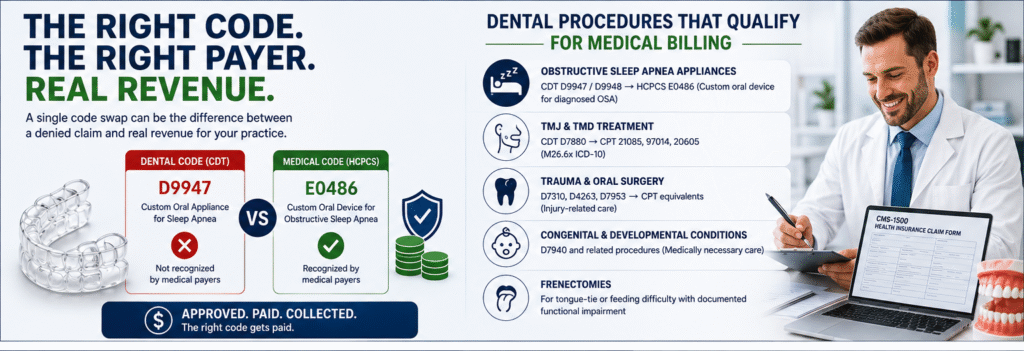
A custom oral appliance for sleep apnea gets billed under CDT code D9947. Submit that same code to a medical payer, and it goes nowhere; medical insurers don’t recognize dental procedure codes at all. Submit HCPCS code E0486 instead, the code that actually describes a custom oral device for obstructive sleep apnea, and the same appliance can get paid by the patient’s medical plan. That single code swap is the entire difference between a denied claim and real revenue most dental practices leave sitting on the table.
What Is Dental-Medical Cross Coding?
Cross-coding is the practice of billing a dental procedure to a patient’s medical insurance instead of, or alongside, their dental plan, using medical code sets rather than CDT codes alone. Dental claims run on CDT and, for some payers, ICD-10-CM, submitted through the ADA dental claim form. Medical claims are based on an entirely different set: CPT, HCPCS Level II, and ICD-10-CM, submitted on the CMS-1500 form. Dental medical billing isn’t a gray-area workaround; it’s a legitimate, established process for a specific category of procedures that treat a diagnosed medical condition rather than routine dental disease.
Which Dental Procedures Actually Qualify for Medical Billing
Obstructive sleep apnea appliances. A custom oral device (CDT D9947, adjustment D9948) can be billed to medical insurance under HCPCS code E0486, provided there’s a physician’s diagnosis, generally backed by a sleep study, and a prescription for the appliance. One detail that trips up practices new to this: E0486 is specifically for a custom device treating diagnosed OSA. A different code, A9270, covers non-covered devices, like an appliance addressing snoring alone without an OSA diagnosis. Submit the wrong one and the claim gets denied regardless of how well everything else was documented.
TMJ and TMD treatment. Splint therapy for temporomandibular disorders (CDT D7880) crosses over to CPT 21085 for splint fabrication, sometimes alongside 97014 for electrical stimulation or 20605 for arthrocentesis. TMD is classified as a musculoskeletal condition under ICD-10 (the M26.6x series), which is exactly why medical plans, not dental ones, typically cover it.
Trauma and oral surgery. Procedures addressing an injury rather than routine dental disease, alveoloplasty with extractions (D7310), incision and drainage of an intraoral abscess, and similar oral surgery codes each map to a specific CPT equivalent. Bone grafts related to trauma or head and neck cancer treatment (D4263, D7953) fall into this category too.
Congenital and developmental conditions. Procedures like orthognathic reconstruction for congenital jaw deformities (D7940) can also cross over, since they’re addressing a diagnosed medical condition rather than elective dental work.
Frenectomies. Common in newborns with tongue-tie or feeding difficulty, these can qualify for medical billing when there’s a documented functional impairment, not simply a preference for the procedure.
Why the CDT Code Isn’t Enough on Its Own
Here’s the part a lot of dental-only content misses entirely: the CDT code tells the story of what happened in your office, but it isn’t what decides medical coverage. The medical payer makes that decision based on the ICD-10 diagnosis and the specific HCPCS or CPT code submitted, not the CDT code sitting in your practice management system. A practice can document a procedure perfectly on the dental side and still get denied on the medical side if the crosswalk to the correct medical code, and the diagnosis code that justifies it, wasn’t done correctly.
The rule worth remembering: translate CDT to CPT only when there’s a genuine matching or equivalent medical procedure. Not every dental code has one, and forcing a crosswalk where none legitimately exists is how a practice ends up with a pile of denied medical claims instead of the revenue it was hoping to capture.
What Medical Payers Actually Require That Dental Payers Don’t
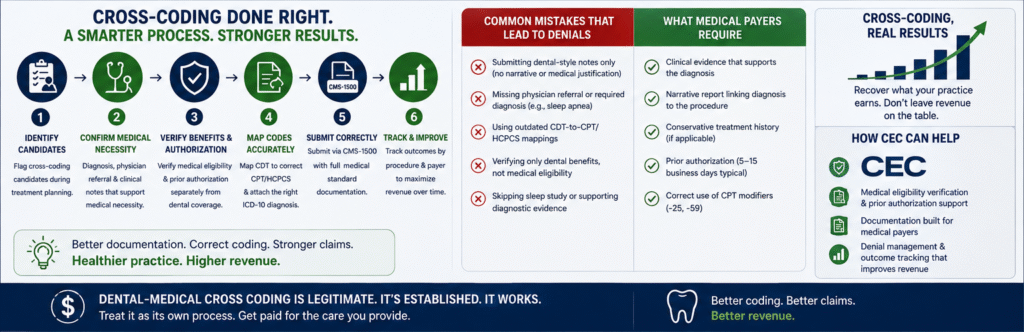
Medical claims carry a meaningfully higher documentation bar than dental claims. A diagnosis alone rarely carries a claim, medical payers want to see the clinical evidence that supports it: photographs of pathology, measured range of motion for a TMJ claim, the patient’s own described symptoms in their own words, and documentation of any conservative treatment that was tried and failed before the current procedure. A narrative report tying the specific diagnosis to the specific procedure, explaining why this treatment is medically necessary rather than elective, matters more on the medical side than almost anywhere in dental billing.
Prior authorization is common for oral surgery, sleep apnea appliances, and TMJ treatment specifically, and most carriers take five to fifteen business days to process it. Treating before authorization comes through is a real risk, a claim denied for missing prior auth generally can’t be appealed after the fact, the procedure has to have waited for approval in the first place.
CPT modifiers matter here too. Modifier -25 signals a separate, significant evaluation on the same day as a procedure. Modifier -59 signals a distinct procedural service. Missing or misusing these is a common, avoidable reason a technically correct claim still gets denied.
Common Mistakes That Get Cross-Coded Claims Denied
Submitting a medical claim with only dental-style clinical notes attached, no narrative, no diagnosis-to-procedure justification, is close to guaranteed denial on the medical side, even when the same documentation would have been perfectly fine for a dental claim.
Missing the required physician referral or diagnosis for conditions like sleep apnea, where medical payers specifically require it before an oral appliance claim will be considered at all.
Using an outdated CDT-to-CPT or CDT-to-HCPCS mapping. These crosswalks get updated as code sets change annually, and a mapping that was accurate two years ago isn’t guaranteed to be accurate today.
Treating medical eligibility verification as an extension of dental eligibility, rather than its own separate check. A patient’s medical and dental plans are frequently different insurers entirely, with different verification processes and different portals.
Skipping the sleep study or supporting diagnostic evidence a specific payer requires, and assuming a prescription alone will be sufficient.
A Basic Process for Cross-Coding Dental Claims
- Flag cross-coding candidates during treatment planning, not after the claim is already ready to go out the door.
- Confirm the medical necessity documentation exists: diagnosis, physician referral where required, and clinical notes that specifically support the medical code, not just the dental one.
- Verify medical insurance eligibility and prior authorization requirements separately from dental coverage.
- Map the CDT code to its correct CPT or HCPCS equivalent, only where a genuine match exists, and attach the correct ICD-10 diagnosis code.
- Submit through the CMS-1500 form with full medical-standard documentation, not a dental-style claim with the codes swapped out.
- Track outcomes by procedure type and payer, so the practice learns over time which cross-coded claims get approved consistently and which need a different documentation approach.
Where Dental-Medical Billing Fits Into a Practice’s Revenue Strategy
Cross-coding done well is genuine, recoverable revenue, not a loophole and not a marginal tactic. Practices that treat medical billing for dental procedures as its own disciplined workflow, separate eligibility checks, separate documentation standards, separate follow-up process, tend to see real results from it. Practices that bolt medical codes onto an otherwise dental-only process mostly generate denials that cost more staff time than the additional revenue is worth.
How CEC Supports Dental-to-Medical Cross Coding
Getting this right requires two things most dental practices don’t have much spare capacity for: a second, entirely separate eligibility verification process for medical insurance, and a documentation standard built for medical payers specifically, not adapted from dental notes after the fact. CEC’s Dental Insurance Billing and Verification Solutions extend to medical eligibility checks for cross-coding candidates, confirming coverage and prior authorization requirements before treatment rather than discovering a gap after a claim’s already been submitted.
On the claims side, CEC’s Denial Management and Credentialing team applies the same structured follow-up to cross-coded medical claims that gets used for standard denials, tracking outcomes by payer and procedure so the practice’s approach improves with real data instead of guesswork.
Find Out Which Procedures Qualify for Cross-Coding
Sleep apnea appliances, TMJ treatment, trauma-related oral surgery, and more may qualify for medical billing. Our experts will review your case mix, verify medical eligibility, and build the documentation standard payers actually require.
Find Out What Qualifies →The Bottom Line
Cross-coding is a legitimate, well-established part of dental billing for a specific set of procedures that genuinely meet medical necessity criteria, not a general workaround for limited dental benefits. The practices getting real revenue from it treat it as its own process, its own documentation standard, its own eligibility check, rather than a dental claim with a different code stapled on. Contact CEC to find out which of your current procedures may already qualify.
FAQs
What CDT codes are most commonly cross-coded to medical insurance?
Sleep apnea appliance codes (D9947, D9948), TMJ treatment (D7880), trauma-related oral surgery (D7140, D7210, D7250, D7280), and certain bone graft and implant codes (D4263, D7953) are among the most frequently cross-coded procedures, provided each meets the specific medical necessity documentation a payer requires.
Why would a sleep apnea appliance claim get denied even with a correct diagnosis?
Often because the wrong HCPCS code was used. E0486 applies specifically to a custom oral device treating diagnosed obstructive sleep apnea, while a different code, A9270, applies to non-covered devices like an appliance addressing snoring alone. Submitting the wrong code, even with an otherwise accurate diagnosis, typically results in denial.
Can a routine filling or cleaning ever be billed to medical insurance?
No. Cross-coding applies only to a specific set of procedures connected to a diagnosed medical condition, trauma, TMJ dysfunction, sleep apnea, and similar. Routine dental care without an underlying medical diagnosis doesn’t meet medical necessity criteria and shouldn’t be submitted to medical insurance.
How is medical billing for dental procedures different from standard dental billing?
The code sets, the claim form, and the documentation standard are all different. Dental claims use CDT codes on the ADA dental claim form. Medical claims for cross-coded procedures use CPT, HCPCS, and ICD-10 codes on the CMS-1500 form, and generally require far more clinical documentation supporting medical necessity than a dental payer would ask for on the same procedure.
What’s the biggest reason cross-coded dental claims get denied?
Insufficient documentation is the most common cause by far. Medical payers want a clear diagnosis, supporting clinical evidence, and often a physician referral, a meaningfully higher bar than dental claims require. Submitting a medical claim with only dental-style notes attached is the most frequent reason these claims come back denied or flagged for additional information.