AI in Medical Billing: Trends, Challenges, and What to Expect in 2026 and Beyond
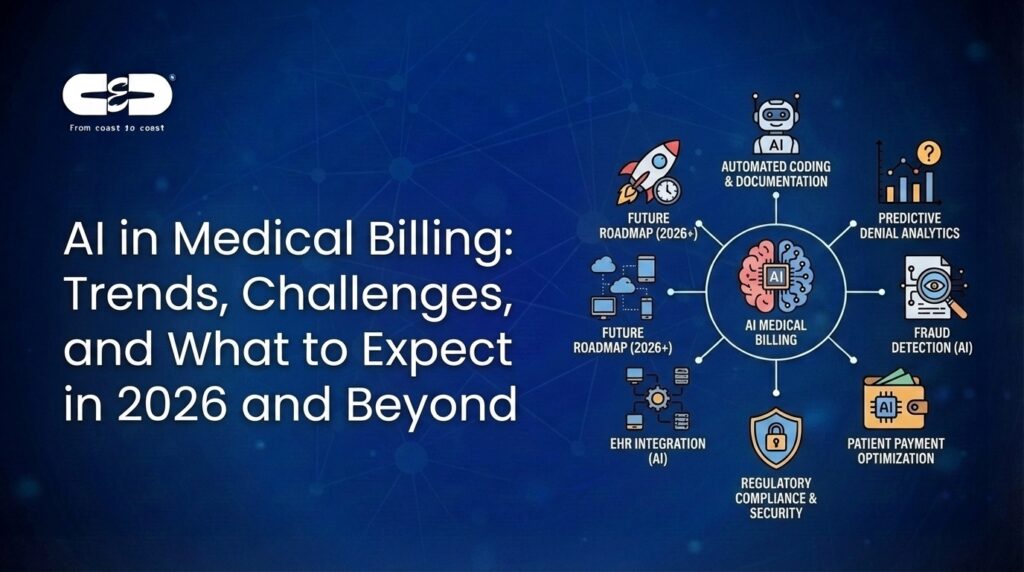
What if your billing system could identify errors before claims are submitted and predict revenue risks in real time? AI in medical billing makes this and a lot more possible. It is precisely the application of machine learning, natural language processing, and automation tools to streamline billing workflows. The article explains how AI in medical billing is transforming the healthcare revenue cycle. Let us explore more: Did you know? 94% of healthcare organizations affirm that AI finds a non-negotiable place in their fundamental operations. Medical billing automation with AI lowers the number of manual errors by 60-80%. Artificial intelligence is transforming medical billing by reducing coding errors by 38 percent and 25 percent of administrative expenses. What is AI in Medical Billing and Why It Matters in 2026 Medical billing AI can be defined as the use of modern technologies, including machine learning, natural language processing, and rule-based automation, to streamline the overall billing process in healthcare systems. AI in medical billing is of significant importance in 2026 as it caters to numerous perks. It allows smart clinical data mining of electronic health records, automated medical coding in accordance with both ICD and CPT standards, real-time claim verification, and predictive denial control depending on past payer behavior. AI medical billing solutions can detect anomalies, predict reimbursements, and constantly increase billing accuracy. How AI in Medical Billing Is Reshaping Healthcare Revenue Cycles AI is transforming the meaning of AI in revenue cycle management as it is turning processes into corrective actions rather than proactive optimization. Rather than detecting problems once a claim has been submitted or rejected, AI can provide real-time intelligence throughout the entire billing lifecycle, which is faster and more accurate. According to McKinsey, AI can optimize revenue cycles with a 30-60% decrease in cost to collect, quicker cash realization, and an enhanced patient value. Automated Coding: Natural language processing is used by AI systems to retrieve structured information in clinical documentation and translate it to correct ICD and CPT codes. AI algorithms are trained on millions of records and can explicitly scan clinical documentation and suggest or assign codes. This minimizes coding errors, enhances compliance, and reduces reliance on manual review of codes, particularly in high-volume settings. Real-Time Claim Scrubbing: Claim scrubbing engines are AI-driven to confirm claims prior to their submission by verifying the absence of data, use of incorrect codes, and payer-specific regulations. This pre-submission validation will greatly lower the rejection rates and also speed up the first-pass claim acceptance. Denial Prediction: Through historical claims data analysis and payer behavior patterns, AI can determine high denial claims. This will enable billing teams to act proactively to correct the situation, increase approval rates, and minimize rework. Payment Forecasting: With the help of AI models, previous reimbursement patterns, payer schedules, and claim statuses are analyzed to forecast future cash flow more precisely. This assists the providers in improving their financial planning and having better control over the revenue cycles. Workflow Automation: AI automates routine processes, including checking eligibility, tracking claim status, and follow-ups. This saves on the administrative load, enhances turnaround time, and enables the billing teams to concentrate on high-value tasks that are complex. Key Regulatory Changes Impacting AI in Medical Billing in 2026 Here are the key regulatory changes impacting AI in medical billing: CMS Regulations Starting in 2026 The regulatory frameworks in 2026 are exerting more pressure on transparency, auditability, and standard reporting across healthcare billing systems. The providers now have to keep meticulous audit trails, support their coding choices, and prove that they adhere to the payer-specific instructions. WISeR Model Launch and Its Impact on Billing The WISeR model proposes tightening the process of prior authorization and making the data submission more structured and quicker in responding. This complicates the operations, particularly among the multi-specialty providers. Services and States Affected by New Authorization Rules Authorization requirements are increasingly becoming fragmented depending on the type of service, payer policies, and geographic regions. This brings discrepancies in the billing processes of providers that are working in more than one state. AI supports the standardization of these processes by dynamical application of payer-specific rules, which will ensure that claims meet both the regional and service-level requirements without human intervention. Critical Prior Authorization Deadlines Providers Must Track Failure to meet the authorization deadlines is one of the major reasons claims are denied. The tighter schedules in 2026 render manual tracking unreliable. The systems are automated to deliver AI-driven notifications, deadlines, and workflow prioritization to guarantee timely submissions. This goes a long way to minimize unnecessary denials and increase rates of claim approvals. 2026 CPT Code Updates and Their Billing Impact Medical coding and billing are becoming more complex due to frequent changes in CPT codes. These changes may result in compliance risks and errors during manual adaptation. The AI systems constantly revise the coding logic, confirm the use of codes with the current standards, and help the billers with correct code recommendations. This enhances the accuracy of coding and decreases rework. The Rise of Agentic AI in Medical Billing The concept of agentic AI is a transition from assistive automation to autonomous decision-making in billing systems, in which intelligent systems can autonomously perform tasks, modify workflows, and optimize results based on real-time data. It audits claims prior to their submission with a view to detecting mistakes, provides follow-ups on rejected or slow claims, optimizes workflows according to the behavior and response trends of payers, and aligns the work of billing, coding, and accounts receivable teams. Such freedom eliminates the need to rely on manual control and speeds up the whole billing process. According to Deloitte, around 80% and more healthcare systems are investing in agentic AI for revenue cycle management, everyday operations, and patient care. What Providers Experienced with AI in Medical Billing in 2025 The Benefits of AI in Reducing Manual Work Repetitive administrative work was substantially reduced in 2025 among the providers. Coding validation, eligibility checking, and tracking claims were automated with AI, and
The Hidden Revenue Leak in Medical and Dental Practices (And How AI Fixes It)
You’re working harder than ever, seeing more patients, and delivering exceptional care. Yet your bottom line doesn’t reflect your efforts. Well, you are not alone! Most hospitals lose between 5 and 10% of their revenue annually just through routine blind spots. For instance, in one department, documentation is delayed by a shift change. In another, billing waits for missing codes. Now, what if you could plug these leaks without any complex process or long hours? AI solutions ensure your practice’s long-term financial growth and help you focus on better patient care. Keep scrolling to find out how AI can recover your lost revenue! What Is a Revenue Leak? Revenue leakage is money you’ve legitimately earned but are never able to collect due to errors, inefficiencies, or oversights in your billing and collection processes. These are preventable losses caused by internal operational gaps. Revenue leakage typically includes coding errors, underbilling, missed charges, untimely claim submissions, unnoticed denied claims, unclear communication with patients regarding financial responsibilities and poor follow-up on unpaid accounts. Where Hidden Revenue Leakage Happens (Medical + Dental)? Revenue leakage often goes unnoticed in your financial reports, quietly affecting your profit margins while you focus on clinical care. Here are some areas where revenue leakage could happen: Your front office staff collects patient demographics and insurance information during scheduling and check-in. Any mistakes, like omissions or wrong data feeding, will create disruptions in the system. Ultimately, it will lead to claim denials and delayed payments down the line. When you fail to verify patient insurance eligibility or obtain pre-authorization, it can result in revenue leakage. When patients’ services are not covered in their insurance, you may not be able to collect the payment from the firm. Sometimes, revenue problems happen because clinical notes are incomplete. Without proper documentation, you cannot code the procedures correctly or ensure appropriate billing. Even small coding mistakes cause claim denials, delayed payments, or underpayments. For instance, data entry errors can result in poor financial consequences, which is particularly high in emergency departments and specialty practices. Claims that are neither paid nor denied might get lost until they appear on an Aging Report 60 or 90 days from the date of service. By then, payers have grounds to refuse payment. Most denied claims are never reworked. Even if they are reworked, manual processes could be expensive per denied claim. It will overwhelm your staff and pile up the denied claims over time. Most dental practices say delayed or rejected claims are their primary reason for lost revenue. Additionally, patients delay or decline treatment when they don’t understand what they have to pay. This way, it will hinder your revenue gain. AI – The Solution to Hidden Revenue Leak Artificial intelligence transforms your revenue cycle management, converting constant losses into a profit gain for every claim. Hospitals and health systems now use AI in their RCM operations in the following ways: 1. Automated Coding and Claims Scrubbing AI-driven systems automatically assign billing codes from clinical documentation. It helps you to reduce manual effort and errors. These systems scan claims for inconsistencies before submission and reduce denial rates. 2. Predictive Denial Management AI assesses historical denial patterns, so that you will know which claims are more likely be rejected. This way, you can fix the errors or any issues before submission, and improve first-pass acceptance rates. 3. Real-Time Eligibility Verification AI-powered systems link directly to payer databases to verify coverage instantly. It will prevent eligibility issues before you provide services to the patients. 4. Intelligent Revenue Cycle Monitoring AI provides real-time dashboards so that you will have complete visibility into every claim, payment, and denial. You can also track key performance indicators and resolve any problems before they become an expensive revenue leak. How to Identify Revenue Leak in Your Practice? Here’s how you can find hidden leaks that are hindering your revenue. Debunking Common Misconceptions About AI in Billing Don’t let myths stand in the way of resolving your lost revenue. Here’s the truth about AI in healthcare billing. Myth: AI will replace our billing personnel Reality: AI will automate repetitive tasks so that your staff can concentrate on more complex cases and patient care. AI does not replace people, but frees them. Myth: AI is too costly for smaller practices Reality: The expense of lost revenue is much higher than the cost of implementing AI. Many systems are scaled to your practice’s growth, making them economical. Myth: AI is prone to errors and cannot be trusted Reality: Current AI technology is more accurate than manual billing. AI is constantly learning and improving with human oversight. Myth: Implementation will disrupt our practice Reality: Most AI systems are easily integrated with your current practice management software. Implementation is usually completed in 30-60 days with little disruption to your practice. Conclusion Hidden revenue leakage is a problem that impacts the financial potential of your practice. But you can easily overcome with the right strategies. By using AI solutions, you will be able to automate tasks that are prone to errors, anticipate issues before they happen, and gain real-time insights into your financial performance. You didn’t become a healthcare professional to go after payments. You became one to help others. AI technology gives you the power to make sure that your practice is financially healthy and stable. Ready to make sure that revenue isn’t leaking out of your practice? CEC uses a proprietary dental RCM that automates claims, payment, and reporting with AI-powered analytics. With secure and GDPR-compliant data handling, we can streamline your revenue cycle and fix all the issues that lead to revenue leakage. FAQs Q: How much revenue is the average practice losing to leakage? Healthcare practices lose between 5-10% of their annual income to revenue leakage. Most of these reasons are preventable with AI solutions. Q: Can AI really reduce claim denials? Yes. AI-powered claims scrubbing and predictive denial management reduce denial rates, with exceeding clean claim rates. Q: How long does it take to
From Manual to Intelligent: The Evolution of Medical and Dental Billing Outsourcing Medical billing is the backbone of the healthcare system, ensuring providers get paid for their services. Billing’s shift from manual, paper-based processes to the digital world reflects years of regulatory change and technological improvement. Outsourcing billing, however, has become strategic for hospitals, clinics, and private practices. It reduces administrative load, increases revenue cycle efficiency, and lets teams focus on what really matters in the long run: patient care and the organization’s financial health. But this change took time. We will focus on the journey of medical billing and the role of technology throughout the journey. The Early Days: Manual Medical & Dental Billing From 17th-century disease record keeping to today’s fully-fledged global health standards, international collaboration and continuous innovation have shaped the frameworks behind modern healthcare data systems. Medical coding has a long history. It traces back to William Farr’s advocacy for global disease classification in the 19th century, followed by Jacques Bertillon’s system of international classification, which gained rapid global traction in 1893. It made consistent mortality statistics possible, which laid the groundwork for evidence-based medicine, standardized coding, and contemporary epidemiology. Moving forward, global health data standardization began in 1948 with the World Health Organization’s formalization of the International Classification of Diseases. This significant advancement made medical coding a single, global language of health rather than a collection of regional systems. Why Manual Billing Didn’t Scale? Before computerized systems were developed, medical billing was a laborious process that involved a lot of paperwork, manual record-keeping, and a higher frequency of errors. Healthcare providers used handwritten notes to record patient visits, treatments, and billing information. This approach increased the likelihood of errors and data loss in addition to wasting a significant amount of time and money. Additionally, the drawn-out process of filing claims with insurance carriers causes medical practices to experience financial difficulties and payment delays. The First Shift: Outsourcing Medical & Dental Billing When the Regenstrief Institute created the first electronic medical record (EMR) in 1972, the 1970s saw a change. It was expensive, but it paved the way for digitization. Coding speed was increased, and claim errors were decreased with the use of personal computers and encoder software. Leapfrog Group accelerated the digitization of healthcare by promoting computer-based order input. Outsourcing growth and billing efficiency were enhanced by digital records, standardized coding, and insurance expansion. EHR systems became widely used in 2009 thanks to the HITECH Act and ARRA. In order to cut expenses and increase accuracy, healthcare providers started outsourcing billing. With scalability, quicker claims processing, and better revenue cycles, offshore outsourcing grew. Next Shift: Automation Enters Billing Revenue cycle management transformed as a result of the use of technology in medical and dental billing outsourcing. But because of developments like cloud-based solutions, robotic process automation (RPA), and AI-powered billing software, billing businesses can now process claims more quickly, accurately, and with less administrative strain on healthcare providers. Automation benefited the overall procedures by: The adoption of automated claim processing is one of the biggest developments in medical billing outsourcing. Automation has decreased claim denials by 30%, while traditional billing techniques often resulted in delays and inaccuracies. Outsourced companies used cloud tools for instant eligibility checks. Results? Reduced errors, workloads, and rapidly processed claims. Blockchain technology and HIPAA-grade encryption safeguard data. RPA reduced errors by automating billing operations. This led to stronger security, more precision, and improved regulatory compliance. Present Era: Intelligent, AI-Powered RCM Outsourcing The way billing companies function has changed due to the integration of cloud-based platforms, robotic process automation (RPA), and AI-driven billing software. Another game-changer is outsourcing dental insurance verification, which guarantees real-time eligibility checks and reduces approval waits. AI expedites reimbursements, lowers errors, and automates claims. It increases first-pass approvals, detects problems early, and enhances cash flow. Outsourced RCM agencies use machine learning that examines claim data and forecasts denials. Teams reduce revenue loss by correcting errors before submission. Chatbots manage insurance verification, billing inquiries, and claim tracking. This enhances patient satisfaction and reduces workload. AI-powered systems lower fraud risks and fines by spotting odd billing trends and guaranteeing regulatory compliance. Healthcare providers can now anticipate quicker payments, better compliance, and less administrative work as medical billing outsourcing firms continue to use AI-powered solutions. How Intelligent Outsourced RCM Transformed Billing? AI-driven RCM outsourcing removes tedious activities and uses predictive analytics to enable revenue forecasting. You get industry experts who regulate the RCM process and ensure that it always stays in line by automating repetitive tasks. Intelligent Outsourced RCM services also offer: AI expedites approvals, reduces errors, and automates billing activities. Delays are decreased, and accuracy is increased with real-time insurance verification. Real-time access to records, reports, and claims is provided by cloud platforms. They lower IT expenses and enhance collaboration and scalability. Blockchain, MFA, and HIPAA encryption safeguard patient information. Robust structures guarantee both regulatory compliance and privacy. AI maximizes revenue by analyzing claims and denials. It assists in determining losses, enhancing reimbursements, and improving billing tactics. For quicker, error-free workflows, billing systems seamlessly interface with practice management and EHR systems. Medical vs Dental Billing: How Evolution Played Out Differently Dentistry and medicine have traditionally been distinct fields. That’s not unusual, though, since optometry, podiatry, and chiropractic are also taught independently. Naturally, the evolution of the billing systems also differed. Factor Medical Billing Dental Billing Evolution Rapid, driven by complex healthcare systems Gradual, shaped by simpler treatment models Coding Systems ICD, CPT, HCPCS with frequent updates CDT codes with fewer revisions Claim Complexity Multi-diagnosis, multi-procedure claims Procedure-focused, simpler claims Insurance Coverage Broad, multi-payer coverage Limited coverage, higher out-of-pocket costs Technology Adoption Early adoption of EHR, AI, automation Slower adoption, now accelerating Bottom Line The evolution of medical billing reflects humanity’s enduring desire to comprehend, classify, and enhance healthcare through methodical data collecting and analysis. Medical coding changes to capture new complexities while preserving the accuracy and integrity necessary for the best possible patient outcomes as healthcare continues to evolve
Medical & Dental Billing Outsourcing: How AI-Powered RCM Helps Practices Reduce Costs? As healthcare practices grow and the regulations tighten, managing revenue cycle management in-house becomes more complex and expensive. And billing is one of the areas in medical and dental practice where small efficiencies quietly turn into major costs. That’s why most of the healthcare practices are rethinking traditional billing models. Medical and dental practices are outsourcing billing to service providers that use an AI-powered RCM platform to automate the manual, time-consuming tasks and have experts to review the claims, documentation, patient communication, and exceptions to ensure accuracy. And this can help in reducing costs as well. Let’s understand how. What is AI-Powered Revenue Cycle Management? AI-powered revenue cycle management is the use of AI-driven systems to automate, analyze, and optimize every aspect of the healthcare revenue cycle, from patient elibility verification and charge capture to claim posting and denial management. AI-powered RCM combines automation with data intelligence to reduce manual effort, improve claim accuracy, and shorten the reimbursement timelines. According to a Gartner, up to 90% of finance analytics will use AI by 2027 to automate procedures. AI has the capacity to coordinate various tasks, cutting down on rework and speeding up revenue recognition. How AI-Powered RCM Reduces Costs? AI-powered automation has the ability to significantly lower operating costs. Rule-based, data-intensive operations that need a lot of manual labor and are prone to human mistakes can be streamlined by providers. This results in quantifiable increases in production and cost. 1. Cut Revenue Cycle Expenses One of the highest costs in the revenue cycle is labor, and a direct way to reduce these expenses is through automation. Teams are able to concentrate on higher-value, patient-facing, and analytical tasks by automating procedures that previously required human labor. 2. Reduced Administrative Costs AI reduces the need for manual labor and staffing expenditures by automating repetitive billing operations. 3. Simplify Important RCM Processes Many crucial RCM procedures are repetitive and manual, which makes them perfect for automation. To increase productivity and accuracy, healthcare executives are giving automation top priority for a number of crucial operations. 4. Reduced Rework and Correction Expenses AI reduces follow-ups and claims resubmissions by identifying problems early, which saves time and operating costs. 5. Predictive Information for Underpayments and Denials According to a recent survey, 67% of healthcare finance executives think automation and artificial intelligence have a lot of promise for better handling of underpayments and denials. How AI-Powered RCM Works? Let’s see how outsourcing your billing operations to an AI-powered RCM service provider benefits your practice. Consider the example of an insurance eligibility check and claim submission. Manually, the front-desk staff verify coverage by logging into multiple payer portals, billing teams re-enter patient and visit details, and errors are often discovered only after a claim is denied. However, when you outsource these tasks to a service provider with an automated RCM platform, like CEC, the entire workflow changes. Here’s how the process changes when an automated RCM platform coes into the picture: The billing and coding specialists review exceptions, complex cases, and flagged claims to ensure accuracy, compliance, and correct reimbursement. The human oversight ensures automation improves efficiency without sacrificing control, compliance, and accuracy. How Does This Help in Saving Costs? Here’s how the costs are saved, not only in terms of money, but also in other aspects, like time, resources used, etc. Cost Comparison: Traditional Billing vs AI-Powered Outsourced RCM This comparison demonstrates that while AI increases RCM efficiency, it does not completely replace the requirement for seasoned experts. Cost Factors Traditional Billing AI-Powered Outsourced Billing Overall Cost Efficiency Lower efficiency with higher long-term costs Higher efficiency with optimized and predictable costs Staffing Costs High costs for hiring, training, and salaries Significantly lower due to automation and outsourcing Technology & Software Expensive billing software and regular upgrades Included in outsourcing with AI-driven tools Claim Error & Rework Costs Frequent errors lead to higher rework expenses AI reduces errors, lowering rework and correction costs Operational Overheads High infrastructure and administrative expenses Minimal overhead with outsourced operations Denial Management Costs Manual follow-ups increase time and expenses AI predicts and reduces denials, cutting costs Security, Compliance & Data Protection in AI-Powered RCM Even while AI has the potential to improve processes and financial transactions, its application necessitates careful consideration of the regulatory environment. RCM is mostly concerned with financial operations, which facilitates integration, in contrast to clinical applications. How to Choose the Right AI-Powered RCM Outsourcing Partner Common billing errors that can prevent you from succeeding include staff opposition, integration with outdated systems, and unclear governance. Success depends on working with a knowledgeable RCM technology partner. Beyond technology, the ideal partner offers: The Final Thought A systematic approach to compliance will be essential for long-term adoption as AI continues to transform the financial foundation of healthcare. So, you’re not the only one attempting to determine when, how, and where to integrate AI into your healthcare RCM ecosystem. The stakes are so great that this choice is challenging. CEC provides end-to-end AI-powered RCM automation, offering decreased staff workload, enhanced claim and billing accuracy, and improved forecasting. FAQs Why does AI matter for Revenue Cycle Management in Healthcare? By simplifying procedures, cutting expenses, boosting accuracy, and enhancing both profitability and patient satisfaction, AI has the potential to completely transform RCM in the US healthcare sector. Healthcare businesses may generally compete more successfully in the market. How does AI-powered RCM lower billing staffing costs? AI eliminates the need for sizable internal billing teams and lowers personnel costs by automating processes like code checks, claim confirmation, and follow-ups. Can AI prevent practices from losing money on rejected claims? Yes, AI helps procedures avoid expensive rejections and rework by identifying possible problems prior to submission and predicting denial risks. How can long-term cost effectiveness be enhanced by outsourcing AI-driven RCM? Workflows are optimized, cash flow is improved, and operational waste is decreased with outsourced AI-powered RCM, which eventually results in long-term cost savings.