
A practice manager we work with called in a panic last year. Her associate, sedation-certified, fully insurance-credentialed, had been treating patients for months. Then a claim got flagged, and it turned out his sedation permit had lapsed two states away from where she’d assumed the renewal deadline was. Insurance side, he was completely fine. It was the other paperwork nobody had been watching.
That’s the confusion at the center of this whole topic. Dental credentialing gets a dentist approved to bill Delta Dental, Cigna, Aetna, whatever Medicaid plan applies in their state. Privileging is a separate, narrower thing, and it only matters once sedation, oral surgery, or hospital work enters the picture. Most articles online don’t even make this distinction, because they’re written for hospitals, not dental offices, so the dental version of this problem barely gets covered anywhere.
What Dental Credentialing Actually Covers
Credentialing is a qualification check. Nothing more dramatic than that. A payer needs proof a dentist is licensed, has a clean-enough malpractice history, and meets whatever bar that particular network sets before they’ll agree to pay for care under that plan. It says nothing about what procedures the dentist can perform.
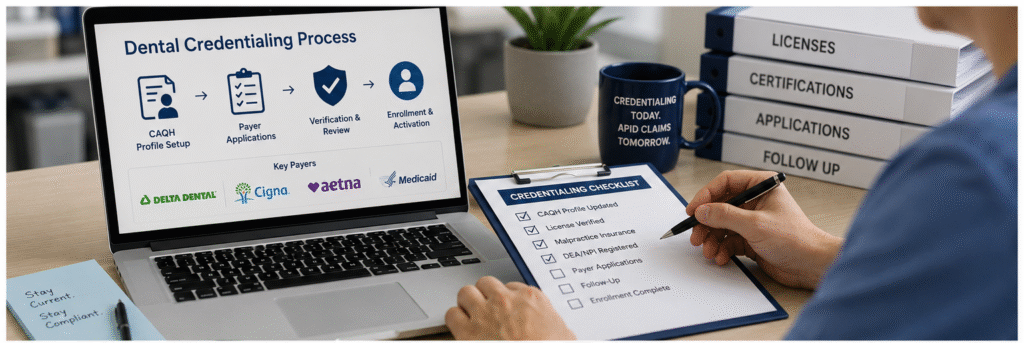
CAQH Profiles and Payer-Specific Application Requirements
A CAQH profile has to stay current. License and education records need to be on file. NPI has to be attached correctly. Then there’s waiting, because every payer works through applications at its own pace and its own standard. Delta Dental’s process isn’t Cigna’s process. Medicaid runs on a completely different clock depending on the state. We’ve seen practices submit the exact same packet to three payers and get three different outcomes, not because anything was wrong, but because each payer wanted something formatted or documented slightly differently.
How Provider Enrollment Connects to Dental Billing
People lump enrollment in with credentialing constantly, and it’s not the same thing. Enrollment comes after credentialing clears, it’s the part where fee schedules and billing details get switched on for that specific payer. A dentist can be sitting on full credentialing approval and still can’t bill a plan, simply because enrollment hasn’t finished catching up. This is exactly where credentialing and dental billing intersect: a claim can’t go out clean if enrollment is still pending, no matter how solid the coding is.
What Privileging Means for Dentists (It’s Not Just a Hospital Term)
Hospitals do this differently than dental offices do, and it’s worth understanding why. A hospital’s medical staff office decides exactly which procedures a physician is cleared to perform inside that building, completely separate from their license. Dentistry has something similar. It’s just quieter, and a lot of general dentists go their whole career without running into it.
State Board Sedation and Anesthesia Permits
Routine fillings, cleanings, crowns, none of that touches privileging. Sedation does. Nitrous oxide, oral conscious sedation, IV sedation, each level requires its own permit from the state dental board, and a dentist has to apply and get approved before they’re legally allowed to sedate anyone. Years of general practice experience don’t substitute for that specific approval.
Hospital Privileges for Oral and Maxillofacial Surgeons
Oral and maxillofacial surgeons run into a version closer to the hospital model. If an OMS wants to operate inside a hospital, that hospital’s medical staff office puts them through its own review, separate from any dental license or payer credentialing already sitting on file somewhere. It’s the physician process, just borrowed for a dental specialty.
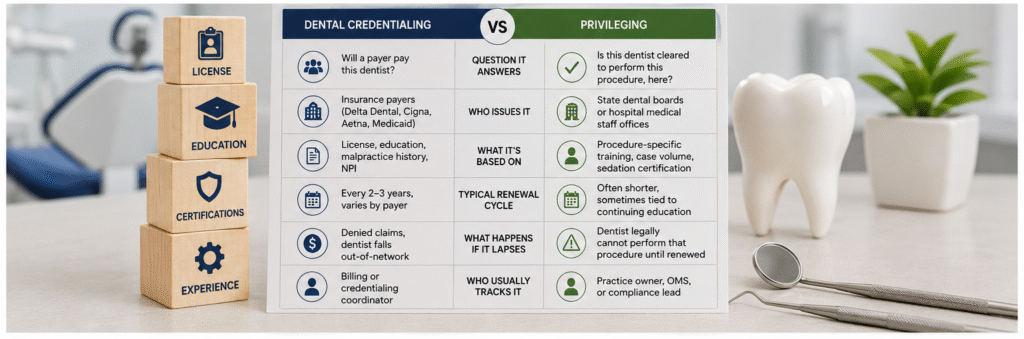
Dental Credentialing vs. Privileging: A Side-by-Side Comparison
| Factor | Dental Credentialing | Privileging |
|---|---|---|
| Question it answers | Will a payer pay this dentist for treating members? | Is this dentist cleared to perform this specific procedure, here? |
| Who issues it | Insurance payers (Delta Dental, Cigna, Aetna, Medicaid) | State dental boards or hospital medical staff offices |
| What it’s based on | License, education, malpractice history, NPI | Procedure-specific training, case volume, sedation certification |
| Typical renewal cycle | Every 2–3 years, varies by payer | Often shorter, sometimes tied to continuing education |
| What happens if it lapses | Denied claims, dentist falls out-of-network | Dentist legally cannot perform that procedure until renewed |
| Who usually tracks it | Billing or credentialing coordinator | Practice owner, OMS, or compliance lead |
A lapsed credential is a cash flow problem. Annoying, fixable, usually recoverable within a billing cycle or two. A lapsed sedation permit is not a billing problem at all. It means the dentist can’t legally do the procedure, full stop, until the state board says otherwise.
Why the Credentialing-Privileging Gap Matters for Dental RCM
Most advice on this subject assumes every provider needs both processes managed with the same urgency, because that’s the hospital model. Dental practices don’t run like hospitals. A solo general dentist may never touch privileging in their entire career. An oral surgeon joining a multi-location DSO absolutely will, and so will a practice adding sedation services for the first time.
Once a practice hits one of those situations, there are suddenly two calendars to watch instead of one. CAQH renewal dates get tracked fairly reliably almost everywhere we’ve seen. Sedation permit expiration dates, sitting on a completely separate timeline, get missed far more often, mostly because nobody assigned anyone to watch them. From a dental RCM standpoint, this matters because either gap, credentialing or privileging, eventually shows up as a stalled claim or a procedure that can’t legally be billed at all.
How CEC’s Dental Credentialing Services Support Your Practice
We run the full dental credentialing services process for practices we work with: CAQH setup and attestation, applications to Delta Dental, Cigna, Aetna, and state Medicaid programs, ongoing tracking so nothing expires quietly. For DSOs and multi-provider groups specifically, we also flag where privileging needs its own separate attention instead of getting buried inside routine insurance paperwork.
Because credentialing, dental billing, and dental RCM all connect at the claims level, we handle them as one workflow rather than separate tasks handed to different people. None of this is about getting a dentist approved once and calling it done. It’s about keeping credentialing, enrollment, and any procedure-specific permits current, so a front desk isn’t stuck mentally juggling three different renewal schedules.
Get a Free Credentialing & Privileging Check
Find out if every provider in your practice is fully covered on both calendars, payer credentialing and any procedure-specific permits. Our experts will review your CAQH status, enrollment gaps, and sedation or hospital privileging deadlines before they turn into a stalled claim or a compliance problem.
Get a Free Credentialing & Privileging Check →Final Thoughts
These two terms get treated as interchangeable constantly, and they aren’t. Every dentist deals with dental credentialing at some point. Only some deal with privileging, and usually only once sedation or hospital work becomes part of the practice. Knowing the difference is really just knowing which calendar to watch, and for whom.
FAQs
1. Who is responsible for tracking a dentist’s sedation permit renewal?
Usually the practice, since state boards rarely send proactive reminders. Some practices assign this to whoever manages credentialing, but it needs its own separate tracking line rather than getting lumped in.
2. Can a DSO credential a dentist across multiple states in one application?
No. Each state, and each payer within it, requires its own separate credentialing process, even for the same dentist working across locations.
3. Does malpractice history weigh the same in privileging reviews as it does in credentialing?
Payers lean heavily on malpractice history during credentialing. Hospitals and state boards factor it in too, but they generally weigh procedure-specific training and case volume more heavily during privileging reviews.
4. What does handling dental credentialing in-house typically cost a practice?
Mostly staff time rather than a direct fee, applications, payer follow-ups, and status checks can add up to several hours per provider, which compounds fast in a multi-provider group.
5. What should a practice ask before choosing a dental credentialing partner?
Whether they track payer-specific requirements individually rather than using one generic process, how they handle denials, and whether renewal dates get monitored proactively instead of after something’s already lapsed.
6. If a practice adds sedation dentistry, does that trigger re-credentialing with insurance payers?
Not necessarily. The insurance side may stay untouched, but the sedation permit is a separate requirement, which is exactly why the two get confused so often.