
In healthcare billing and RCM services, precision is always non-negotiable. Even a small mistake in coding, eligibility issues, or inconsistencies in the insurance verifications can lead to RCM denials. According to recent data, an average physician practice spends $25 in administrative work per claim denial. Moreover, providers never rework 65% of denied claims at all.
Denials in medical billing are not random events; in fact, they can an effective RCM denial management process can easily predict, trace, and prevent them. By following a structured process of denial management in RCM, practitioners can recover the lost revenue while also preventing any recurring issues that might be disrupting the cash flow.
What Is Denial Management in Revenue Cycle Management?
Denial management in revenue Cycle Management refers to the process a healthcare organization uses to manage claim denials from initial identification through resolution and trend-based prevention. The process identifies what happened and why it happened, corrects the issue, and adopts measures to prevent the same failure in future claims when a payer rejects or denies a claim.
The difference between denial management and simple claim rework is important. Rework assesses individual denied claims. Denial management finds the system that produced those denials. If you only rework claims without analyzing patterns, then you are not resolving the issue at its root.
Who Is Responsible for Denial Management in Healthcare Billing?
Denial management is not one person’s job. Here are some roles involved in the process:
Billing Teams
Billing staff receive remittance advice from payers, identify denied claims, and initiate the rework process. In an RCM denial management system, billing teams arrange every denial by type and root cause at the point of receipt. Clean, consistent data supports downstream analysis instead of relying on retroactive reconstruction.
Coding Specialists
A large number of RCM denials happen due to coding errors, including incorrect procedure codes, mismatched diagnosis codes, unbundling, or the use of deprecated codes. Coding specialists review denied claims, correct the code set, and ensure that the documentation reflects the correction.
Revenue Cycle Managers
Revenue cycle managers set denial rate targets, review monthly trend reports, and escalate issues to department heads. They also make decisions about process changes, staff training, and invest in technology based on denial pattern data. Without this ownership, denial management will not work, no matter how well the operational team performs.
Types of Claim Denials in RCM
Not all denials are the same. If you misidentify a denial type, it can lead to wasted rework effort and missed appeal windows. Let’s take a look at the types:
Hard Denials
Hard denials are claim rejections that cannot be corrected and resubmitted as a new claim. They require a formal appeal or write-off. Common causes for these denials are:
- Non-covered services, timely filing limit violations,
- Duplicate claim submissions, patient eligibility failures, and cases where coverage was genuinely not in force at the date of service.
Experienced billers should be assigned to hard denials in denial management in RCM.
Soft Denials
You can resolve soft denials by correcting an error and resubmitting the claim without a formal appeal. Common causes include:
- Missing information
- Incorrect patient demographics
- Invalid codes
- Claims submitted without required attachments.
Soft denials actually cause most RCM denials. But they are correctable, recoverable, and largely preventable with front-end process improvements.
Common Causes of Claim Denials
Most claim denials are entirely preventable. However, you need to know the causes upfront to make timely decisions. Here are some causes of claim denials:
Incorrect Coding and Documentation Errors
Coding errors are the most common cause of denial in medical billing. These include:
- The use of outdated or retired codes after annual updates
- Mismatched procedure and diagnosis code combination
- Unbundling of services that should be billed under a single code
- Upcoding that triggers payer audit flags.
- Clinical note does not support the code billed
Insurance Eligibility Issues
Billing a service against a lapsed, inactive, or incorrect insurance plan leads to immediate denial and is often non-recoverable. These happen particularly at the start of the calendar year when deductibles reset, and during open enrollment periods when patients change employers or coverage plans. Real-time eligibility verification from 24 to 48 hours before every appointment reduces such risks before they reach the payer.
Missing or Incomplete Information
Clearinghouses or payers can deny or reject claims if they are submitted without required attachments, have missing referring provider NPI numbers, incomplete patient demographic fields, or lack prior authorization reference numbers. These are soft denials and are correctable with a pre-submission claim scrubbing process.
Timely Filing Errors
Each payer sets a time window, which defines the period within which a claim must be submitted from the date of service. These windows range from 90 days to 365 days, depending on the payer and plan type. The system denies claims submitted outside the timeline. A submission workflow can avoid timely filing violations.
Impact of Claim Denials on Healthcare Revenue Cycle
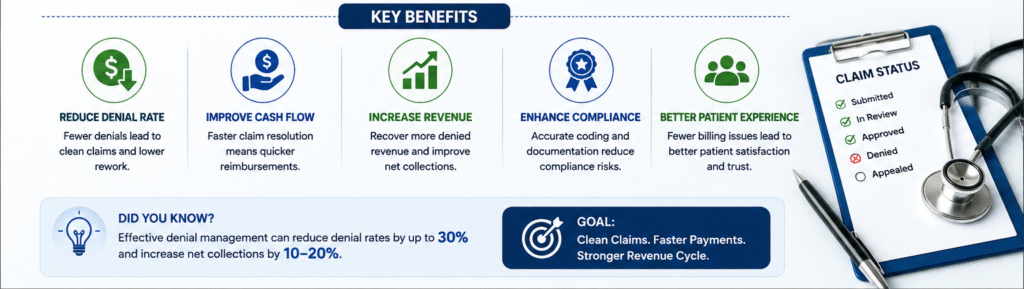
Claim denials are not just a billing problem. They also cause indirect financial consequences for a practice.
- AR days increase as denied claims age without resolution.
- Cash flow becomes unpredictable as payment cycles extend.
- Staff productivity drops as billing teams spend increasing proportions of their time on rework rather than new claim processing.
- Payer relationships deteriorate when appeal volumes signal persistent billing quality issues.
Step-by-Step Denial Management Process
The goal of the denial management process is to generate the data that prevents the issue from happening in the next batch. Here is the step-by-step guide for the process:
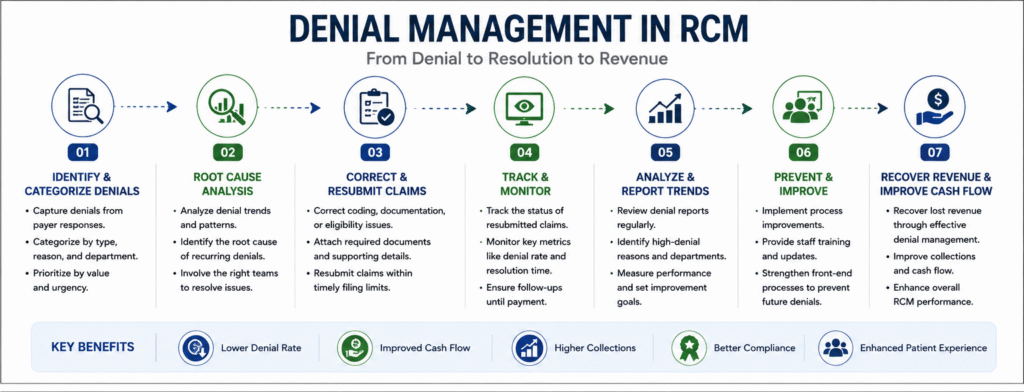
Identify and Categorise Denials
Categorize the claims on the basis of denial types (hard vs soft denials) and the root cause (coding, eligibility, missing information, timely filing, authorization). This categorization helps in root cause analysis and trend reporting of denial management in RCM.
Perform Root Cause Analysis
For each denial category, trace the failure back to its origin point in the revenue cycle. For instance,
- A coding denial traces to the coder, the documentation, or the code update process.
- An eligibility denial traces to the verification workflow.
- A timely filing denial traces to the submission process or the AR monitoring system.
Correct and Resubmit Claims
Once you identify the root cause and correct the error, you should resubmit the claim within a defined SLA. For instance, the timeline is five business days for soft denials. Similarly, assign hard denials that require a formal appeal to an experienced biller who has direct knowledge of the payer’s appeal process.
Track and Monitor Denial Trends
Perform monthly denial trend reporting — by category, by payer, by provider, and by denial code. It can help in converting individual claim data into an actionable report. For example:
- When a specific denial code rises in volume, it shows a process failure.
- When a specific payer’s denial rate increases, it shows a change in coverage policy or documentation requirements that the billing team needs to address.
Here, the trend data is the principle behind denial management that gets better over time.
Proven Strategies to Prevent Claim Denials
Claim denials can be prevented. Here are some proven strategies that you must consider:
Accurate Coding and Documentation
Accurate coding and complete documentation play an essential role in preventing claim denials. For example, even a minor inconsistency with the CPT or ICD codes can increase the chances of a claim denial. Thus, for efficient denial management:
- Establish strict documentation protocols that capture every minute detail from patient history, treatment, to physician notes.
- Perform regular internal audits to identify recurring errors, detect gaps, and ensure compliance.
- Eliminate retired codes from the system.
Real-Time Insurance Verification
Eligibility errors are one of the most common reasons for RCM denials. To prevent them, perform real-time insurance coverage around 24 to 48 hours before the appointment. This way, you can validate active coverage, identify limitations, and verify authorization requirements before the appointment.
Staff Training and Compliance
The coding standards and the compliance requirements for healthcare are continuously evolving. Ensure to provide proper staff training on new coding systems (like ICD, CPT, and HCPCS), payer-specific billing requirements, documentation best practices, and compliance regulations such as HIPAA.
How CEC Computech Improves Denial Management Outcomes
CEC offers denial management and credentialing services with a structured and technology-driven approach. We combine our domain expertise with advanced analytics that help healthcare professionals to quickly address and reduce denial rates without losing revenue.
Here’s what we offer:
- Complete denial tracking that includes problem identification, work allocation, and regular follow-ups until reimbursements or closure.
- Skilled staff to identify root cause, assist in process correction, and reduce recurrent denials.
- Timely follow-ups for refused claims, documentation-supported appeals, and tracking payer response.
- Ensure compliance with claims appeal and payer regulations.
- A real-time KPI dashboard and denial trend reports.
Get a Free Denial Management Review
Find out exactly where your denial process is losing revenue. Our experts will analyze your denial trends by category and payer, trace each one back to its root cause, and show you what a structured denial management process could recover.
Get a Free Denial Management Review →Conclusion
A well-defined approach to denial management in RCM can actually improve the financial performance of your practice and also the operational efficiency. It can help you identify the root cause, implement preventive workflows, adopt accurate coding practices, and conduct real-time verification to gradually scale from denial recovery to denial prevention, with sustainable revenue outcomes.
Want to build your denials management programme from scratch, or improve an underperforming one? CEC has the expertise and the infrastructure to deliver the best results. Contact us to schedule a complimentary RCM denial management review and find out exactly where your practice’s denial process is losing revenue.
FAQs
1. What is denial management in RCM?
Denial management in RCM is the process of identifying, categorizing, resolving, and preventing claim denials across the revenue cycle. It uses denial data to find failures that produce recurring denials and drives corrections to reduce denial volume over time.
2. What are the most common causes of claim denials in medical billing?
The most common causes of denial in medical billing are
- Coding errors
- Insurance eligibility failures
- Missing or incomplete claim information
- Timely filing violations, and
- Missing prior authorization.
3. When should a practice outsource its denial management function?
Outsourcing denial management makes sense when the denial rate consistently exceeds 10%, especially when:
- Denied claims are ageing beyond 30 days before rework.
- Billing staff turnover has created an unresolved backlog.
- The in-house team lacks the capacity to perform daily rework on denials.