
Ask a front desk coordinator how they decide which of a patient’s two insurance plans to bill first, and you’ll often get an honest answer: whichever card was on top. Nobody ever walked them through the actual rule, and an insurance card doesn’t come with instructions printed on the back.
That rule has a name: coordination of benefits, or COB. Getting it backwards rarely looks like a mistake right away. The claim goes out, weeks pass, and then a payment comes back wrong or a secondary claim gets denied for reasons that don’t make sense, and by then nobody remembers the ten-second decision at check-in that caused it.
Not Every Dual-Coverage Patient Actually Needs COB
Here’s a detail that trips up a lot of billing teams: coordination isn’t universal. Only group or employer-sponsored plans are required to coordinate benefits, so if one of a patient’s two policies is an individual plan, that plan generally isn’t obligated to coordinate at all. Treating every dual-coverage patient as a standard COB case, without first checking whether both plans are actually group plans, means some claims get processed under an assumption that never applied in the first place.
The Rules That Actually Decide Who Pays First
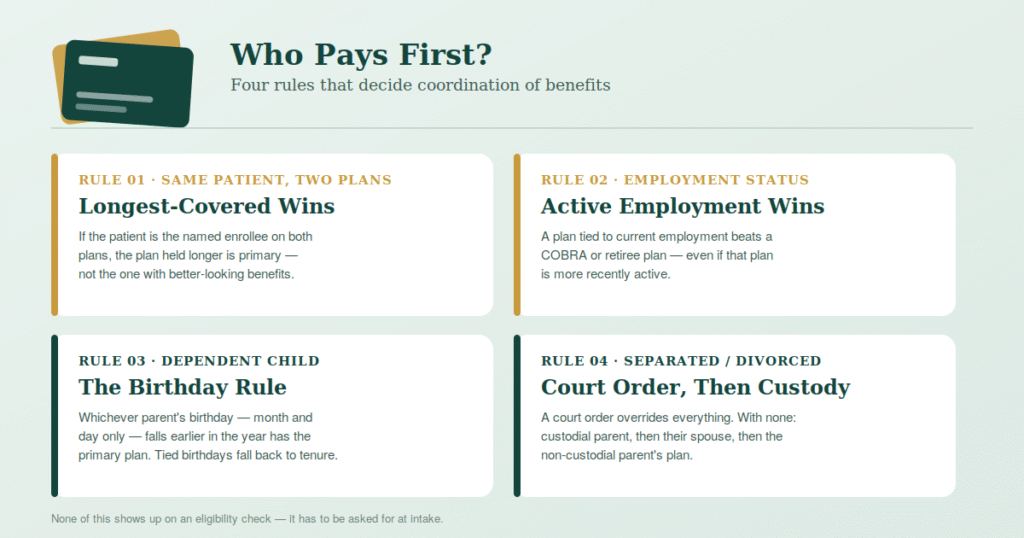
When the patient is the named enrollee on both plans. If someone is a primary policyholder, not a dependent, on two separate plans, the tiebreaker usually comes down to tenure. The plan that has covered the patient longer is generally treated as primary, which is easy to miss if staff assume the plan with better-looking benefits should lead.
When one plan is tied to active employment, and the other isn’t. A plan through current employment is primary over a COBRA plan or a retiree plan, even if the COBRA coverage happens to be the one that’s been active more recently.
When a child is covered under both parents’ plans. This is the birthday rule: whichever parent’s birthday, month and day only, falls earlier in the calendar year has the primary plan. If both parents share a birthday, tenure becomes the tiebreaker, the same logic as above.
When parents are separated or divorced. A court order naming one parent responsible for coverage overrides everything else. Without one, the order generally runs the custodial parent’s plan first, then the plan of the custodial parent’s spouse, then the non-custodial parent’s plan. The birthday rule only reappears if custody is genuinely joint with no court decree.
The honest problem with all four of these rules: none of that information, plan type, tenure, employment status, custody arrangement, shows up on a standard eligibility check or an insurance card. The only reliable way to get it is to ask the patient directly at intake, with specific questions rather than a general “do you have other insurance,” and to document whatever they state as the working COB determination until an EOB either confirms or contradicts it.
Non-Duplication and Carve-Out: Where Secondary Coverage Stops Meaning What Patients Expect
Say a procedure costs $1,000. The primary plan covers 80%, paying $800. If the secondary plan would normally have covered 75% as if it were primary, that’s $750. Under a non-duplication clause, the secondary doesn’t pay the gap between $800 and $750, because there is no positive gap. The primary payment already met or exceeded what the secondary would have paid on its own, so the secondary pays nothing at all.
To a patient, that feels like the second plan didn’t do its job. To the payer, it’s the contract working as designed, not a processing error, which means it isn’t something to appeal, only something to anticipate before the claim goes out.
Carve-out plans calculate differently: the secondary works out what it would normally pay, then subtracts whatever the primary already paid from that figure. This usually produces a smaller secondary payment than non-duplication would, and without knowing which method a specific secondary plan uses in advance, it’s easy for a biller to mistake the result for an underpayment.
Worth knowing too: these calculation methods aren’t standardized nationally, they vary by carrier and are further complicated by differing state laws. The NAIC has drafted model COB regulation and the ADA supports states adopting it, but adoption isn’t uniform, so a rule that holds firm with one payer in one state isn’t guaranteed to apply identically elsewhere.
The Timely Filing Trap Most COB Advice Gets Backwards
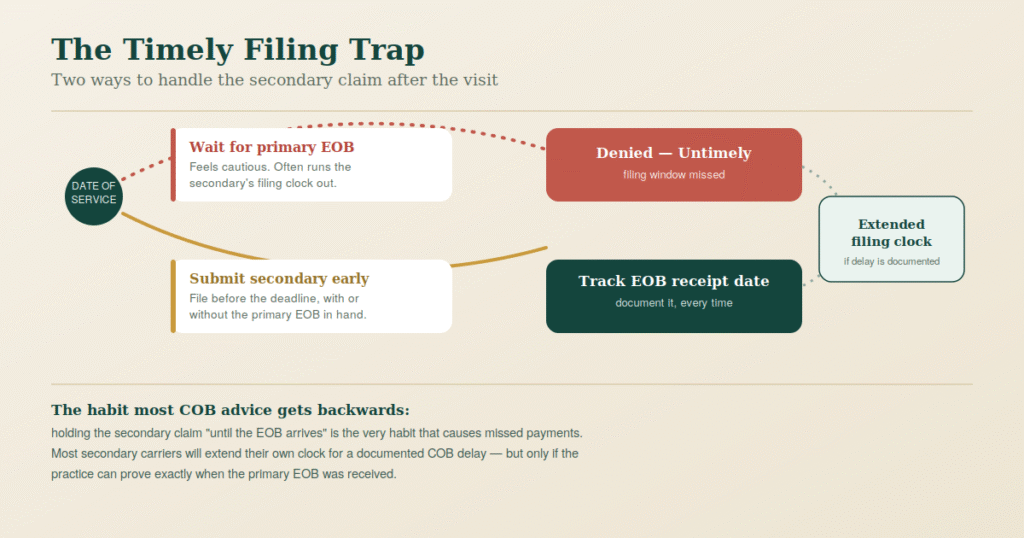
A lot of billing guidance says to hold the secondary claim until the primary EOB arrives. In practice, that’s exactly the habit that causes missed payments. Best practice is to submit the secondary claim before the filing window closes even without the primary EOB in hand, and if it comes back denied for that reason, appeal it citing the wait. Most secondary carriers do extend their own clock once they see a documented COB delay, but only if the practice can show when the primary EOB was actually received.
Many secondary carriers calculate their filing deadline from the date the primary’s EOB was received rather than the original date of service, which effectively extends the window, but this isn’t universal across every carrier. The safer habit is getting the secondary claim on file early and tracking the primary EOB date carefully, rather than assuming there’s unlimited time to wait.
Where This Actually Breaks Down: The Software Layer
Understanding the rules is one thing. Getting a practice management system to apply them consistently is another. In Open Dental, for example, the COB rule has to be manually selected on each secondary insurance plan, and creating a claim automatically generates a primary claim marked “Waiting to Send” alongside a secondary claim held at “Hold until Pri received” until that status is changed. If that field was never set correctly when the plan was entered, or if staff clear the hold status manually out of habit, the software’s protection against premature submission disappears.
Dentrix and Eaglesoft handle this with their own version of claim holds and payment-table logic, but no PMS handles coordination of benefits accurately out of the box, and getting there generally takes months of consistent effort: correct fee schedules attached, accurate benefit breakdowns entered, and careful payment posting sustained over time. A practice that configured this correctly two years ago and hasn’t revisited it since may be running on settings that no longer match its current payer mix.
A Verification Process That Actually Holds Up
- Ask specific COB questions at intake, plan type, who’s the named enrollee, custody arrangements, rather than a general dual-coverage question.
- Confirm whether both plans are group plans before assuming standard COB rules apply at all.
- Submit the secondary claim early rather than waiting on the primary EOB, and document the date the EOB is received either way.
- Check the COB rule configured on each secondary plan in the practice management system, don’t assume it was set correctly at entry.
- Re-verify at every visit, since plan type, employment status, and custody terms can all change without anyone thinking to mention it.
Where CEC Fits Into This
This is a problem that’s simple to describe in the abstract and genuinely hard to execute across every dual-coverage patient, especially with front desk staff juggling scheduling and phones at the same time. CEC is one of the dental billing services providers that builds COB verification directly into intake questions rather than treating it as a downstream billing fix, confirming plan type and the applicable rule before treatment, submitting secondary claims early enough to protect the filing window, and keeping the COB rule configured correctly against each payer inside the practice’s own system.
For practices deciding whether to manage this in-house or bring in dedicated dental billing services, the honest answer depends on volume and payer mix. A practice with occasional dual-coverage patients can usually manage this with a solid checklist and correctly configured software. A practice where it shows up constantly, or one juggling several PMS platforms across locations, tends to benefit from a dental RCM services partner tracking coordination rules and filing windows payer by payer, since the variation between carriers and states is genuinely too much to memorize reliably in-house.
Get a Free COB Verification Review
Find out if your front desk and practice management system are getting coordination of benefits right. Our experts will review your COB workflow, catch misconfigured plan rules, and help you stop losing secondary payments to preventable errors.
Get a Free COB Verification Review →The Bottom Line
COB looks like a small administrative detail. It isn’t, and unlike a lot of billing problems, it’s largely preventable with the right questions at check-in and the right settings configured in the software your team already uses. Contact CEC if you want a second look at how COB is actually being handled at your front desk and inside your practice management system right now.
FAQs
Does coordination of benefits apply to every patient with two dental plans?
Not always. Only group or employer-sponsored plans are generally required to coordinate. If one of a patient’s two policies is an individual plan, it may not be obligated to coordinate at all, which is worth confirming before assuming standard COB rules apply.
Should a dental office wait for the primary EOB before billing the secondary insurer?
Not if it risks the secondary’s filing deadline. The safer approach is submitting the secondary claim early, tracking when the primary EOB actually arrives, and appealing any timely filing denial by documenting that delay. Many carriers extend their filing clock for documented COB delays, but that protection only applies if the practice can prove the timeline.
Why does a practice management system sometimes calculate secondary payments incorrectly?
Often because the coordination of benefits rule wasn’t set correctly on that specific insurance plan when it was entered into the system. Most platforms require this to be selected manually per plan, and if it’s wrong or was never updated after a payer changed its coordination method, the system will keep calculating secondary payments incorrectly until someone corrects the setting directly.