
Dental insurance laws by state changed a lot this year, and the rules your team follows in Illinois may not match what applies in Ohio or Florida. Some laws change how insurers can pay you. Others limit what they can take back or what you can charge for services they don’t cover.
The catch is that many of these protections don’t reach every patient. This guide covers what changed in nine states, what your team should check, and where the gaps are. If your practice works with a dental billing services partner, these are the rules they should already be tracking.
Key Takeaways
- The ADA says 18 states enacted 33 new dental insurance reform laws so far in 2026
- Many state protections apply to fully insured plans, not self-funded employer plans
- Payment method rules (virtual credit cards and fees) now differ across California, Florida, Illinois, Michigan, and New Jersey
- Ohio and Arizona have rules on what practices can charge for non-covered services
- Verification now has to confirm plan type and payment terms, not just coverage
Do State Dental Insurance Laws Apply to Every Patient?
No. Most state dental insurance laws apply to fully insured plans, and many self-funded employer plans sit outside them.
Fully Insured vs Self-Funded Plans
The ADA says insurers running large self-funded employer plans often claim federal law (ERISA) overrides state rules, and it’s backing a federal bill to close that gap. The New Jersey Dental Association puts it plainly: two patients in the same chair can be under two different sets of rules. Illinois dentists report the same confusion, and their state dental society has asked regulators to clarify how the ERISA exemption affects its law.
How to Tell Which Plan a Patient Has
According to a California dental insurance reform group, plans there must now tell providers at eligibility whether coverage is federally regulated. Other states don’t have that rule, so the call to the payer matters. Ask directly whether the plan is fully insured or self-funded, and write down the answer.
Which States Passed Dental Insurance Reform Laws in 2026?
Lawmakers filed more than 100 dental insurance reform bills across 37 states this year. According to the ADA, 18 states have enacted 33 new laws so far.
Indiana cut its recoupment window from two years to 180 days, and Connecticut went from 18 months to 12. Georgia and Louisiana switched virtual card rules from opt-out to opt-in. Below are the nine states where the changes hit day-to-day billing hardest.
What Changed in Dental Billing and Insurance Verification Across Major States in 2026?
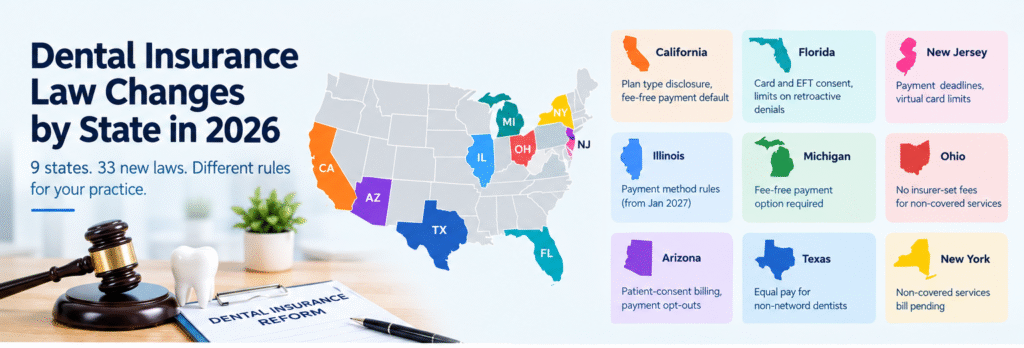
Verification itself didn’t change. What your team has to check did. Good dental insurance billing and verification now covers plan type, payment method, and authorization records, not only benefits and deductibles.
| State | What changed | What to verify |
| California | Fee-free payment default, plan type disclosure | Plan type, payment method |
| Florida | Card and EFT consent, limits on retroactive denials | Authorization records |
| New Jersey | Payment deadlines, virtual card limits | Plan type, claim timing |
| Illinois | Payment method rules from Jan 2027 | Consent on file, assignment of benefits |
| Michigan | Fee-free payment option required | Payment method set up |
| Ohio | No insurer-set fees for non-covered services | Contract date, service status |
| Arizona | Patient-consent billing, payment opt-outs | Written consent |
| Texas | Equal pay for non-network dentists held | Network status |
| New York | Non-covered services bill pending | Bill status |
California: Plan Type Disclosure and Payment Defaults
SB 386 took effect April 1, 2026, and it changes the default. Plans must offer a payment method without fees and get a dentist’s consent before using one that charges fees, according to the California Dental Association. Add the plan type disclosure above and intake gets simpler. Practices setting this up for the first time can get help through dental billing services in California.
Florida: Authorizations and Retroactive Denials
Florida’s SB 892 bars credit-card-only payments and requires fee disclosure and written consent for electronic payments. It also limits insurers from denying payment on procedures they already authorized, except for reasons like benefit limits, missing documentation, a changed patient condition, or fraud, as The Capitolist reported. That makes saved authorization records worth their weight, and dental billing services in Florida can keep them organized by payer.
New Jersey: Payment Deadlines and Plan Type
Insurers must pay clean claims within 30 days if filed electronically or 40 days otherwise, and deny or dispute them in that same window. The state’s insurance department says those prompt pay rules don’t cover self-insured plans, which is why plan type matters here too. A 2023 law also limits virtual card defaults. Teams tracking late claims can use dental billing services in New Jersey to watch those deadlines.
Illinois: Payment Method Rules Starting January 2027
Governor Pritzker signed HB 4464 on June 26, 2026. It stops insurers from forcing virtual card or EFT-only payment, requires fee disclosure and written consent, and entitles dentists to the full contracted amount. It takes effect January 1, 2027, so there’s time to update payer settings, and dental billing services in Illinois can handle that switch.
Michigan: Fee-Free Payment Option
Michigan’s SB 105 requires insurers to offer at least one payment method with no fees, and insurers must keep it in place once a dentist opts out. The Michigan Dental Association says virtual card fees had been running 3% to 5%. Check each payer’s setup rather than assuming the change is automatic. Michigan practices can lean on dental billing services in Michigan to audit that.
Ohio: Non-Covered Services Fees
Ohio’s SB 40 stops insurers from setting fees for services they don’t cover. The Ohio Dental Association says contracts signed from January 1, 2025 must follow it. Older contracts may work differently, so check the contract date first. For contract reviews, there are dental billing services in Ohio.
Arizona: Non-Covered Services and Payment Opt-Outs
A 2024 law lets dentists, with the patient’s written informed consent, collect for non-covered services or for medically necessary care denied on frequency, at their own fee schedule, per the ADA’s enactment list. Another law makes insurers honor a dentist’s payment method choice. Get the consent form signed first, and dental billing services in Arizona can build that step into intake.
Texas: Equal Payment for Non-Network Dentists
Texas lawmakers rejected a 2025 proposal to repeal the rule that insurers pay non-network dentists the same as network dentists, according to the ADA. Nothing changed, but confirming network status still matters. Texas practices can find dental billing services in Texas for payer follow-up.
New York: Pending Non-Covered Services Rule
A bill in the legislature would require plans to state that participating dentists can charge normal fees for non-covered services and provide a cost estimate. If enacted, it would apply to contracts issued on or after January 1, 2027, per the text of Assembly bill A3687-B. Check its status before relying on it, and keep dental billing services in New York in mind if it passes.
How Can Dental Practices Stay on Top of State Billing Rules?
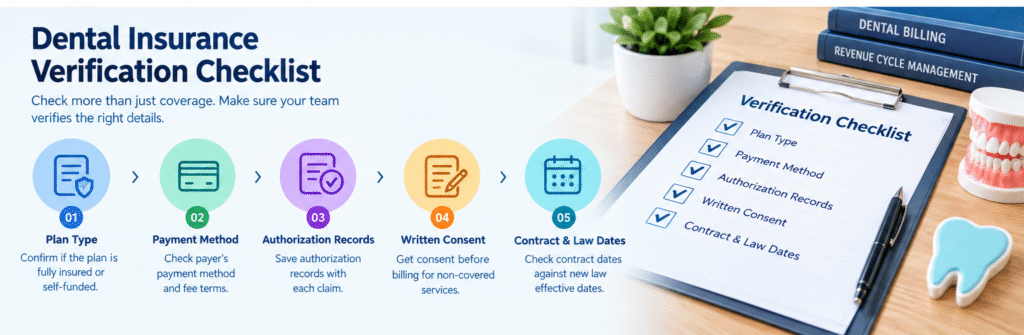
Keep it simple, and build it into the front desk workflow:
- Confirm plan type (fully insured or self-funded) at every verification
- Record each payer’s payment method and fee terms
- Save authorization records with the claim
- Get written consent before billing patients for non-covered services
- Check contract dates against new law effective dates
Groups working across several states need this in one system. That’s a job for dental revenue cycle management, where a central team tracks rules for every location.
How CEComputech Helps
- Verification that confirms plan type and payment terms, not just benefits
- Payer payment settings checked against each state’s rules
- Authorization records attached to every claim
- Denial and appeal follow-up built around state deadlines
- Dental billing services for practices across nine states, from solo offices to multi-location groups
Conclusion
State dental insurance laws are moving faster than most billing teams can track. Payment methods, non-covered service fees, and claim timing all changed in 2026, and the biggest gap is patients whose plans fall outside these laws. The practices that stay ahead check plan type first and keep good records. A reliable dental billing company in USA can carry that load.
Get a Free State Compliance Check for Your Practice
New payment method rules, non-covered service limits, and claim deadlines now differ from state to state. Let CEC review your plan type verification, payer payment settings, and authorization records against the laws that apply to your state.
Talk to CEC →FAQ
Do state dental insurance laws apply to self-funded employer plans?
Usually not. Insurers running self-funded plans often argue federal law overrides state rules, and the ADA is pushing Congress to change that. Until then, confirm plan type during verification so you know which rules apply.
Can a dental insurer force me to accept virtual credit card payments?
It depends on the state. California, Florida, Illinois, Michigan, and New Jersey now limit it, and Illinois’ rules start January 2027. Check each payer’s payment settings and get your preferred method on file.
What can I charge patients for services their plan doesn’t cover?
It varies. Ohio stops insurers from setting those fees for contracts from 2025 on. Arizona allows billing your own fee with written patient consent. Read your contract and check the state rule.
How long does a dental insurer have to pay a clean claim in New Jersey?
Thirty days for electronic claims and 40 days for others, according to Horizon’s prompt pay guidance. Claims not paid must be denied or disputed in the same window. Self-insured plans fall outside those rules.
Which states have new dental insurance reform laws for 2026?
The ADA counts 18 states with 33 new laws so far. Illinois, Michigan, and California are among the nine covered here. Others include Indiana, Connecticut, Oregon, Georgia, and Louisiana.
How do I know which rules apply to a patient’s plan?
Ask the payer during verification whether the plan is fully insured or self-funded, and where it was issued. California plans must disclose federal regulation status. Elsewhere, get the answer by phone and note it.