
An incomplete or skipped insurance verification can be a major root cause of a dental claim denial. That means even a small missing detail or any inconsistency in dental insurance verification can lead to costly surprises that do not appear immediately, but after 30, 60, or 90 days in the form of denied claims, ageing AR, and collectable revenue that has quietly slipped past its recovery window.
To address this issue, you don’t need more management or administrative staff; instead, you need a proper dental insurance verification checklist before every appointment. This checklist can help you eliminate a majority of eligibility-related claim failures before they reach the payer. According to industry research, practices that implement structured dental insurance verification services see first-pass claim acceptance rates improve by 25%-35% in the first month. Such revenue impact is direct: fewer denials mean faster payment cycles, lower rework costs, and a stronger net collection ratio for the practice.
This guide covers everything you need to know about dental insurance verification, the full checklist, step-by-step workflow, measurement KPIs, and how outsourcing the process can benefit your team. Let’s find out!
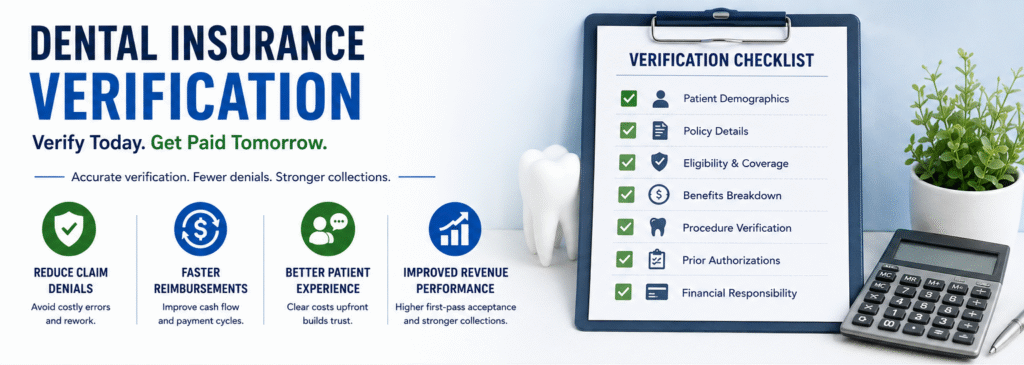
What Is Dental Insurance Verification and Why Is It Important?
Dental insurance verification is the process of reviewing and confirming a patient’s insurance coverage details, which include the patient’s eligibility, benefits, financial responsibility, and limitations. The staff performs this verification process before offering the treatment and usually communicates directly (via online portals) with the payer and the insurance provider.
Accurate dental insurance verification is important, as it helps:
- In maintaining clean claim denials.
- Decreased administrative work for the staff.
- Faster reimbursement.
- Enhanced patients’ trust with complete cost clarity.
Without verification, the practice will not be aware of the lapsed coverage of a patient’s plan, or a plan that doesn’t cover the procedure, which results in claim denial.
Who Should Perform Dental Insurance Verification?
Verification is not one person’s job; it is a team responsibility.
Front Desk Teams
In most dental practices, front desk coordinators handle initial patient registration and collect the insurance data. They collect member IDs, group numbers, and coverage during check-in.
Billing Specialists
Billing staff confirm the eligibility of the patient based on the collected data, document frequency limitations, and identify procedures that require prior authorization. In practices with in-house billing teams, the team usually has a dental insurance verification sheet.
Outsourced Verification Teams
For practices using dental insurance verification services, third-party verifiers are usually responsible for conducting the whole verification process. They handle eligibility checks, documentation, and communication with patient responsibility.
Complete Dental Insurance Verification Checklist for Practices
Let’s take a look at the checklist for dental insurance verification that you need to confirm before a patient appointment.
Patient Demographics Verification
The staff verifies basic patient demographics, such that:
- The full name should match the Legal name mentioned on the insurance card.
- Date of birth and subscriber should be correct.
- Verifying the home address and correct contact details.
- Confirmation regarding whether the patient is a subscriber or a dependent.
Insurance Policy Details Confirmation
Ensuring correct policy details is necessary to reduce the chances of denials. The verification process involves:
- Confirming the insurance carrier name and plan type.
- Noting down the group number and policy number.
- Verifying the insurance plan start and expiration date.
- Validating whether the two insurance plans can work together.
Eligibility and Coverage Validation
Verifying the patient’s eligibility under the plan. It involves:
- Confirming that the insurance plan is currently active.
- Checking if the dentist is in network.
- Verifying the requirement of any referral.
- Checking if a waiting period applies to the treatment or not.
Benefits Breakdown — Deductibles, Co-Pay, Annual Maximum
| Benefits Item | What to Confirm |
|---|---|
| Annual Deductible | Check the total deductible amount and how much the patient has already paid this year |
| Annual Maximum | Find out the highest amount the plan pays per year and how much is left to use |
| Co-Insurance and Co-Pay | Confirm how much the patient needs to pay out of pocket for each type of procedure |
| Preventive Coverage | Check if routine cleanings, exams, and X-rays are fully covered at no cost |
| Basic Restorative | Find out what percentage the plan covers for fillings, tooth removal, and similar work |
| Major Restorative | Check the coverage percentage for crowns, bridges, and dentures |
| Orthodontic Benefit | Confirm the lifetime dollar limit for braces and whether there is an age cutoff for eligibility |
Procedure-Specific Verification — Frequency Restrictions and Prior Authorizations
- Verify frequency restrictions on each procedure type (for example, two cleanings annually, one X-ray session every 12 months).
- Determine whether the scheduled procedures were done within the allowed time period.
- Note the procedures that require prior authorization, and make sure to get it before the dental visit.
- Verify missing teeth exceptions or waiting periods for major repairs.
Step-by-Step Dental Insurance Verification Workflow
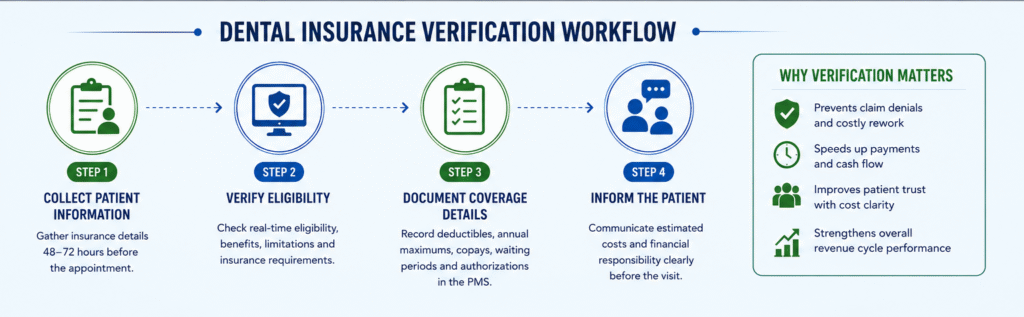
Here’s the step-by-step guide to follow the dental insurance verification at your practice:
Step 1: Collect Patient Information
Look at the schedule 48-72 hours prior to the patient’s appointment and gather the member ID number, the group number, the name of the carrier and the subscriber if they are an existing client; otherwise, request those from the new client.
Step 2: Verify Eligibility
Verify the eligibility involves connecting with the insurance company either through phone or via real-time portal options. Once verified, fill the verification sheet with details like date of verification, verification number and the complete coverage details.
Step 3: Document Coverage Details
Enter all the verified details into the PMS system. Ensure to input the details like annual maximum, deductibles, pre-authorization numbers, etc.
Step 4: Inform the Patient
Make sure to inform the patient about any additional expenses before they come for the appointment. This way, you can set clear expectations, eliminate the chances of any billing disputes, and ultimately improve same-day collections.
Advantages of Outsourcing Dental Insurance Verification
Some of the benefits of outsourcing dental insurance verification include:
- Dedicated expertise: Outsourcing dental insurance verification services can help you conduct the verification process by an expert team of dental insurance professionals who have complete knowledge of the documentation, restrictions, and pre-verification requirements.
- Consistent 48-hour turnaround: The patients can get done with the verification process within 48 hours before the appointment.
- Real-time eligibility tools: The outsourced dental insurance verification allows professionals to access the real-time tools and direct payer portals.
- Reduced front desk burden: Since the dental verification process is outsourced, the administrative team can feel less burdened and focus more on other important tasks.
- Documented verification records: As the entire verification process is recoded on a structured dental insurance verification sheet, all data is easily accessible at any time.
Key KPIs to Measure Verification Accuracy
What gets measured gets managed, and verification performance is no different. Here’s what you need to verify:
Verification Accuracy Rate
The percentage of appointments where all coverage details were confirmed before the visit.
First-Pass Claim Acceptance Rate
The percentage of claims accepted by the payer on first submission without rejection.
Denial Rate Due to Eligibility Errors
The share of denials is tied to eligibility failures such as lapsed coverage, inactive subscribers, or missed authorizations.
How CEC Improves Insurance Verification
At CEC, dental insurance verification services play an important part in our dental revenue cycle management offering. Here’s how we stand out on insurance verification:
- White-label dental billing and verification services.
- Early patient eligibility (around 5-7 days prior to the appointment).
- Eliminates manual entry and errors with easy PMS integration.
- Dependable verification and same-day appointments.
- Personalized benefit breakdown that includes insurance coverage, yearly maximums, deductibles, and waiting times.
- Ongoing annual plan renewals.
Our trained team of professionals and modern tools help optimize the insurance verification process that boosts revenue and decreases the administrative load.
Get a Free Insurance Verification Audit
Find out how many of your denials trace back to a missed or incomplete eligibility check. Our experts will review your verification process and show you where first-pass claim acceptance is slipping.
Get a Free Insurance Verification Audit →Conclusion
Dental insurance verification is not an administrative task that sits at the edge of the revenue cycle. It is the foundation every clean claim is built on. When verification is incomplete, inconsistent, or skipped, the billing consequences arrive weeks later as denials, rework costs, and ageing AR. But when you implement the structured dental insurance verification checklist before every appointment, you can avoid the majority of these failures before they reach the payer.
Seeking outsource dental insurance verification to a specialist team? Contact CEC today. Our dental insurance verification services can reduce your denial rate and improve first-pass claim acceptance from the very first appointment.
FAQs
Q1. What is dental insurance verification, and why does it matter?
Dental insurance verification is the process of confirming a patient’s active coverage, benefits, and financial responsibility before their appointment. It matters because eligibility errors are one of the leading causes of claim denials.
Q2. What should a dental insurance verification checklist include?
A complete dental insurance verification checklist should confirm:
- Patient demographics,
- Policy details,
- Active eligibility,
- Benefits breakdown (deductibles, co-pay, annual maximum),
- Frequency limits by procedure category, and
- Any prior authorization requirements
Q3. When does outsourcing dental insurance verification make sense?
Outsourcing dental insurance verification makes sense when,
- You have limited front desk capacity,
- Denial rates due to eligibility errors are above 5%, or
- The practice is growing faster, and the administrative load is increasing.
Find the revenue gaps costing your practice money
Request a complimentary dental revenue review. Our team will identify opportunities across verification, claims, denials, payment posting and A/R follow-up.
Request My Free Revenue ReviewNo obligation. Built for independent practices, groups and DSOs.