Most dental practices hit a point where the PMS and a busy front desk can’t keep up with billing anymore. From there, you have two realistic options. You can buy dental RCM software and keep billing in-house, or you can outsource dental billing to a company that provides dental RCM services and runs the revenue cycle for you. Vendors on both sides promise fewer denials and faster payments. They get there in very different ways, though.
Below, we break down what each option covers, where software runs out and a person has to step in, what each one really costs, and which makes sense for your practice. It applies whether you’re comparing software, a dental RCM company, or a dental billing company, and whether you have one office or ten.
What Are Dental RCM Services?
Dental RCM services handle the money side of patient care, from the moment an appointment is booked to the day the last dollar is posted. Insurance verification, coding, claim submission, payer follow-up, denials, payment posting, and reporting all fall under it.
How a Dental RCM Provider Manages the Full Revenue Cycle
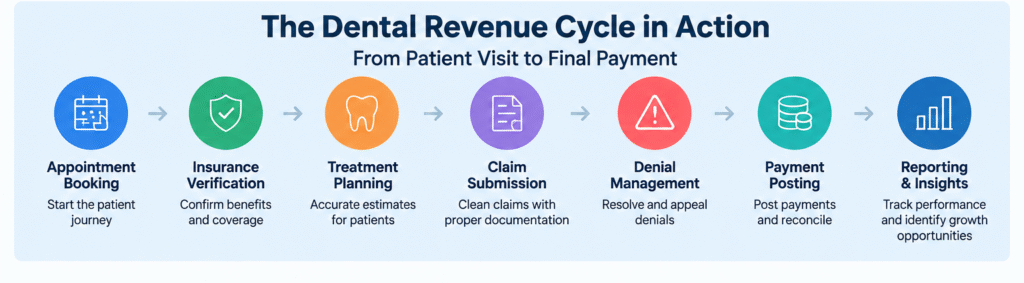
A dental RCM provider works inside your practice management system, usually through secure remote access, and does the billing work your team would otherwise squeeze in between patients. The provider is also on the hook for results, things like clean claim rate and days in A/R. You’re no longer relying on one biller who also answers the phones. Different people handle verification, claims, and follow-up, and each of them does that job all day.
Dental Revenue Cycle Management Services vs Basic Dental Billing Services
Plenty of companies sell dental billing services that amount to sending claims and chasing a few of them. Dental revenue cycle management services cover more ground. Work starts before the patient sits in the chair, with eligibility and benefit checks, and it doesn’t stop when the check arrives, because someone still has to reconcile that payment and report on it. A lot of denials trace back to front-end mistakes like a wrong subscriber ID or a frequency nobody checked. Billing that only begins at claim submission is already a step behind.
What Dental RCM Software Does and Where It Falls Short
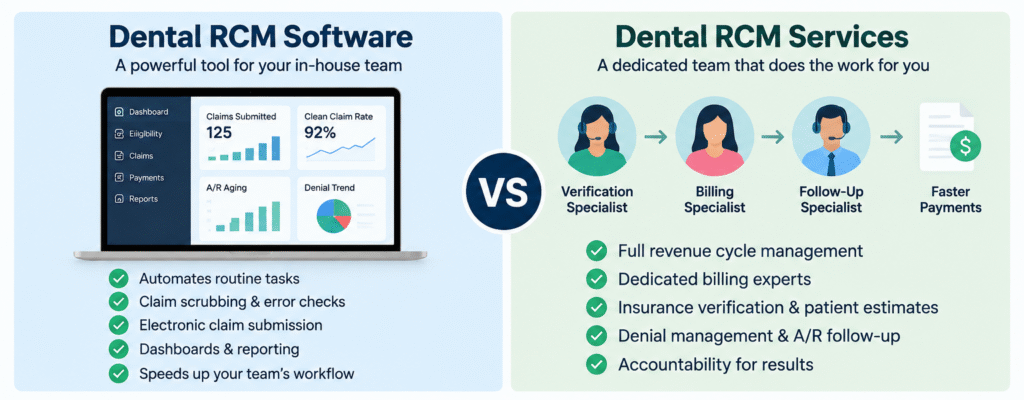
Dental RCM software, often sold as dental billing software, speeds up the work your in-house team already does. It doesn’t do that work for them. Somebody on staff still has to log in and run it every day.
Core Features of Dental Revenue Cycle Management Software
Most dental revenue cycle management software comes with some mix of these:
- Automated eligibility checks through payer connections
- Claim scrubbing that catches missing codes, attachments, or data errors
- Electronic claim submission with status tracking
- ERA and EOB import to speed up payment posting
- Dashboards for aging, collections, and denial trends
A few newer platforms add AI that predicts which claims are likely to be denied. That helps, as long as someone acts on the warning.
The Work RCM Software Still Leaves With Your Billing Team
This is where expectations and reality tend to split. The software will tell you a D4341 scaling and root planing claim came back denied for missing perio charting. It won’t pull the chart, attach it, and resubmit. It will show a crown claim stuck in pending for 45 days, but a person still has to call the payer, sit on hold, and find out the narrative never made it through.
Eligibility works the same way. A portal check can show the patient as active and still miss that the plan covers only two cleanings per calendar year, or downgrades posterior composites to amalgam. Someone has to read the full breakdown or pick up the phone.
So the software makes each task quicker. The number of tasks stays about the same.
What a Dental RCM Company Handles That Software Cannot
A dental RCM service provider, or a dental billing company if that’s the term you’re more used to, picks up the tasks software leaves undone and answers for the outcome.
Dental Insurance Verification and Eligibility Checks
Before each visit, the provider pulls the patient’s full benefits, not just a yes on active coverage. That includes frequencies, waiting periods, missing tooth clauses, downgrades, and how much of the annual maximum is left. Your treatment plan and patient estimate end up based on what the plan will actually pay. Many practices outsource this piece first, because dental insurance verification services for busy front offices take hours of hold time off the front desk every week.
Claim Submission, Denial Management, and A/R Follow-Up
Claims go out with the right CDT codes, X-rays, perio charts, and narratives attached. The provider tracks each one until it’s paid, works denials as they come back, and appeals where it makes sense. Follow-up runs on a set schedule instead of whenever someone has a free hour. That consistency is what good accounts receivable management for dental practices really comes down to. Once a claim passes 90 days, the odds of collecting it drop, and timely filing deadlines start to come into play.
Payment Posting and Revenue Reporting
Every payment gets posted against its EOB. When a payer pays less than the contracted fee or applies the wrong adjustment, it gets flagged and disputed instead of written off. Each month you get reports that break down collections, denial reasons, and aging by payer, so you know which insurers are slow to pay and why.
Dental RCM Services vs RCM Software: Side-by-Side Comparison
| Factor | Dental RCM Software | Dental RCM Services (Outsourced Dental Billing) |
|---|---|---|
| What you get | A tool your team operates | A team that runs the revenue cycle for you |
| Cost structure | Subscription or license fees plus staff salaries | Flat monthly fee, percentage of collections, or per-claim rate |
| Billing staff needed | In-house billers to run the system | Little to no dedicated billing staff |
| Who answers for collections | Your team | The provider, measured against agreed KPIs |
| Payer calls and appeals | Your staff | The provider’s billing specialists |
| Adding locations | Usually means hiring more billers | The provider adds capacity as volume grows |
| When a biller leaves | Billing slows until you rehire and train | Work continues without a gap |
Cost of Dental Revenue Cycle Management Services vs In-House Software
The software subscription is the number everyone looks at. It’s rarely the biggest cost of keeping billing in-house.
Hidden Costs of Running Dental RCM Software In-House
Start with payroll. You need at least one trained biller, often more, plus benefits and overtime whenever claims back up. Then there’s training every time a payer changes a policy or the software rolls out a new version. Turnover hits hardest. When an experienced biller leaves, collections usually slow down for months while the replacement learns your payers and your system. On top of that come clearinghouse fees and paid add-on modules that many base licenses leave out.
The largest cost never appears on an invoice at all: claims nobody appealed and follow-ups that never happened because the team ran out of time.
How Dental Billing Companies Price Dental RCM Services
Providers of outsourced dental billing services usually charge a percentage of collections, a flat monthly fee, or a per-claim rate. Percentage pricing ties the provider’s pay to what you collect. Flat-rate pricing is easier to budget for, especially as claim volume grows. Whatever the model, ask what’s included. Some companies bill separately for verification, credentialing, or custom reports, which can change the math quite a bit. This breakdown of dental billing services pricing in 2026 walks through each model and what a fair rate looks like.
When Dental RCM Software Alone Is Enough
Software on its own can be the right call. It usually works when you already have a stable, experienced billing team that knows your payers, you run a single location at a volume they can handle, and your denial rate and A/R aging are in good shape. It also suits owners who want to sign off on every billing decision themselves.
Good software makes a good team faster. It won’t make up for missing skills or too few people.
When Your Practice Needs a Dental RCM Provider
If the team itself is the bottleneck, a better tool won’t fix it. That’s the point where a dental RCM provider starts paying for itself.
Signs Your In-House Dental Billing Team Is Stretched Too Thin
- Insurance gets verified the morning of the appointment, if at all
- Denials sit in a pile because nobody has time to appeal them
- The 90+ day A/R bucket gets bigger every month
- Collections drop whenever a biller is on vacation or quits
- You ask why revenue is down and nobody has a straight answer
Recognize more than one or two of these? Then you have a capacity problem rather than a software problem, and it may be time to outsource dental billing to a team that has the people for it.
Dental RCM Services for Multi-Location Practices and Dental Groups
Multi-location dental billing gets messier with each office you open. Every location brings its own payer mix, provider credentials, and fee schedules, and sometimes its own PMS setup. When each office runs billing its own way, the numbers can’t be compared and problems at one site stay hidden. That’s why a lot of growing groups move to centralized dental revenue cycle management services for group practices. Every office follows one process, and leadership sees all locations in a single report.
Dental RCM Services Backed by Technology: The Hybrid Approach
You don’t actually have to pick one. The best dental RCM services use technology for the repetitive steps and trained billers for everything that needs judgment.
As a dental billing company in the USA, CEC runs its service this way. A US-based billing team works verification, claims, denials, and follow-up. CEC’s own RCM platform handles claim workflows, payment posting, and reporting in the background, and it connects with more than 50 practice management and EHR systems, including Dentrix, Eaglesoft, and Open Dental. Your practice keeps the software it already uses. You can read more about CEC’s dental RCM technology for multi-location groups and single-office practices.
How to Choose a Dental RCM and Dental Billing Company in the USA
If outsourcing looks like the right move, a few questions will tell you a lot about any dental billing company in the USA you’re considering.
PMS Integration and Data Access
Find out whether they’ll work directly in your PMS or ask you to export data into their system. Working in your PMS means your team can check any claim’s status whenever they want, and nothing lives in two places. Also get it in writing that your data and reports stay yours if you end the contract.
Reporting Transparency and Ownership of Payer Follow-Up
Ask for a sample monthly report. You want collections, denial reasons, aging by payer, and month-over-month trends, not a single total. Then ask who works unpaid claims, how often, and what happens at 30, 60, and 90 days. A dental RCM provider that knows what it’s doing will answer quickly and specifically. Vague answers here usually mean vague follow-up later.
Conclusion
Dental RCM software and dental RCM services aren’t really competing for the same job. Software helps a solid in-house team move faster. Professional dental billing services add capacity, and a dental RCM provider takes responsibility for results, which matters more as claim volume grows or you add locations. The real question is whether your problem is the tool or the number of hands available. For many practices, the answer is a partner that brings both.
If you’re still deciding, contact CEC to walk through your current billing setup and see how dental revenue cycle management services could work for your practice.
Find Out If Your Practice Needs Software or a Team
Software makes a good team faster, it doesn’t replace missing hands. Let CEC walk through your current billing setup, PMS, claim volume, and denial patterns, and show you exactly where the gap actually is.
Talk to CEC →Frequently Asked Questions
Does outsourcing dental RCM services mean replacing my front desk staff?
No. Your front desk still handles scheduling, check-in, and talking with patients in the office. Outsourcing takes the billing tasks off their plate, like insurance calls and claim follow-up, so they have more time for the people in the waiting room.
Can a dental RCM provider work on my existing A/R backlog?
Yes. Most providers will take on older unpaid claims along with new ones. They usually sort the backlog by age and payer, then go after the claims that are still within timely filing limits and most likely to get paid.
How long does it take to switch from in-house billing to a dental billing company?
It depends on your claim volume, how many locations you have, and how fast system access gets set up. A typical transition covers PMS access, a review of current A/R, and a short handoff where both teams work side by side. Ask any provider for a written onboarding timeline before you sign.
Do dental revenue cycle management services include patient statements and collections?
Many do, but not all. Some providers handle patient statements, balance follow-up, and payment plans, while others stick to insurance billing only. CEC includes patient billing support in its dental RCM services, but it’s worth confirming the scope in writing with whoever you choose.
Is my practice data safe when a dental RCM provider accesses our PMS?
It should be. A reputable provider follows HIPAA rules, signs a Business Associate Agreement, uses encrypted access, and limits PMS access to the staff who actually need it. Ask for each of these in writing before you grant access.