
Pull up your last five posted claims from any payer and compare the allowed amount on the EOB against your actual contracted rate for that procedure code. There’s a real chance at least one of them paid less than it should have, and unless someone has recently done exactly that comparison, nobody in your office knows it yet.
The Habit That Lets Underpayments Survive
Most billing teams have a solid process for denied claims. Something gets flagged, someone works it, it either gets appealed or written off with a reason attached. Paid claims almost never get that same scrutiny, because a paid claim looks finished. That asymmetry is exactly why underpayments survive as long as they do: a practice’s entire follow-up process is built around the assumption that “paid” means “correctly paid,” and most of the time nobody’s specifically testing that assumption.
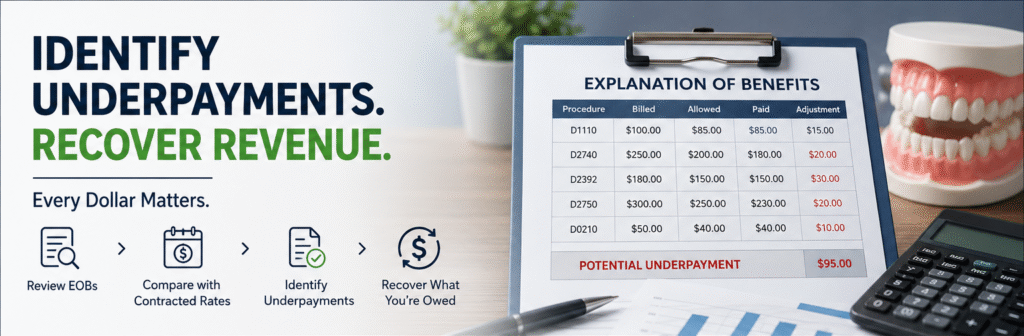
What an Underpayment Actually Looks Like on an EOB
An underpayment rarely announces itself. It shows up as a few dollars less than expected, with a reason code attached that looks routine enough to skip past. A payment coded as a standard contractual adjustment can be exactly that, or it can be a downcoded procedure quietly paid at a lower rate than what was actually performed and billed, a composite filling reimbursed at an amalgam rate, or a more involved crown procedure paid out as if it were a simpler one. Treating every adjustment reason code as self-explanatory, without checking it against the actual CDT code billed, is one of the most common ways underpayments get waved through without anyone noticing.
Signals Worth Watching For
Unexplained adjustments showing up repeatedly on EOBs. A one-off adjustment might be nothing. A pattern of them, especially from the same payer, is worth a closer look.
One specific insurer consistently paying less than expected. If a particular payer’s payments run lower than your fee schedule suggests they should, that’s rarely a coincidence. It usually points to either a contract misalignment or a processing issue on that payer’s end that keeps repeating.
Accounts receivable that stays high even when patient volume is steady. A growing AR balance despite a consistent schedule often means claims are being partially paid and never followed up on afterward, not that fewer patients are being seen.
No process that actually compares billed amounts to received payments. If reconciliation happens, but nobody’s specifically checking the payment amount against the fee schedule, underpayments will keep passing through undetected no matter how thorough the reconciliation otherwise is.
How to Actually Identify an Underpayment
The mechanics here aren’t complicated, they’re just easy to skip when a billing team is already stretched. Pull your contracted fee schedule for a specific payer, then compare the allowed amount on a handful of recent EOBs against the negotiated rate for each CDT code billed. Anything where the EOB allowable falls below the contracted rate is a candidate for appeal. This is worth doing payer by payer, since fee schedules and their update cycles differ from one insurer to the next, a rate comparison that’s accurate for one payer tells you nothing about another.
It’s also worth being honest about where this doesn’t apply. A Medicaid claim paid well below your standard fee isn’t automatically an underpayment, state Medicaid programs set their own reimbursement rates, often significantly below commercial insurance and below your own fee schedule, and that’s simply the contracted rate for that program. The real underpayment question for a Medicaid claim is whether the payment matches what the state’s own published schedule says it should, not whether it matches your general fee schedule.
Recovering an Underpayment Once It’s Found
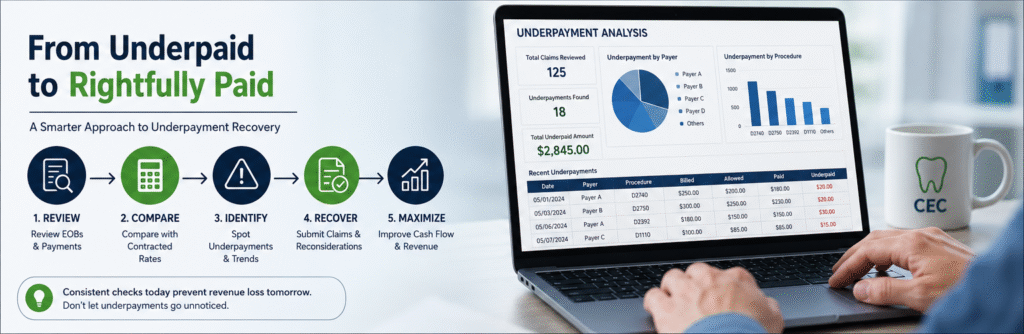
- Confirm the underpayment against the specific contracted fee schedule for that payer before reaching out, so the appeal cites an exact dollar figure and code, not a general complaint.
- Pull the original claim, the EOB showing the short payment, and the relevant fee schedule page as documentation.
- Submit through the payer’s specific reconsideration or corrected claim process. Many payers handle underpayment corrections through a different channel than a standard appeal, and using the wrong one just adds delay.
- Track the payer’s specific timeline for reconsideration requests. These windows close, and once they do, that specific recovery opportunity is generally gone for good.
- Log the outcome by payer and procedure code. A payer that underpays the same code repeatedly is a pattern worth escalating on its own, not re-discovering from scratch every time it happens.
Why Speed Matters More Than It Seems
An underpayment caught the week it happens is a quick fix: pull the fee schedule, confirm the gap, submit a correction. An underpayment discovered eight months later, buried in an aging report, is a much harder recovery, the appeal window may already be closed, the documentation is harder to reconstruct, and staff turnover means the person untangling it wasn’t the person who originally posted the payment. The gap between “recoverable” and “gone” is usually just how quickly someone looked.
Underpayments Are Not Denials, and Treating Them the Same Way Loses Money
It’s worth being precise about this distinction, because the two get billed and tracked completely differently. A denial is a claim the payer refused to pay and flagged as such, it shows up on a denial report and typically triggers a defined appeal process. An underpayment is a claim the payer did pay, just for less than the contracted amount, and it often never touches a denial workflow at all because nothing about it was technically rejected. A practice with a strong denial management process can still be losing real money to underpayments simply because they were never built into the same follow-up system.
How CEC Helps With Underpayment Recovery
Underpayment recovery genuinely benefits from the same infrastructure most practices already have in place for denials, defined follow-up timelines, documentation discipline, and someone actually tracking outcomes by payer. CEC’s Denial Management and Credentialing service extends that exact discipline to underpayments specifically, treating a short payment with the same structured follow-up as a denied one, rather than letting it disappear simply because it was technically paid.
This connects directly to the broader Accounts Receivable (A/R) Management Services CEC provides as well, since an uncaught underpayment is, at its core, an A/R accuracy problem: revenue the practice is contractually owed that isn’t reflected correctly in what’s actually been collected. Comparing posted payments against fee schedules on a recurring basis, rather than only when something looks obviously wrong, is what catches these before they age past the point of recovery.
Get a Free Underpayment Recovery Audit
Find out how much of your paid revenue was actually paid correctly. Our experts will compare your recent EOBs against your contracted fee schedules, payer by payer, and flag every underpayment worth appealing before the recovery window closes.
Get a Free Underpayment Recovery Audit →The Bottom Line
A paid claim isn’t automatically a correctly paid claim, and the only way to know the difference is to actually check. Building a habit of comparing EOBs against your fee schedule, payer by payer, catches revenue that’s already legitimately earned and currently just sitting unclaimed. Contact CEC if it’s been a while since your posted payments were checked against your actual contracted rates.
FAQs
What’s the real difference between a denied claim and an underpaid claim?
A denied claim is one the payer refused to pay outright and flagged as such, which usually triggers a defined appeal process. An underpaid claim was paid, just for less than the contracted rate, and because it’s marked “paid” rather than “denied,” it typically doesn’t get the same automatic review unless someone specifically compares it against the fee schedule.
How common are dental claim underpayments, really?
Exact figures vary by practice and payer mix and should be checked against your own claims data rather than assumed. What’s consistent is that underpayments tend to be individually small, a few dollars per claim, which is exactly why they’re easy to overlook one at a time and meaningful once added up across a full patient panel over a year.
Is a low Medicaid payment the same thing as an underpayment?
Not necessarily. State Medicaid programs set their own reimbursement rates, which are typically well below commercial insurance and below a practice’s standard fee schedule. That’s the contracted rate for that program, not an underpayment. A genuine Medicaid underpayment is when the payment falls below the state’s own published fee schedule, not below your general office fee.
How far back can a dental practice recover an underpayment?
This depends entirely on the specific payer’s reconsideration or appeal window, which can range from a few months to well over a year depending on the plan. Because these windows close permanently once missed, it’s worth checking the specific payer’s timeline as soon as an underpayment is identified rather than batching the review for later.
Can downcoding cause an underpayment even without a denial?
Yes, and this is one of the easier types to miss. If a payer processes a claim as a lower-complexity procedure than what was actually performed and billed, the payment can come through looking routine, with no denial code attached, while still being meaningfully less than the correct contracted amount. Comparing the EOB’s paid procedure code against the original CDT code billed is the only reliable way to catch this.