If your dental practice is doing great in terms of services and patients, but struggling financially, then there is a problem with your revenue cycle. Several challenges, such as claim denials, payment delays, and increasing administrative tasks, if left unaddressed, often disrupt cash flow, leading to revenue cycle inefficiencies and limited growth.
To address this issue, several practitioners are turning to dental RCM services to achieve financial stability with an improved revenue cycle process. In fact, 62% of dental practices now partially or fully outsource their revenue cycle processes with a reliable dental RCM company. Within a short period, they see improvement in first-pass claim acceptance rates and net collection ratios.
But before making a switch, most practitioners ask the obvious question: How much do they actually need to pay for dental RCM services in 2026? Well, this guide is actually going to break down everything you need to know about the average pricing to ROI for dental RCM services.
What Are Dental Revenue Cycle Management (RCM) Services?
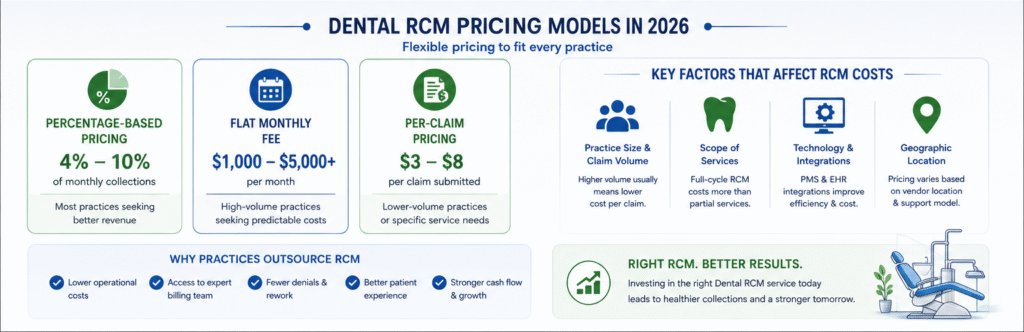
Dental RCM (Revenue Cycle Management) refers to the end-to-end process to manage the financial lifecycle of a dental practice. The process begins from the moment a patient schedules an appointment to the moment the final payment clears. A full-service dental RCM services provider handles the following functions:
• Patient scheduling and pre-registration data collection
• Insurance eligibility verification and benefits breakdown
• CDT coding and documentation review
• Claim submission and clearinghouse processing
• Payment posting and reconciliation
• Accounts receivable follow-up and denial management
• Patient statement processing and balance collection
• Reporting and performance analytics
The type of services varies by vendor. Some offer full-cycle management; others focus on specific functions such as billing and AR management.
Who Needs Dental RCM Services?
Dental RCM outsourcing does not limit itself to large practices. You might need the services if you belong to one of the following facilities:
Small and Mid-Sized Dental Practices
Solo practitioners and small group practices often carry the highest administrative burden relative to their team size. A dental RCM company gives these practices access to dedicated billing expertise.
Multi-Speciality Clinics
Multi-speciality clinics that offer general dentistry with orthodontics, endodontics, periodontics, or oral surgery face challenges in billing. A specialist dental RCM services provider with multi-speciality experience manages these challenges better than a generalist in-house team.
High-Volume Dental Offices
Practices processing 30 or more appointments per day have to claim volumes that are difficult to manage at the in-house level. In such practices, outsourcing dental RCM services reduces the risk in billing operations and gaps caused by staff turnover.
Average Cost of Dental RCM Services in 2026
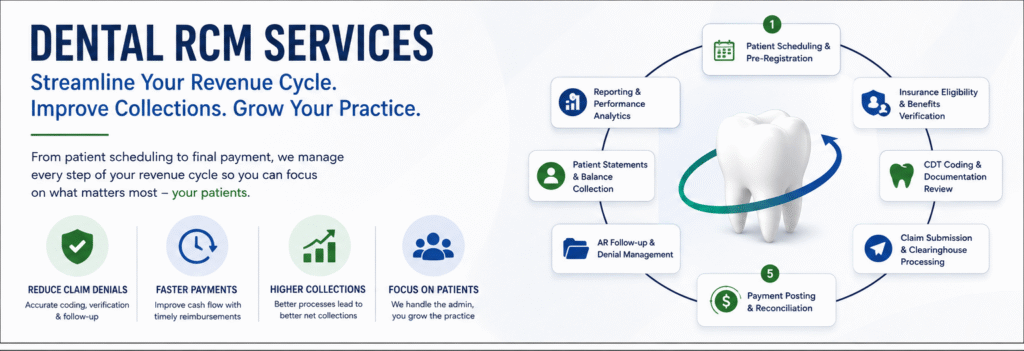
The price for dental RCM varies by model, type of service, and practice. Always compare total cost against the full cost of in-house billing, not just the vendor fee.
Here’s a quick overview to help you out:
| Pricing Model | Typical Range | Best Suited For |
|---|---|---|
| Percentage-Based Pricing | 4%–10% of monthly collections | Most practices that seek better revenue |
| Flat Monthly Fee | $1,000–$5,000+ per month | High-volume practices seeking affordable service |
| Per-Claim Pricing | $3–$8 per claim submitted | Lower-volume practices seeking to outsource one or two functions |
Percentage-Based Pricing (4%–10%)
The dental RCM company charges a percentage of what the practice actually collects, not what it bills. For example, if your practice is collecting $100,000 per month, then the price for RCM will be $4,000–$10,000.
Flat Monthly Pricing
The practice has to pay a fixed monthly fee for the agreed services, no matter how much it collects for the month. It works well for practices with stable, high claim volumes.
Per-Claim Pricing Model
The company charges a per-claim fee for each claim submitted. This model is most common when a practice outsources dental insurance verification for a single billing function and not a full-cycle RCM. It provides flexibility for practices with different claim volumes.
Key Factors That Affect Dental RCM Costs
No two dental practices have the same revenue cycle requirements. Here are some factors that affect the costs:
Practice Size and Patient Volume
The number of patients you see every day and the size of the practice have a direct impact on the overall dental RCM cost. Since a large practice processes more claims, it pays high total fees. However, mostly the dental RCM service providers offer improved pricing structures to high-volume practices, this benefits them to achieve low percentage rates.
Claim Complexity and Specialities
The type of dental services your provide also affects how much you will have to spend for dental RCM services. If you offer multi-speciality practices or specisalized treatments, then your team must be managing detailed documentation, coding requirements, and accruate verification. Such added efforts increase the overall cost of the RCM services.
Denial Rates and AR Backlog
If your practice experiences frequent claim denials or delays in the payments, then the dental RCM services provider will have to work extensively on identifying the root cause of delays and denials, claim resubmissions, and recovering the unpaid revenue. This can lead to additional charges for cleanups and revenue recovery efforts.
Software and Integration Requirements
For your dental practices if you need advanced integrations and modern EHR platforms, then your dental RCM company will have to configure, customize, and maintain these systems according to your services. Such technical requirements usually increase the pricing plan for your dental RCM services.
Hidden Costs in Dental RCM Services You Should Know
The quoted service fee is not always the total cost. Some vendors include additional charges that are easy to miss in a proposal. Here’s what you need to know about the hidden costs to avoid last-minute surprises before signing a contract.
Setup and Onboarding Fees
Some vendors charge a one-time setup fee to cover account configuration, software integration, staff training, and workflow mapping.
Clearinghouse Charges
Claim submission through a clearinghouse typically carries a per-transaction fee. Some vendors include clearinghouse costs in their service fee; others pass them through as a separate item.
Software Licensing Costs
Some vendors require the practice to purchase or upgrade to a specific practice management platform. Verify the exact software used by the vendor to handle your account and the additional charges for the platform.
ROI of Outsourcing Dental RCM Services
You can evaluate ROI from dental RCM outsourcing through certain metrics in the revenue cycle. Here is what you need to watch for before considering any vendor’s offer.
Faster Reimbursements
Clean claims submitted within 24 to 48 hours of service, combined with same-day clearinghouse rejection resolution, reduce the time between service delivery and payment receipt. Practices working with a quality dental RCM services provider can reduce their average payment cycle within the first quarter.
Reduced Accounts Receivable Days
AR days (the average number of days between service delivery and payment) decide the health of the revenue cycle. Dental RCM offers structured AR management workflows and defined follow-up SLAs to improve AR days compared to the in-house team.
Higher Clean Claim Rates
The first-pass clean claim rate is the percentage of claims accepted by the payer without rejection or denial. It directly determines how much rework your billing operation carries. A dental RCM company can achieve 95%+ first-pass rates. It reduces rework costs and speeds up the payment cycle for the entire practice.
How to Choose a Cost-Effective Dental RCM Partner
Look out for these three criteria before choosing your dental RCM partner:
Transparent Pricing Structure
The dental RCM services provider should be willing to provide a clear, written breakdown of all fees, including setup costs, clearinghouse charges, and any performance-based components.
Proven Industry Experience
Ask specifically about dental billing experience, not general medical or healthcare RCM. CDT coding, dental payer contracts, and ADA documentation standards are different from medical billing.
Reporting and Performance Metrics
A quality dental RCM partner provides regular reporting on AR ageing, first-pass acceptance rates, denial volumes, and net collection ratio.
How CEC Delivers Cost-Effective RCM Solutions
CEC provides full-cycle dental RCM with transparent pricing. Here’s how we stand out:
- Accurate dental insurance verification before the appointment.
- Real-time tracking for claim submissions that reduces the denial rate, improves the denial rate, and offers a transparent billing process.
- Follow-ups on outstanding claims every 7 days to ensure continuous cash flow in the A/R management process.
- Efficient payment posting and denial management to detect resubmissions, lost revenue, and maintain financial integrity.
- End-to-end credentialing support to reduce administrative delays and maintain compliance.
Get a Free RCM Pricing Proposal
Find out exactly what dental RCM outsourcing would cost for your practice, and what it could recover. Our experts will review your claim volume, denial rates, and payer mix, then give you a transparent, no-surprise pricing breakdown.
Calculate Dental RCM Cost For Free →Conclusion
The cost of dental RCM services in 2026 for a practice varies based on several factors, including the size, complexity and more. But the more relevant number you need to focus on is the net financial ratio. Make sure to account for reduced denials, faster reimbursements, and recovered AR, where the in-house team often struggles. A qualified dental RCM services provider pays your practice within the first quarter through profitable revenue cycle improvements.
Are you ready to outsource your dental RCM? Connect with CEC today to discuss your practice’s revenue cycle needs. Our team provides you with a transparent, detailed pricing proposal with the value in outcomes, not just effort.
FAQs
Q1. How much do dental RCM services cost on average?
Dental RCM services typically cost between 4% and 10% of monthly collections under a percentage-based model. Flat monthly pricing and per-claim models are also available. They may be more cost-effective for some practices.
Q2. Is outsourcing dental RCM more cost-effective than in-house billing?
Yes. The full cost of in-house billing, including salary, benefits, training, software, and recruitment, could be higher. But the outsourcing to a dental RCM company is typically lower in total cost.
Q3. What should I look for in a dental RCM services provider?
Before choosing a dental RCM services provider, look out for
- transparent pricing (no hidden fees)
- dedicated dental billing expertise
- proven performance metrics
- real-time reporting dashboards