Dental billing in 2026 is being shaped by four things: more claim denials, a big CDT code update, a wave of new state insurance laws, and patients picking up more of the bill themselves. None of it is really about technology, even though that’s where most of the coverage lands.
Everyone’s talking about AI and automation this year. Fair enough, it’s part of the picture. But it’s not what’s actually driving the changes underneath. That’s coming from payer policy, coding, and state legislation, and a lot of practices are still catching up.
Key Takeaways
- Claim denials rose 78% in 2026. The driver is stricter payer interpretation of medical necessity rules, not billing mistakes
- CDT-26 added 31 new codes, revised 14, and deleted 6. Some payers are slower to adopt them than others
- States are passing new dental insurance laws on loss ratios, downcoding, and retroactive denials
- 31% of billing professionals say rising patient out-of-pocket costs are their top concern for 2026
- Automation adoption is real, 58% of practices, but solo practices and DSOs are putting money into different tools for different reasons
What Are the Biggest Dental Billing Trends in 2026?

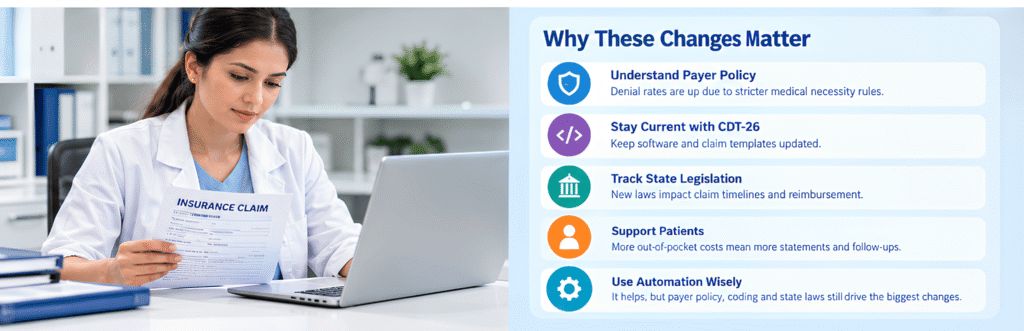
Four things: claim denials, coding changes, state regulation, and patients paying more themselves. Each one is hitting a different part of the billing workflow, and they don’t stay in their own lane. Take a denial caused by a payer reading medical necessity more strictly. Now it also depends on whether the claim used the right CDT-26 code, and whether the patient’s state has a new downcoding rule that applies. Practices still handling these as four separate problems are already behind.
Working with an experienced dental billing services partner tends to help here, mostly because tracking payer policy, coding, and state law all at once isn’t a part-time job anymore.
Why Are Dental Claim Denials Increasing in 2026?
Denials are up sharply this year. The reason isn’t what most people assume.
What the Data Shows
Zentist surveyed more than 160 dental revenue cycle and billing professionals for its 2026 report, and 78% said denials or payer scrutiny had increased over the past year. 71% named insurance verification as their biggest daily headache. And yet 63% of practices are still hitting net collection rates above 90%, which researchers are calling the “efficiency paradox,” good numbers propped up by a lot of manual effort that can’t really scale.
Is It Billing Errors or Payer Policy?
Turns out it’s mostly not staff mistakes. It’s payers reading medical necessity and frequency rules differently than they did a year ago. Same rules on paper, stricter application in practice. That means more documentation, more time spent building a case for something that used to be straightforward. Dental claim denial trends like this one are worth watching closely, because the fix isn’t cleaner claims, it’s understanding what changed on the payer’s side.
What This Means for Appeals
Here’s the part most practices miss: almost nobody appeals. Fewer than 1% of denied in-network claims get contested industry-wide. Yet appeals win more often than people expect, in at least one state, the overturn rate climbed from 38% in 2019 to nearly 53% in 2025, and for dental claims specifically, over half of appeals succeeded. That gap, between how rarely people appeal and how often it works, is probably the single biggest missed opportunity in billing right now.
What Changed in CDT 2026 Codes?
CDT 2026 code changes landed January 1: 31 new codes, 14 revisions, 6 deletions, 9 editorial tweaks.
| Change Type | Count | Practice Impact |
| New codes added | 31 | New documentation options for procedures previously billed generically |
| Codes revised | 14 | Includes restorative and anesthesia-related updates |
| Codes deleted | 6 | Needs removing from claim templates and front-desk shortcuts |
| Editorial actions | 9 | Clarifies existing code language and usage |
Why Some Payers Are Slower to Adopt Them
Not every payer moves at the same speed. Some update their claim logic and portals fast, others lag, especially right after January. So a code that’s technically valid under CDT-26 can still get denied or downgraded depending on which plan you’re billing. Correct code, wrong timing, still a problem.
Codes Practices Should Watch Closely
A few payers rolled their own coverage changes into the CDT-26 update, particularly around perio evaluation, debridement, and ridge preservation grafting. Worth double-checking payer-specific rules on these rather than assuming the code alone guarantees payment. Getting ahead of it starts with tightening up dental insurance billing and verification before claims go out, since catching a coverage gap early is a lot cheaper than reworking a denial later.
What New Dental Insurance Laws Are States Passing in 2026?
This is probably the least-talked-about dental insurance regulation 2026 trend, and it deserves more attention than it’s getting.
Dental Loss Ratio Legislation
The American Dental Association tracked ten states considering dental loss ratio legislation this year. In plain terms: laws requiring insurers to disclose how much of every premium dollar actually goes to patient care.
Downcoding and Retroactive Denial Restrictions
States also looked at downcoding, retroactive denials, virtual credit card payment practices, network leasing, and assignment of benefits. All of it affects how and when a practice actually gets paid, separately from anything happening at the coding or payer level.
What Mississippi’s Law Means for Other States
Mississippi passed a law this year requiring dental insurers to report what share of premiums goes toward patient care. Given how many other states considered similar bills in the same session, it’s a reasonable bet more will follow before 2027.
Why Are Patients Paying More Out of Pocket for Dental Care?
Patients are covering more of the bill, and billing teams are the ones dealing with the fallout.
What’s Driving the Shift
31% of the professionals Zentist surveyed said rising patient out-of-pocket costs were the single biggest concern heading into 2026, the top answer in the whole survey.
How It Changes Billing and Collections
When insurance covers less, the billing process doesn’t stop at claim submission anymore. It stretches into statements, payment plans, collections, all the stuff that used to be simpler when insurance picked up most of the tab. This tends to show up hardest near year-end, when patients rush to use whatever benefits are left before their annual maximum resets. Patient billing is turning into its own workflow now, not just a follow-up to insurance billing.
Is Dental Billing Automation Actually Working in 2026?
Yes, but not the same way for everyone.
How Solo Practices Are Using It
Smaller and solo practices are leaning into patient payment tools first, anything that helps lock in cash flow as patients take on more of the cost. Less interested in the bigger automation stack.
How DSOs Are Using It Differently
DSOs are going the other direction, building out automation across multiple locations at once. That often means rethinking dental revenue cycle management around centralized eligibility checks and payment posting instead of handling each location separately. Overall, 58% of practices have adopted or plan to adopt AI and automation this year, mostly aimed at the highest-volume repetitive work: eligibility checks and payment posting.
What Dental Billing Trends Should Practices Watch in 2027?
Legislative Momentum Likely to Continue
Given how much state activity happened in 2026, expect loss ratio laws, downcoding rules, and retroactive denial limits to keep spreading into more states through 2027. Multi-state practices should brace for an increasingly patchwork regulatory picture rather than one national standard. Staying on top of dental billing compliance 2026 requirements now is really just getting a head start on 2027.
The Next CDT Code Cycle
CDT updates come out every year, and 2027 will bring another round of additions, revisions, and deletions, same carrier-adoption lag we just saw with CDT-26. Practices that wait until January to check what changed tend to eat the same denial spike every single year. Building the habit of checking early is worth more than reacting after the fact.
How CEC Computech Helps
- Claim scrubbing that factors in CDT-26 changes and payer-specific coverage rules, not just whether the code is technically valid
- Real-time eligibility verification built into intake, tackling the challenge 71% of billing professionals named as their biggest one
- Denial management handled by billers who actually track appeal deadlines and payer-specific success patterns, not just software flagging a rejection
- Ongoing tracking of state insurance law changes that affect claim timelines and reimbursement
- Patient billing support designed for a world where patients are paying more, with clear statements and payment plan setup
Conclusion
Automation isn’t what’s reshaping dental billing in 2026. It’s stricter payer policy, a major CDT code update, a wave of state legislation, and patients carrying more of the cost. Practices treating these as one connected shift, instead of four unrelated problems, are the ones staying ahead of the denial curve going into 2027. A reliable dental billing company in USA makes it a lot easier to keep up with all four without adding headcount every time a rule or code changes.
Stay Ahead of the 2026 Denial Curve
CDT-26 changes, stricter payer policy, and new state laws are hitting practices from every direction at once. Let CEC show you how real-time verification, updated claim scrubbing, and structured denial follow-up can cover all of it without adding headcount.
Talk to CEC →FAQ
Why are dental insurance claims getting denied more often in 2026? Mostly because payers are reading medical necessity and frequency rules more strictly, not because of billing mistakes. Claims that would’ve sailed through a year ago now need extra documentation, or get denied outright under the same coverage terms. That’s why verification and documentation matter more this year than they used to.
Do I need to update my practice management software for CDT-26? Yes. Six codes got deleted and fourteen revised, so any claim template still referencing an old code is a denial waiting to happen. Most systems need a manual update to pull deleted codes and add the new ones, it doesn’t just happen on its own when the year turns over.
How do new state insurance laws affect my practice if I only operate in one state? Worth tracking anyway. Rules on downcoding, retroactive denials, and loss ratio reporting shape how payers are allowed to handle your claims, even in a single state. If your state hasn’t passed anything yet, the pace of activity elsewhere in 2026 suggests it might be next, and getting ahead of it beats scrambling later.
Should I appeal every denied dental claim, or only certain ones? Not every one, but probably more than you’re currently appealing. Dental claims specifically have a better-than-expected overturn rate, so a denial tied to medical necessity or frequency limitations is usually worth a second look, especially on higher-value procedures, rather than writing it off automatically.
Is it worth switching to outsourced dental billing because of these 2026 changes? Depends on whether your team has room to track CDT updates, payer policy shifts, and state legislation on top of the daily claims grind. Practices already stretched thin on verification and denial follow-up usually see the quickest payoff from outsourcing, since the value is in staying on top of things consistently, not just getting claims out the door.
How can a small dental practice keep up with all these billing changes without hiring more staff? It’s less about headcount, more about what you focus on first. Real-time eligibility verification alone knocks out the biggest source of preventable denials. Pair that with a habit of checking CDT and payer updates as they come, and you’ve covered most of what’s actually changing in 2026 without adding a single new hire.