
A small group of CDT codes causes most of the denials in a typical practice. Same codes, same payers, same reasons, month after month. What makes them hard to fix is the wording on the EOB. “Procedure not covered under this plan” or “inclusive of another service” tells you the claim failed but not what went wrong or whether it’s worth appealing.
This guide covers the codes that get denied most often in dental billing, what each denial reason actually means in practice, which ones are worth appealing, and how to keep them from happening in the first place.
Why Some Dental Codes Get Denied More Than Others
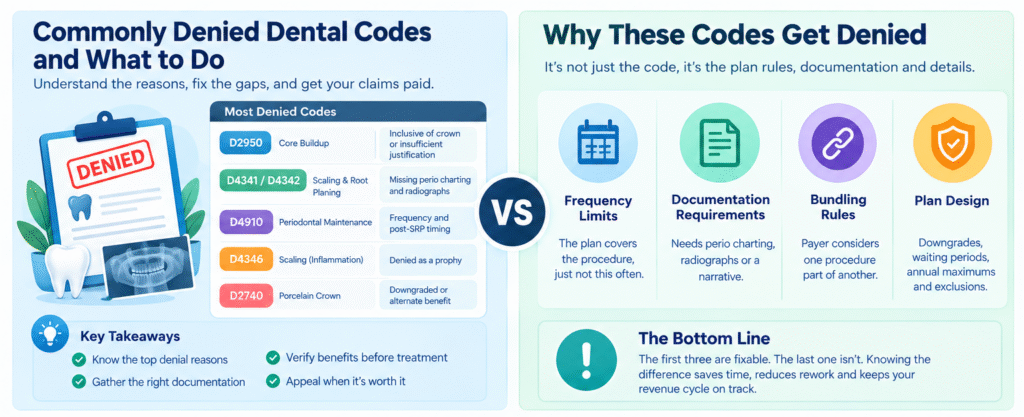
Denials cluster around codes with conditions attached. Look at the list later in this post and you’ll notice none of them are simple procedures. They’re the ones where the payer has to decide whether the plan rules were met.
Four things drive almost all of it:
- Frequency limits. The plan covers the procedure, just not this often.
- Documentation requirements. The code needs perio charting, a radiograph, or a narrative that explains why the procedure was necessary.
- Bundling rules. The payer considers one procedure part of another and pays for only one.
- Plan design. Downgrades, waiting periods, annual maximums, and exclusions such as missing tooth clauses. These aren’t errors, they’re how the plan was written, and the only way to see them coming is dental insurance verification that pulls full benefit details before treatment.
The first three are usually fixable on your end. The fourth one isn’t, and knowing the difference saves your team hours of pointless appeals.
The Most Denied Dental Codes in Dental Billing
D2950 Core Buildup: Denied as Inclusive of the Crown
A core buildup rebuilds enough tooth structure to hold a crown. It’s probably the single most disputed code in dentistry.
Payers deny it because they consider buildups part of crown preparation rather than a separate procedure. Some plans exclude buildups entirely. Others pay only when enough tooth structure is missing that the crown couldn’t be retained without it, which is a clinical judgment they want evidence for.
What to do: submit a pre-op radiograph showing the missing structure, plus a narrative describing what remained and why retention required a buildup. Never bill a buildup that was really just a base or liner under the restoration, since that’s the pattern payers audit for.
D4341 and D4342 Scaling and Root Planing: Denied for Missing Perio Charting
D4341 covers four or more teeth in a quadrant, D4342 covers one to three. The denial almost always traces back to documentation rather than the code choice itself.
Payers want perio charting with pocket depths, radiographs showing bone loss, and a diagnosis that supports active periodontal disease. If the charting shows mostly threes and fours, expect a denial or a downgrade to a prophy. Most plans also limit SRP per quadrant to once every 24 or 36 months.
What to do: attach the full perio chart and current radiographs every time. Check the tooth count in each quadrant before choosing between the two codes, since billing D4341 for three teeth is an easy and avoidable denial.
D4910 Periodontal Maintenance: Denied on Frequency and Post-SRP Timing
Periodontal maintenance follows active periodontal therapy. That history is what payers check first.
Two common denials here. The first is no record of SRP or periodontal surgery on file with that payer, which happens constantly when the patient had their SRP under a previous plan or at a previous office. The second is frequency, since many plans cover maintenance twice a year even though the clinical recommendation is often three or four times. Some plans also require a waiting period after SRP before maintenance becomes billable, and some downgrade D4910 to a prophy fee.
What to do: when a new patient has perio history elsewhere, get documentation of the prior therapy before the first maintenance claim goes out. Confirm how many visits the plan allows per year and what the patient owes beyond that, and have that conversation before treatment rather than after the denial.
D4346 Scaling in the Presence of Inflammation: Denied as a Prophy
This code covers generalized moderate to severe gingival inflammation without bone loss, so it sits between a prophy and SRP. That in-between position is exactly why it gets denied.
Payers frequently process it as a prophy and pay the lower fee, especially when the documentation doesn’t establish generalized inflammation. It also can’t be billed on the same day as a prophy, since they cover overlapping work.
What to do: document the extent of inflammation across the mouth, including bleeding points and a gingival index if your team records one, plus intraoral photos where you have them. Without evidence of a generalized condition, this code reads to the payer like a cleaning with extra words.
D2740 Porcelain Crown: Denied, Downgraded, or Alternate Benefited
Crowns rarely get denied outright. They get reduced, which is harder to notice.
Many plans apply an alternate benefit on posterior teeth and pay at the metal crown rate, leaving the difference as patient responsibility. Others have crown frequency limits, commonly once per tooth every five to seven years, or waiting periods for major services on newer enrollees. Payers also differ on whether to bill at prep date or seat date, and submitting on the wrong one delays payment.
What to do: verify crown frequency, waiting periods, and downgrade provisions before the prep appointment, and quote the patient accordingly. When the payment comes in short, check whether it’s a contractual adjustment or a patient balance before anyone touches the ledger. Accurate payment posting that reconciles every EOB is what keeps a reduced crown payment from being written off as though the payer paid in full.
D0150 Comprehensive Oral Evaluation: Denied on Frequency and Provider History
A comprehensive evaluation is for new patients or established patients who’ve had a significant change. Most plans allow it once per provider in a multi-year window, often three years.
The denial usually comes from billing it for a patient the practice already saw, or a patient who had a comprehensive exam at another office inside the window. Plans often pay it as a periodic exam instead, which is a smaller payment that many offices write off without noticing.
What to do: check evaluation history during verification, not just remaining benefits. If the patient had a comprehensive exam elsewhere recently, D0120 may be the correct code even if the visit feels comprehensive to your team.
D9110 Palliative Treatment: Denied When Billed With Other Procedures
Palliative treatment is emergency care for pain relief. It’s billed per visit, not per tooth, and that alone catches a lot of offices.
The frequent denial is billing it alongside definitive treatment on the same day. If you extracted the tooth or started the root canal, the payer sees the definitive procedure and denies the palliative code as included.
What to do: use it when the visit ended with pain relief only, and write a narrative that describes the problem, what was done, and why no definitive treatment happened that day.
D7210 Surgical Extraction: Denied as a Simple Extraction
The difference between D7140 and D7210 is technique, not difficulty. A surgical extraction involves raising a flap, removing bone, or sectioning the tooth.
When claims get downgraded to D7140, it’s almost always because the narrative didn’t say which of those things happened. Payers won’t assume it from the tooth number or the fee.
What to do: the operative note and the narrative need to state the specific surgical steps. “Difficult extraction” is not documentation. “Mucoperiosteal flap raised, buccal bone removed, tooth sectioned” is.
D6010 Implant Placement: Denied for Coverage or Sent to the Wrong Payer
Plenty of dental plans simply exclude implants, and no appeal changes an exclusion. Others cover them with an annual maximum that the surgical placement alone exhausts.
There’s also a routing problem. Some implant cases, particularly those tied to trauma or pathology, belong on the medical claim rather than the dental one, and the dental denial is the payer correctly saying this isn’t their benefit.
What to do: verify implant coverage and obtain pre-authorization before treatment, since this is one procedure where guessing gets expensive. Check whether a missing tooth clause applies to the replacement, and evaluate whether the case should be cross-coded to medical.
D2390 Resin-Based Composite Crown: Denied on Tooth Type and Documentation
This code covers a direct resin-based composite crown, most often used on primary teeth or as an interim restoration. Under CDT 2027, its descriptor was revised so it applies to any tooth rather than anterior teeth only.
Payers often process it as a multi-surface filling and pay the lower fee, or deny it when the documentation doesn’t distinguish it from a large restoration.
What to do: document why a full coronal restoration was needed rather than a filling, and check whether the payer has published a policy on this code, since adoption of the revised descriptor varies.
Common Reasons for Dental Claim Denials Explained
The code tells you where the problem is. The denial reason tells you what kind of problem it is, once you translate it.
Frequency Limitation Exceeded
The plan covers the procedure but not at this interval. Note that “twice per calendar year” and “once every six months” are different rules that produce different results for the same patient, and offices get caught by the second one constantly.
This isn’t appealable. It’s the plan working as written. The only real fix is catching the limit at verification, so the patient hears about their share before the appointment rather than in a statement afterwards.
Missing or Insufficient Documentation
The payer needs something you didn’t send, or sent something that didn’t support the code. Perio charts, radiographs, photos, and narratives all fall here.
This is the most appealable category, and the most winnable, because the fix is attaching what was missing.
Procedure Considered Inclusive of Another Service
Bundling. The payer treats the procedure as part of another one billed the same day and pays once. Buildups with crowns and palliative treatment with definitive care are the classic pairs.
Worth appealing when the procedures genuinely were separate and the documentation shows it. Not worth appealing when the payer’s policy bundles them as a rule.
Alternate Benefit Applied
The plan paid for a cheaper procedure it considers adequate. Posterior composites paid at amalgam rates, porcelain crowns paid at metal rates, D4910 paid at prophy rates.
This is a plan provision, not a mistake. The difference is usually billable to the patient depending on your contract, but only if they were told beforehand.
Not a Covered Benefit vs Denied
These look similar on an EOB and need opposite responses. A denial means the payer processed the claim and declined to pay based on how it was submitted, so it can often be corrected or appealed. Not a covered benefit means the procedure isn’t in the plan at all, so there is nothing to appeal and the balance moves to the patient.
Practices lose a lot of staff time appealing exclusions. Reading this distinction correctly is one of the fastest ways to cut wasted effort.
Which Dental Denials Are Worth Appealing
Appeal when the payer made a processing error, when documentation was missing and you have it, when bundling was applied to genuinely separate procedures, or when the claim carried wrong patient or plan details.
Don’t appeal plan design. Frequency limits, waiting periods, exclusions, annual maximums, and missing tooth clauses aren’t going to change because you wrote a letter. Those balances belong in a patient conversation.
A useful appeal includes the original claim, the EOB, the clinical documentation that supports the code, a short narrative referencing the payer’s own policy language where you can, and the date of service with the filing deadline in mind. Consistent denial management for dental practices also means tracking what each payer accepts, since an appeal that works with one carrier often fails with another.
How to Prevent These Denials Before the Claim Goes Out
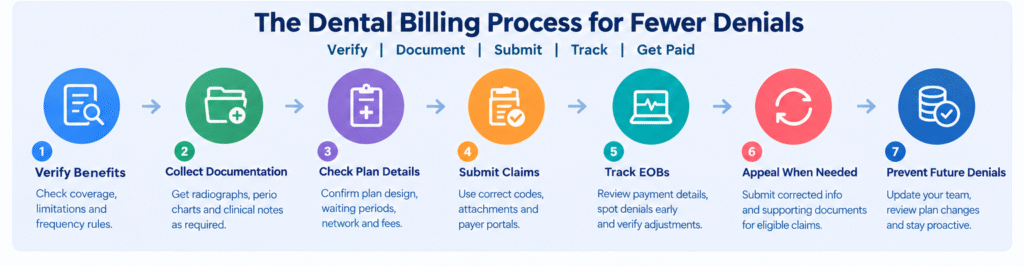
Most of this list is preventable at two points: verification and submission.
At verification, capture frequencies, waiting periods, downgrade provisions, and treatment history rather than just active coverage. For perio patients, confirm SRP history with that payer. For crowns and implants, confirm coverage and any pre-authorization requirement before scheduling.
At submission, attach what the code needs the first time. Build narrative templates for the codes on this list so the language doesn’t depend on who’s at the desk that day, and make the clinical team aware of what the narrative has to say, since billing can’t document surgical steps that were never charted.
Then track denials by reason and by payer. One denial is noise. The same denial reason three times from the same carrier is a process gap you can close. Denials that nobody works don’t disappear either, they age quietly into the 90 day bucket, which is why accounts receivable follow-up for dental practices has to run on a schedule rather than whenever the front desk finds a free hour.
When Denials Become a Dental Billing Problem, Not a Coding Problem
A handful of denials every month is normal. A pattern is different. When the same codes keep coming back unpaid, the issue usually isn’t code selection. It’s that nobody has time to work the denials, spot the pattern, and change what happens upstream.
That’s the point where practices start looking at outside help. CEC works these codes daily for practices across the country, which means its team sees payer patterns individually a practice would need months to notice. Its dental billing services cover verification, claim submission with the right attachments, denial follow-up, and appeals, and practices that outsource dental billing or move to full dental RCM services get denial tracking as part of the routine rather than a task that waits for a slow afternoon. You can see how CEC’s dental billing support for practices across the USA fits alongside your existing front desk.
Conclusion
The codes on this list get denied because they carry conditions: documentation the payer wants, frequencies the plan sets, and bundling rules that vary by carrier. Most of those denials are predictable, which means most are preventable. The practices that collect well aren’t the ones that never get denied. They’re the ones that know which denials to fight, which to bill to the patient, and which to prevent at verification.
If the same denials keep landing in your aging report, contact CEC to talk about how its dental billing team can work them and stop the pattern.
Stop the Same Denials From Repeating
If D2950, D4341, D4910, or any other code on this list keeps landing in your aging report, let CEC’s billing team work the pattern. We’ll handle verification, the right documentation upfront, and appeals on the denials actually worth fighting.
Talk to CEC →Frequently Asked Questions
What is a normal dental claim denial rate?
There’s no official benchmark, but most billing teams treat anything under about 5% as healthy and anything above 10% as a sign of a process problem. What matters more than the rate is the mix. Denials concentrated in one code or one payer point to a specific fix, while denials spread evenly usually point to verification gaps.
How long do we have to appeal a denied dental claim?
It varies by payer and by state, and the window commonly runs somewhere between 90 and 180 days from the date on the EOB. Some payers allow a second-level appeal after the first is declined. Check each carrier’s published timeframe and track appeal deadlines separately from filing deadlines, since they’re different clocks.
Can we bill the patient for a denied dental claim?
It depends on why it was denied and on your contract with the payer. Non-covered services and amounts above an alternate benefit are usually billable. Amounts denied because the claim was submitted incorrectly, or contractual adjustments in your PPO agreement, generally are not. Read the participating provider agreement before billing a denied balance.
What’s the difference between a rejected and a denied dental claim?
A rejected claim never reached the payer’s adjudication system, usually stopped by the clearinghouse for a formatting or data error, so there’s no EOB and nothing to appeal. Fix it and resubmit. A denied claim was processed and declined, which produces an EOB and may be appealable. Rejections are easier to miss, so check clearinghouse reports daily.
Does resubmitting a denied claim restart the timely filing clock?
No. Timely filing runs from the date of service, not from when you resubmit. Some payers allow a separate window to correct or appeal after a denial, but the original filing deadline still governs the claim itself. Work denials quickly rather than letting them sit in a follow-up pile.