
A deposit lands in the bank. Everyone sees it. The claim it was meant for, though, might still be sitting open in your system, untouched, because the payment got applied somewhere else or nowhere at all. That gap between money received and money correctly recorded is where a surprising amount of dental accounts receivable quietly goes to hide.
What “Unmatched” Actually Means, and Why It’s Not the Same as Late
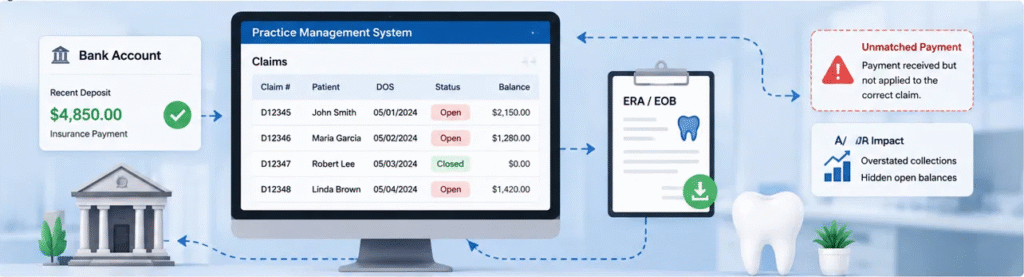
An unmatched payment isn’t a payment that hasn’t arrived. It’s a payment that has arrived and hasn’t been applied correctly to the wrong claim, the wrong patient, or the wrong procedure line. That distinction matters because a late payment is visible; it shows up on an aging report as something still owed. An unmatched payment can do the opposite: it can make a claim look resolved when it isn’t while quietly inflating a completely different account at the same time.
Duplicate payments and unapplied credits create exactly this kind of confusion, and without a solid reconciliation process, a practice can end up overstating its own collections without anyone noticing. The report says one thing. The reality is something else, and the two only get reconciled when someone specifically goes looking.
How This Actually Happens on a Normal Billing Day
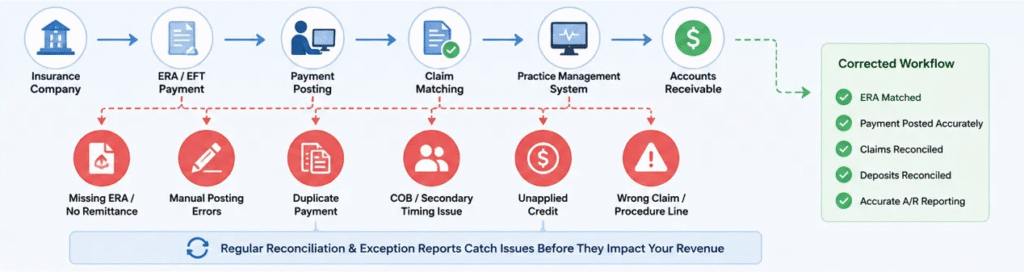
ERA files that don’t import cleanly. When an electronic remittance file fails to import correctly, staff often end up posting that payment manually instead, which is exactly where posting errors tend to creep in. A busy Tuesday with a stack of manual postings is a very different error rate than an automated import running clean.
Multi-procedure claims that get split incorrectly. When several procedures are billed under the same encounter, payers don’t always allocate the payment consistently across payer liability, patient responsibility, deductible, and coinsurance, and the leftover residual balances often sit on an account that otherwise looks closed. This is dental billing’s version of a very common problem in any specialty with bundled same-day procedures.
COB and secondary payment timing. When a secondary claim is processed on a different cycle than the primary, or a crossover payment lands before the corresponding primary EOB has been posted, the payment sometimes gets parked in the wrong place while staff wait for the rest of the picture to arrive. This is the direct downstream cousin of the coordination of benefits sequencing problem covered separately, get the primary/secondary call wrong at intake, and the payment that eventually comes back has a real chance of landing somewhere it shouldn’t.
A deposit with no matching remittance. When an insurance payment hits the bank account without a corresponding ERA on file, that claim is effectively stuck open until someone requests the missing remittance and closes the loop. Left alone, it just sits.
Why an Unmatched Payment Is More Dangerous Than a Denial
A denial gets flagged. Someone works it. An unmatched payment doesn’t announce itself, because on paper, money came in. Detailed remittance reconciliation is actually one of the few ways to catch payer underpayments that never triggered a denial code at all, hidden precisely because nothing about them looks wrong at a glance.
This is the mechanism that quietly separates a practice’s real financial picture from what its own reports show. Unapplied payments sitting in a practice management system are, by definition, revenue that hasn’t been matched to the account it belongs to, and tracking that unapplied balance regularly is one of the more overlooked ways to catch revenue before it ages out entirely.
What This Costs, With an Actual Number
It’s worth being concrete about scale here rather than vague. If a payer reimburses $80 for a procedure with a contracted rate of $95, that $15 difference stays lost unless someone specifically flags and appeals it. Now multiply that by every claim a mid-sized practice processes in a month. Individually, these are small enough to overlook. In aggregate, across a full patient panel, they add up to a genuinely material amount of revenue a practice has already earned but never actually collected.
Where the Silo Between Front Desk and Billing Makes This Worse
Front desk teams typically collect patient payments while billing teams manage insurance payments, and without coordination between the two, discrepancies slip through that neither side is positioned to catch alone. A patient payment posted without visibility into what the insurance side already applied, or vice versa, is exactly how the same balance ends up double-counted, or a legitimate payment ends up misclassified as an overpayment.
Catching Unmatched Payments Before They Compound
- Reconcile bank deposits against posted payments weekly, not monthly. This single habit, checked consistently, is what catches missing EFTs, posting errors, and unapplied funds while they’re still easy to trace back to their source.
- Cross-check ERA files against your practice management system’s claim numbers before batch posting, particularly after any software update or payer system change.
- Flag any deposit without a matching remittance for manual follow-up rather than letting it sit unresolved.
- Review multi-procedure claims separately, since split-payment allocation errors are one of the more common sources of residual balances on accounts that otherwise look closed.
- Run exception reports that highlight unusually large adjustments, repeated write-offs tied to the same payer, and underpayment patterns, since these are exactly the signals a routine reconciliation glance tends to miss.
How CEC Approaches Payment Posting and A/R Accuracy
This is where CEC’s Payment Posting Services and Accounts Receivable (A/R) Management Services work as two sides of the same problem rather than two separate offerings. Payment posting accuracy is what prevents a misapplied payment from happening in the first place, weekly deposit reconciliation, ERA cross-checking before batch posting, careful handling of split multi-procedure payments. A/R management is what catches it if it slips through anyway, identifying accounts where the reported balance doesn’t match the underlying claim history and tracing the discrepancy back to its source.
A meaningful share of what shows up looking like a stuck or stale A/R account traces back to a coordination of benefits sequencing issue at intake, which is exactly why CEC’s Dental Insurance Billing and Verification Solutions work upstream of this problem too, verifying coordination of benefits and eligibility before treatment, so fewer payments arrive with nowhere correct to land in the first place.
Get a Free Payment Reconciliation Check
Find out how much revenue is hiding behind unmatched or misapplied payments in your system. Our experts will reconcile your deposits against posted payments, trace the discrepancies back to their source, and help you recover what’s already been earned.
Get a Free Payment Reconciliation Check →The Bottom Line
The most dangerous accounts receivable problems aren’t the visible ones sitting openly on an aging report. They’re the ones hidden behind a payment that technically posted, just not to the right place. A weekly reconciliation habit and a genuine look at whether front desk and billing are actually talking to each other, catches most of this before it becomes a quarter’s worth of buried revenue. Contact CEC if it’s been a while since your deposits were checked against what’s actually posted.
FAQs
How can a dental practice tell if it has unmatched or misapplied payments?
Compare total bank deposits for insurance payments against total posted payments in the practice management system for the same period. A gap between the two, even a small one, usually means a payment exists that hasn’t been correctly applied yet. Most systems also have an unapplied payments or suspense report, worth checking directly rather than assuming it would surface on its own.
Can an unmatched payment cause a practice to write off money it’s actually owed?
Yes, and this is one of the more damaging versions of the problem. If a payment lands incorrectly on one claim, that claim looks paid while the correct claim still shows outstanding, and staff sometimes write off the correct claim as uncollectible without realizing the payment simply went to the wrong place. Reconciliation is the main defense against this specific outcome.
Why do ERA import failures cause so many posting problems?
When an electronic remittance file doesn’t import cleanly, the payment usually has to be posted manually instead, and manual posting carries a meaningfully higher error rate than automated posting, especially during high-volume days. A failed import isn’t just a technical hiccup, it’s the point where a clean, automated process becomes a manual one with more room for mistakes.
How often should a dental practice reconcile deposits against posted payments?
Weekly is the standard worth aiming for, rather than monthly. The longer a misapplied payment sits, the harder it becomes to trace back to the correct claim, since staff memory of a specific visit fades and overlapping payments from the same payer start to blur together.
Is an unmatched payment the same thing as an underpayment?
No, and it’s worth keeping the two separate. An unmatched payment is money that arrived but was applied incorrectly, the amount itself may be entirely correct. An underpayment is money that was paid correctly to the right claim, just for less than the contracted rate. Both quietly erode collections, but they need different fixes, one is a posting and reconciliation problem, the other is a fee schedule and appeals problem.