
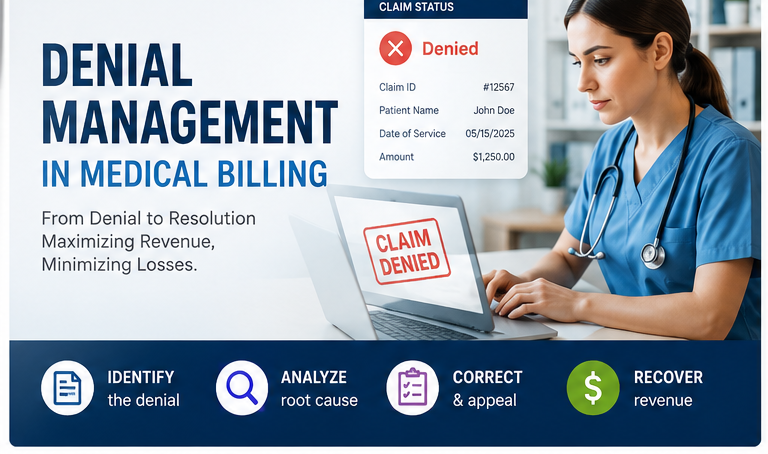
Claim denials remain one of the largest sources of preventable revenue loss in healthcare billing. Despite that, many practices still handle them reactively, correcting and resubmitting one claim at a time without asking why the denial happened in the first place. A claim reworked without understanding its root cause tends to come back denied again. A claim that misses its appeal window doesn’t get a second chance at all. Managing denials well takes more than persistence. It takes a defined sequence: catching the issue accurately, tracing it to its cause, choosing the correct path to resolution, and applying what’s learned so the same denial stops recurring.
Below is a breakdown of what the denial management process looks like from the point a claim is rejected to the point it’s either paid or closed out, along with where medical and dental practices most commonly lose ground in between.
What is Denial Management in Medical Billing?
Denial management in medical billing covers the work of figuring out why a claim was rejected, correcting whatever caused it, resubmitting or appealing it to the payer, and using that outcome to reduce future denials of the same kind. Practices frequently handle the first three steps and skip the fourth. That’s how the same three or four denial reasons keep showing up month after month without any real progress against them.
This also isn’t work that belongs to a single person. Front desk registration affects it. Coding affects it. Billing affects it. Occasionally the provider’s own documentation is the actual source of the problem, since a missing clinical note can trigger a denial just as easily as an incorrect billing code can.
Denial Management vs. Denial Prevention
The two terms get used as if they mean the same thing, and they don’t. Management happens after a claim has already been denied. Prevention happens before submission, through eligibility verification, accurate coding, and confirmed authorizations. Both matter. A practice that only manages denials after they happen, without investing in prevention, will always be working from behind.
What Counts as a Denial in Medical Billing?
A denial is a payer’s formal, documented refusal to pay a claim as submitted. It’s not the same as a rejection, which usually happens earlier, often at the clearinghouse level, before a payer ever reviews the claim’s substance. A denial means the payer looked at the claim and declined it for a specific reason, tied to a specific code.
Soft Denials and Hard Denials
Some denials are minor and some aren’t, and lumping them together slows everything down. A soft denial can typically be fixed and resubmitted without a formal appeal, a missing modifier, an incorrect date of birth, something in that range. A hard denial holds unless the practice files a proper appeal backed by documentation, and in certain cases the decision can’t be reversed at all, such as a service that genuinely wasn’t covered.
What Actually Causes Claims to Get Denied
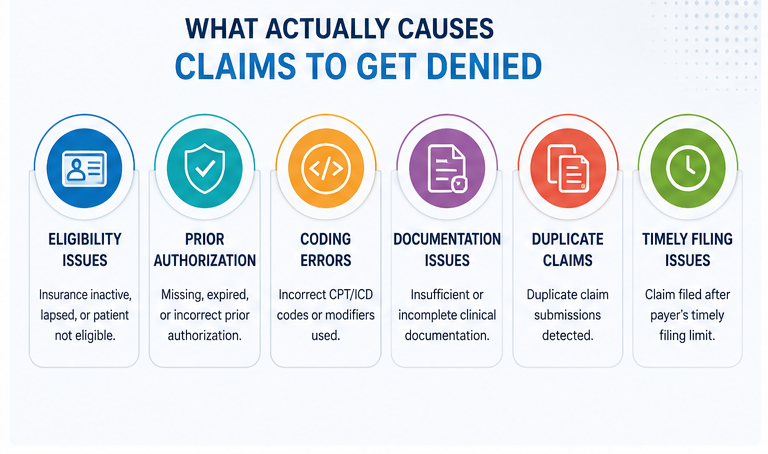
The exact reasons shift by payer and specialty, but a handful of categories account for most of them. Coverage that lapsed or changed before the visit. Prior authorization that was missing or incorrect. Coding that doesn’t line up with the documentation on file. Claims filed past a payer’s deadline. Duplicate submissions flagged during processing. None of these are unusual, and most trace back to something in the front-end workflow that could have been caught earlier.
The Denial Management Process, Step by Step
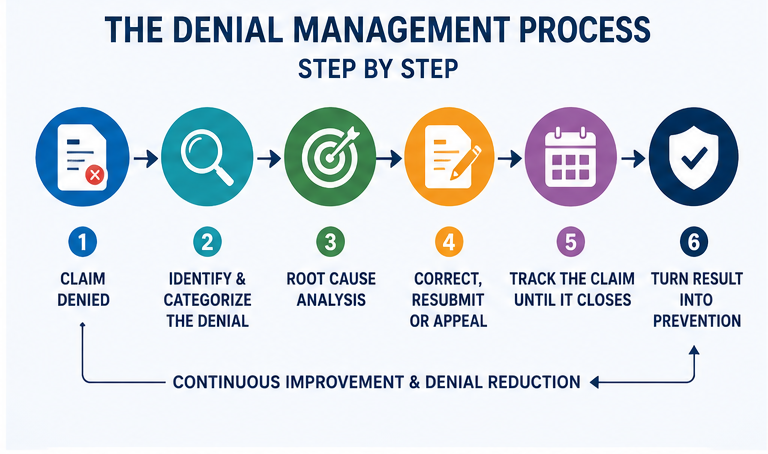
Step 1: Identifying and Categorizing the Denial
Every denial arrives with a reason code attached, and reading it correctly matters more than most billers give it credit for. Payers sort denials into groups, eligibility, authorization, coding, documentation, and sorting incoming denials the same way is what makes it possible to spot patterns later. Skip this step and a practice ends up reworking claims one by one forever, with no sense of whether the same problem keeps repeating.
Reading the Code Before Acting on It
A CO-16, missing information, needs a very different response than a CO-50, not medically necessary. Treating both the same way, correcting and resending without checking what the code actually says, wastes effort on claims that needed a documentation review or a conversation with the payer instead of a simple resubmission.
Step 2: Root Cause Analysis
Once a denial is sorted, the next question is why it happened. Was this a one-time data entry slip, or is a specific payer denying the same CPT code for the same reason for the fourth time this quarter? The answer changes everything downstream. A one-time error just gets corrected. A repeating pattern points to something structural, an outdated authorization workflow, a coding habit that’s slightly off, a documentation gap at the point of care, and until that gets addressed, the denial keeps coming back regardless of how quickly it’s resubmitted.
Step 3: Correcting, Resubmitting, or Appealing
This step splits depending on the type of denial involved.
Choosing Between Resubmission and Appeal
A soft denial usually just needs the error fixed, a corrected modifier, updated patient information, and a clean resubmission through the clearinghouse. A hard denial calls for a formal appeal: written justification, supporting clinical records, and occasionally a peer-to-peer discussion between the provider and the payer’s medical director. Treating a hard denial like a routine resubmission is a common misstep, and it almost never results in payment the second time either.
Step 4: Tracking the Claim Until It Closes
A denial that’s been corrected and resubmitted still needs to be tracked, because payers set firm windows for resubmission or appeal, sometimes as short as 30 days, occasionally stretching closer to 90. A claim sitting untouched past that window stops being a delay. It becomes a permanent loss. This is where a surprising amount of revenue disappears at smaller practices, not because the denial couldn’t have been won, but because nobody was watching the calendar.
Step 5: Turning the Result Into Prevention
The final step is what separates practices that actually improve from practices that stay busy forever. Every closed denial contains information. A payer consistently rejecting one particular code is telling the practice something about documentation requirements it hasn’t adjusted for yet. A front desk employee whose registrations generate more eligibility denials than average isn’t necessarily doing anything wrong, but it’s worth a conversation and maybe some retraining.
Reduce Claim Denials and Recover More Revenue
CEC helps medical and dental practices identify the root causes of claim denials, manage appeals, reduce recurring errors, and improve reimbursement with reliable denial management services.
CONTACT USWhy Denial Management in Healthcare Isn’t Only a Hospital Problem
Most material on this subject is written with hospital-scale denial volume in mind: dedicated denial teams, DRG specialists, physician advisors weighing in on clinical necessity disputes. A solo practice or a small dental office has none of that infrastructure, and doesn’t need a scaled-down version of it either. What it needs is consistency, someone actually sorting denials by category instead of reworking them blindly, and someone actually watching the appeal deadlines before they pass.
The dollar amount lost scales with practice size, but the impact on cash flow doesn’t shrink the same way. A smaller practice loses fewer total dollars to unworked denials than a hospital system would, but as a share of overall revenue, the damage can be worse, since there’s no scale to absorb it quietly. Denial management in healthcare deserves attention well outside hospital finance departments, arguably more urgently in smaller practices running on tighter margins.
Denial Management Services: Keeping It In-House or Bringing in Help
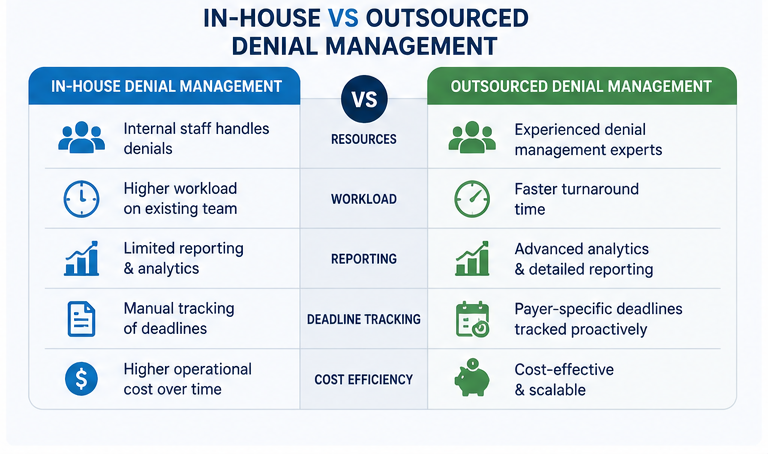
Some practices build this internally, usually a biller or two whose main job becomes following denials through to resolution. Others rely on outside denial management services, typically once claim volume grows past what an in-house team can realistically track.
Evaluating a Denial Management Partner
The gap between a strong partner and a weak one usually shows up in whether they’re running an actual system or just clearing a queue. Ask whether they categorize and investigate root causes instead of resubmitting on autopilot. Ask whether they track payer-specific appeal deadlines without being reminded. Ask whether they report on denial trends, not just how many claims got closed this month. A partner who can tell you which payer denied the most last quarter, and why, is doing something a queue-clearing service isn’t.
How CEC Handles Denial Management
CEC runs denial management for medical and dental practices as a continuous loop rather than a single task. Claims are categorized as they come in. Root causes get tracked by payer and by reason code. Appeals go out with the documentation they actually require. And whatever gets learned from a resolved denial feeds directly into how future claims are coded and submitted. For practices working with limited staff, that structure tends to bring down repeat denials within a few billing cycles, not just clear whatever’s currently sitting in the queue.
Final Thoughts
Denial management isn’t reducible to one action. Categorization, root cause work, choosing between resubmission and appeal, tracking deadlines, and applying what’s learned back to prevention, each step matters, and skipping any one of them tends to cost money somewhere down the line. Practices that run this as a complete cycle usually see their denial rate move over time, instead of staying occupied reworking the same handful of issues indefinitely.
CEC handles this process for the medical and dental practices we bill for, tracing each denial back to its cause rather than pushing out a quick correction and moving on. If your practice’s denial rate has been stuck in the same place for a while, our team can look at where the current process is breaking down.
FAQs
1. How long does the denial management process usually take from denial to resolution?
It depends on the payer and the type of denial involved. A soft denial with a quick fix might close within one billing cycle. A formal appeal on a hard denial can run 30 to 60 days or longer, depending on how fast supporting documentation comes together.
2. Can a claim be denied more than once for the same reason?
Yes, and it happens fairly often, usually when a resubmission or appeal doesn’t fully address what the original reason code was actually pointing to. That’s the argument for root cause analysis before resubmitting, not after.
3. What’s the difference between a claim rejection and a claim denial?
A rejection typically occurs before a claim reaches the payer’s review, often caught by a clearinghouse over a formatting or data error. A denial happens after the payer reviews the claim and formally declines payment for a documented, coded reason.
4. Is there a cap on how many times a claim can be appealed?
Most payers set a limited number of appeal levels, commonly two or three, before treating the decision as final. The specifics vary by payer, which is part of why tracking each payer’s individual policy matters.
5. Do small practices actually need a formal denial management process, or is that mainly a hospital concern?
Small practices need it arguably more. Without the claim volume to absorb losses, a handful of unworked denials can affect cash flow noticeably faster than it would inside a large health system.
6. Where does the front desk fit into denial management if billing is handling the claims themselves?
More than most people assume. A large share of denials trace back to registration, wrong patient information, a skipped eligibility check, an authorization that was never confirmed before the visit. Denial management works better when front desk staff understand how their part of the process shows up in claims later.