
Ophthalmology billing is one of the most complex specialities in medical billing. It sits at the intersection of medical and surgical specialities, vision and medical insurance. Eye care practices deal with a wider range of CPT codes, ICD-10 requirements, and payer-specific rules than most other specialities. A single modifier error, a missing laterality code, or a timely filing lapse can result in a denial that takes weeks to resolve.
In fact, Studies from the Medical Billing Advocates of America have consistently found that roughly 8 out of 10 medical bills contain at least one error. And ophthalmology practices, with their high procedure volume and payer-specific rules, are particularly exposed to these errors.
Keep scrolling to find out how to get the fundamentals of ophthalmology medical billing services right from submission to reimbursement.
What Is Ophthalmology Medical Billing?
Ophthalmology medical billing is the process of coding and submitting insurance claims for services provided by ophthalmologists and eye care practices. It includes office visits, diagnostic testing, medical management, and surgical procedures. The plan covers everything from a routine comprehensive eye exam to complex retinal surgery, as well as both medical insurance and vision plan billing, depending on the nature of the service.
Unlike general medical billing, ophthalmology billing involves a unique set of CPT code series (the 920xx range for eye-specific exams and the 66xxx–67xxx range for surgical procedures), a laterality requirement on most ICD-10-CM codes. It also determines when a service falls under a patient’s medical plan versus their vision benefit.
Why Is Ophthalmology Billing More Complex Than General Medical Billing?
Ophthalmology medical billing is more demanding than billing in general medicine. It is due to the following factors:
- Ophthalmology billing includes two parallel billing tracks: medical and vision. They operate under entirely different rules.
- The speciality’s procedural volume is high. A single patient visit can involve an eye exam, diagnostic imaging, and a minor procedure. Each stage requires separate codes, modifiers, and documentation.
- Laterality is non-negotiable. Almost every ICD-10-CM code in ophthalmology requires specification of the right eye, left eye, or bilateral involvement. Ignoring the detail could lead to automatic denials. Global surgical packages apply to most ophthalmic procedures. If the billing of a service falls within a global period, then considering it as a separate service will be a costly mistake.
- Payer rules vary significantly. Medicare has strict frequency limitations on certain diagnostic tests. Commercial plans may require prior authorisation for the same procedures that Medicare covers without it. Vision plans have their own fee schedules, covered service lists, and claim formats that don’t align with standard medical billing systems.
Key Components of Ophthalmology Medical Billing
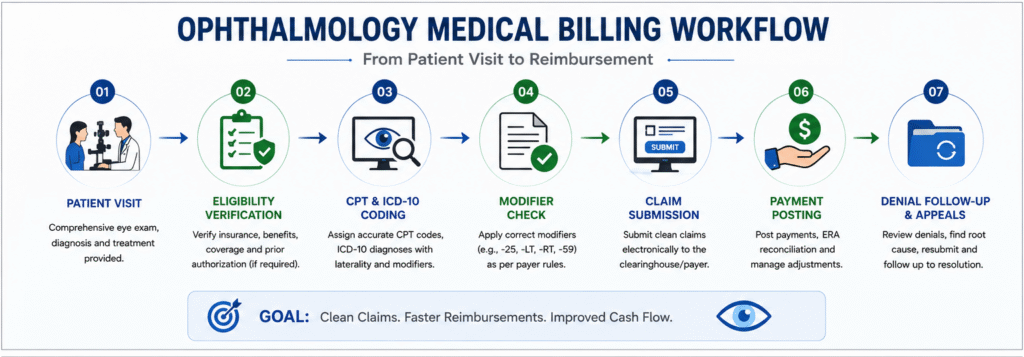
A complete ophthalmology billing workflow involves six stages. Let’s take a look at them below:
CPT Code Selection for Eye Care Services
CPT code selection in ophthalmology begins with identifying the type of patient (new or established) and the level of service provided. The codes covered are:
- Eye-specific exam codes (920xx series) for ophthalmic examinations
- E&M codes (99xxx series) are based on the payer and the nature of the visit.
- 660xx–670xx range for Surgical procedures
- Codes within the 920xx series for diagnostic tests
Accurate CPT codes require proper documentation that supports the level of service billed. Upcoding (selecting a higher-complexity code) could lead to unnecessary audits. On the other hand, downcoding reduces the revenue of your practice.
ICD-10 Diagnosis Codes in Ophthalmology
ICD-10-CM codes in ophthalmology are highly specific. Most require laterality, including right eye (suffix 1), left eye (suffix 2), or bilateral (suffix 3). Severity staging is also required for conditions like glaucoma. Here, the code must reflect whether the disease is mild, moderate, severe, or indeterminate. A diagnosis code that doesn’t match the documented findings or lacks required specificity might lead to denial.
Use of Modifiers in Ophthalmology Claims
Modifiers are important in ophthalmology, but are often misapplied. The most commonly used modifiers include:
- -25: Separately identifiable E&M service on the same day as a procedure. It is required when billing an exam alongside a diagnostic test or minor procedure.
- -LT / -RT: Left and right eye designators. It is required when a procedure is performed on one eye only
- -54 / -55: Split surgical care. -54 for the surgical procedure itself, -55 for postoperative care when performed by a different provider
- -59: Distinct procedural service. It is used when two procedures that would normally be bundled are legitimately separate on that date.
- -79: Unrelated procedure during a global period. It is considered a new, unrelated procedure performed while a prior surgical global period is still active.
Insurance Eligibility and Coverage Verification
Before you offer any service, confirm active coverage, identify the correct plan (medical or vision), and check whether the planned procedure requires prior authorisation. In recent days, payers have increased prior authorization requirements for repeat diagnostic testing, particularly for glaucoma and diabetic retinopathy follow-ups. If you miss the step, the claim will be denied, even though you have the accurate codes.
Claims Submission and Clearinghouse Processing
Claims are submitted electronically through a clearinghouse, where it be checked for formatting errors before forwarding to the payer. A clean claim, one that passes scrubbing without corrections, reaches the payer faster and gets processed sooner. If the claim scrubbing protocols at the submission stage are weak or inconsistent, then your practice may end with high denial rates.
Payment Posting and Denial Follow-Up
Payment posting confirms that ERA (Electronic Remittance Advice) amounts match the contracted fee schedule. If any discrepancies like payer underpayments, incorrect adjustments, or contractual write-offs are applied incorrectly in ophthalmology medical billing, they might lead to revenue leakage. Review the denied claims promptly, find the root causes, correct them and resubmit them within the time period.
Most Commonly Used Ophthalmology Billing Codes
Here’s a quick overview of common CPT codes used in ophthalmology medical billing services:
| Service Category | CPT Code(s) | Description |
|---|---|---|
| New Patient Eye Exam | 92002 / 92004 | Intermediate/comprehensive (new patient) |
| Established Patient Eye Exam | 92012 / 92014 | Intermediate/comprehensive (existing patient) |
| Cataract Surgery with IOL | 66984 | One-stage cataract removal with lens implant |
| Trabeculostomy (Glaucoma) | 66174 | Minimally invasive glaucoma surgery (MIGS) |
| Intravitreal Injection | 67028 | Anti-VEGF therapy, retinal conditions |
| OCT (Optic Disc) | 92133 | Optical coherence tomography, anterior segment |
| OCT (Retina) | 92134 | OCT for retina and posterior segment |
| Fundus Photography | 92250 | Retinal imaging for ongoing disease monitoring |
| Visual Field Testing | 92081 – 92083 | Threshold/peripheral visual field (severity-based) |
Routine Eye Exam CPT Codes (92002, 92004, 92012, 92014)
These four codes cover the standard ophthalmology office visit.
- 92002 and 92004 are for new patients (intermediate and comprehensive, respectively).
- 92012 and 92014 are for established patients.
The difference between intermediate and comprehensive is based on the breadth of the examination. It depends on how many elements of the eye are evaluated and documented.
Surgical Procedure Codes (Cataract, Glaucoma, Retinal)
Cataract surgery (CPT 66984) is the most commonly performed ophthalmic procedure and falls under a 90-day global surgical package. The package includes pre-operative care, the procedure itself, and all routine post-operative care within the global period. It means billing separately for routine follow-up visits within 90 days makes an mproper billing. Glaucoma surgery (66174 for trabeculostomy ab interno) and intravitreal injections (67028) are also high-volume codes with their own global period and documentation requirements.
Diagnostic Testing Codes (OCT, Fundus Photography, Visual Field)
Diagnostic code tests need to have two ICD-10 codes that justify their medical necessity.
- The codes 92133 (optic disc) and 92134 (retina) require an accompanying diagnosis or risk factor.
- Fundus photos (92250) require an explanation for the medical necessity of the imaging service.
92250 and 92134 can be denied by insurance companies when filed together unless the documentation justifies the need for both services.
Common ICD-10 Codes for Ophthalmology Diagnoses
Let’s take a look at the ICD-10-CM codes in ophthalmology billing:
| ICD-10 Code | Condition | Notes |
|---|---|---|
| H26.x | Cataract (various types) | Specify: nuclear, cortical, posterior subcapsular |
| H40.x | Glaucoma | Specify type and severity stage |
| H33.x | Retinal detachment/breaks | Requires laterality documentation |
| H35.31 | Exudative AMD | Macular degeneration, specify laterality |
| H52.x | Refractive errors | Billed to Vision Plans |
| H35.00 | Diabetic retinopathy (background) | Must link to diabetes code (E11.x) |
Common Ophthalmology Claim Denials and How to Prevent Them
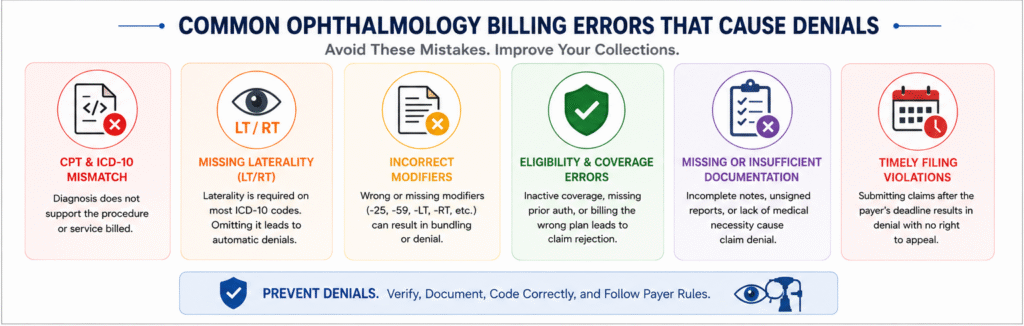
Denial rates in ophthalmology are higher than in many other specialties. It is primarily because of the combination of laterality requirements, global period rules, and the medical-versus-vision billing distinction. Here are some of the causes and how to prevent them:
Incorrect or Mismatched CPT and ICD-10 Codes
A CPT-to-ICD-10 mismatch happens when the diagnosis code doesn’t support the medical necessity of the procedure billed. For example, billing an OCT (92134) against a refractive error diagnosis (H52.x) will be denied. It is because refractive errors don’t justify retinal imaging under medical insurance.
Missing or Insufficient Documentation
Claims that can’t be supported by documentation are denied. Also, in an audit, gaps in the documentation become compliance liabilities. For ophthalmology, it includes
- missing laterality in the encounter notes
- absent visual acuity measurements
- unsigned procedure report
- failure to document the clinical rationale for diagnostic testing.
Eligibility and Benefit Verification Failures
Submitting a claim to the wrong payer type leads to automatic denial. For example, you cannot bill a refractive procedure to medical insurance, or bill a medically necessary eye condition to a vision plan. Verify eligibility at every visit, instead of at the first appointment, to avoid denials.
Modifier Errors
Failure to include modifier -25 while coding for both evaluation & management service along with the procedure performed on the same day results in denial. The lack of -LT or -RT in the modifier results in laterality rejections. The use of the -59 modifier incorrectly to avoid bundling issues is another error. To ensure modifier accuracy, you need ongoing coder training and payer-specific policy review.
Timely Filing Violations
Each payer enforces its own filing deadline, typically 90 days to 12 months from the date of service. If you miss the window, then the claim will be denied without the option of appeal in most cases. Track the submission timelines by payer to avoid an expensive resubmission process.
Payer-Specific Considerations in Ophthalmology Billing
Ophthalmology billing is normally done through Medicare, commercial insurance, and vision plans. But each category operates by different rules. Here’s a fundamental overview for them:
Medicare Billing Rules for Eye Care
Medicare Part B provides coverage for medically necessary eye services. However, routine vision testing and glasses are not covered under Medicare. They include:
- Covered diagnostic imaging, including OCT, visual fields, etc., but only if medically required.
- Subject to frequency limitations as well as medical necessity documentation for each claim.
- Uses a 90-day global period policy for cataract surgery and other ophthalmology surgeries.
Commercial Insurance Requirements
Reimbursement is usually higher from commercial insurers compared to Medicare. However, they have stricter rules and denial practices along with having more complicated prior authorization requirements. For example, their prior authorization practices now include repeat diagnostic testing for conditions like glaucoma and diabetic retinopathy.
Vision vs Medical Insurance: When to Bill Which Plan
The rule is to bill the medical plan if the visit includes treatment or diagnosis of any medical eye problem (glaucoma, cataracts, diabetic retinopathy, macular degeneration, or any other injury). The routine refraction, including glasses or lens prescriptions, should be charged to the vision insurance plan. The medical case submitted to the vision plan or vice versa will always get denied. When both occur in the same visit, split the claim correctly between plans.
Since optometry practices deal with many of these same vision-plan rules, check out our optometry billing guide for a closer look at billing for routine and medical eye care.
How Does Revenue Cycle Management Work in Ophthalmology Practices?
Proper ophthalmology medical billing helps in a positive medical revenue cycle, which begins even before the patient arrives and continues through final payment posting. Here’s how it works in each stage:
Pre-Authorization Requirements
Pre-authorization for surgical procedures and repeat diagnostic testing must be obtained before the service is offered, not after. Intravitreal injections, complex retinal procedures, and many MIGS (minimally invasive glaucoma surgeries) require auth from commercial payers.
AR Follow-Up and Denial Management
Accounts receivable management in ophthalmology should be worked by aging bucket, like 30, 60, 90, and 120+ days, with payer-specific escalation protocols for each tier. Denials must be reviewed and categorized by root cause. Patterns for recurring denials from a specific payer, or consistent errors on a specific CPT code, show systemic billing problems that need solutions for every level.
Performance Reporting and KPIs for Eye Care Billing
Revenue cycle performance should be measured consistently to identify reimbursement issues before they affect the cash flow. Ophthalmology practices should track the following metrics:
| KPI | Target Range |
|---|---|
| Claim Rate | 95% or higher |
| Days in A/R | Under 35 days |
| Denial Rate | Under 5% |
| First-Rate Resolution Pass | 95% or higher |
| Collection Rate | 95% – 98% |
Benefits of Outsourcing Ophthalmology Medical Billing Services
Many eye care practices, including solo ophthalmologists, group practices, and ASCs, outsource their specialist ophthalmology medical billing services to ensure more revenue and lower denial rates. Here’s why you should sign up for their services:
Specialised Coding Expertise
Ophthalmology coders need specialty-specific training, unlike general medical billing teams. They have knowledge of surgical global packages, correct modifier application for eye procedures, ICD-10 laterality requirements, and the medical-versus-vision billing distinction. They also stay current with annual CPT and ICD-10 updates.
Faster Reimbursements and Improved Cash Flow
Outsourced billing teams have dedicated workflows with defined turnaround targets. Claims are scrubbed and submitted faster. Denials are worked within shorter cycles. AR is followed up systematically, which shows better improvement in collection rates — typically within the first billing cycle after transition.
Reduced Administrative Burden
In-house billing for a high-volume ophthalmology practice requires more staff, training investment, and intensive management. Outsourcing transfers that burden to a specialist team, giving your administrators and clinicians more time to focus on patient care.
How does CEC support ophthalmology practices with medical billing?
CEC works with ophthalmology practices of all sizes and delivers medical billing services with specific coding, payer, and compliance requirements of eye care.
Here’s how we stand out:
- Specialty-trained coders: Experienced in 920xx eye exam codes, 660xx – 670xx surgical ranges, diagnostic imaging codes, and modifier application.
- Eligibility and prior auth verification: Confirmed before every visit, with separate checks for medical and vision plan coverage.
- Clean claim submission: Scrubbed and submitted in 24 to 48 hours from when the claims were charged.
- Payment posting and write-offs: Reviewing ERA for underpaid claims compared to contracted payment terms before write-off.
Get a Free Ophthalmology Billing Assessment
Find out where laterality errors, modifier mistakes, or medical-vs-vision misfiling are costing your practice reimbursements. Our specialty-trained coders will review your claims workflow and show you exactly where denials are slipping through.
Get a Free Ophthalmology Billing Assessment →Conclusion
Ophthalmology medical billing is complex, and getting it wrong leads to denied claims, delayed reimbursements, and write-offs. Accurate CPT and ICD-10 pairing, correct modifier use, medical-versus-vision billing decisions, and payer-specific compliance help your practice collect what it earns.
CEC’s ophthalmology medical billing services handle every stage of the revenue cycle with specialty-trained teams and proper workflows. Our team operates as an extension of yours, with full transparency and regular performance reviews.
FAQs
What makes ophthalmology billing different from general medical billing?
Ophthalmology billing uses specialty-specific CPT code series, requires laterality in almost all cases of using ICD-10 codes, and includes the 90-day global surgery package rule. It also includes the need to split claims between medical and vision insurance.
When should a service be billed to vision insurance vs medical insurance?
Bill medical insurance when the visit involves diagnosing or managing a medical eye condition, such as cataracts, glaucoma, diabetic retinopathy, or ocular trauma. Routine visits, refraction, and examination for glasses should be billed as vision services.
What is a global surgical package in ophthalmology?
Global surgery package covers everything, from pre-operation preparations to the surgery itself, and standard postoperative procedures, under one fee. For instance, for the cataract surgery with code 66984, the post-operative visits during the 90 days are not separately reimbursable.
Why is laterality so important in ophthalmology billing?
ICD-10-CM codes related to eye diseases demand the use of laterality, such as right eye, left eye, or bilateral eye. If you fail to apply the correct laterality to the code used, your submission will be denied automatically.
What are the benefits of outsourcing ophthalmology medical billing services?
Here are the benefits of outsourcing ophthalmology medical billing:
- Speciality-trained coding expertise
- Faster claim submission
- Better denial management
- Improved cash flow
- High clean claim rates and AR days