
A practice can be booked solid for weeks and still be scraping to make payroll. That contradiction usually traces back to one report nobody’s opened in a while: dental accounts receivable. Treatment was already delivered, money already earned on paper, just sitting there aging past the point where it’s realistic to collect it. Production isn’t usually the problem in 2026. Collection is, and it hides well right up until someone actually pulls the aging report and looks at the buckets.
Here’s what dental AR aging looks like once you’re actually staring at it, why balances drift into the 60, 90, and eventually 120-day range, and what tends to pull them back.
What Counts as Dental Accounts Receivable
Dental AR is everything owed to a practice for work that’s already been done. Two very different flavors of it exist, and lumping them together is where a lot of practices go wrong.
Insurance AR vs. Patient AR
Insurance AR sits with the payer, a claim still working through processing, or stuck because something in the documentation didn’t line up. Patient AR belongs to the person in the chair, co-pays, deductibles, whatever their plan didn’t touch. Insurance AR ages because payers are slow or a claim got denied. Patient AR ages for a different reason entirely, usually because nobody followed up, or the patient never actually understood what they’d owe. One follow-up process for both categories is a fast way to let both age longer than they should.
Reading a Dental AR Aging Report Without Getting Lost in It
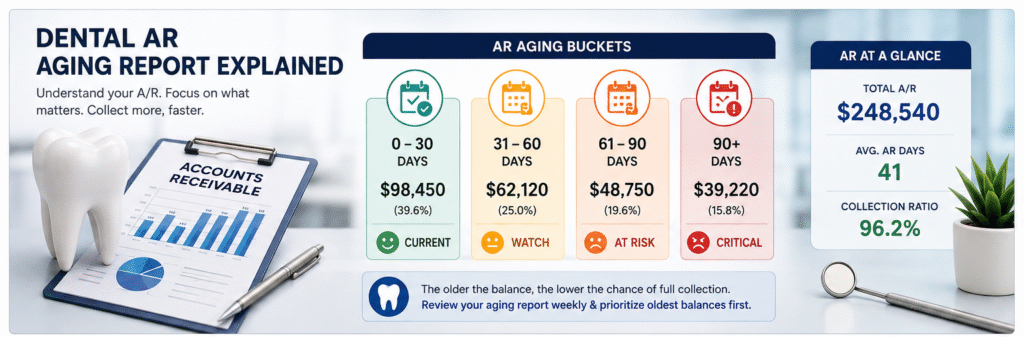
The report itself splits balances into time windows, current through 30 days, then 31-60, 61-90, and past 90. Which window a dollar sits in tells you almost everything about whether you’ll ever see it.
AR Days and Collection Ratio, the Two Numbers That Actually Matter
Average AR days is how long, on average, it takes to get paid, total AR divided by average daily production. Collection ratio is the percentage of what’s owed that actually comes in. A practice can be running at full capacity and still be quietly failing both of these.
Dental AR Benchmarks Every Practice Should Know
| Metric | Healthy 2026 Target | What Falling Short Usually Signals |
|---|---|---|
| Average AR days | 30–45 days | Slow claim submission, delayed follow-up, or payer-side processing issues |
| Collection ratio | 96%+ | Underpricing, missed patient collections, or excessive write-offs |
| AR aged 31–60 days | Under 15% of total AR | Follow-up happening reactively instead of on a set schedule |
| AR aged 61–90 days | Under 10% of total AR | Claims or balances slipping past a first and second follow-up attempt |
| AR aged 90+ days | Under 5% of total AR | A structural gap somewhere in eligibility, coding, or collections |
Stop letting aging accounts reduce your dental practice revenue
CEC helps dental practices recover outstanding accounts receivable with proactive insurance follow-ups, patient collections, denial management, and structured AR aging workflows that improve cash flow and reduce overdue balances.
CONTACT USPast 90 days, the odds of collecting in full start dropping fast. Past 120, a good chunk of that money is basically gone, it just hasn’t been written off yet. These numbers are worth checking against your own report monthly, not once a quarter when someone remembers to look. CEC’s insurance aging A/R calculator makes that comparison quick if you don’t want to pull the full report manually every time.
Why Dental AR Ages in the First Place
Most articles on this topic skip straight to the fix, verify insurance, follow up faster, without asking why the balance got old to begin with. That’s backwards, honestly, because it’s usually the same three or four things happening over and over.
Somebody assumes coverage instead of checking it, so the claim goes out built on outdated benefit info. A claim sits in someone’s queue for a day, sometimes two, before it actually gets submitted, and that delay compounds through everything after it. A patient hears a vague number at checkout, or hears nothing at all, and leaves without really knowing what they’ll owe. And follow-up on older balances happens whenever there’s a free hour, not on any real schedule, which means the oldest, hardest accounts get the least attention instead of the most.
None of this is exotic. It’s also why the AR aging report and the dental billing workflow are basically describing the same thing from two different angles.
Closing the Gaps: What Actually Moves Dental AR in 2026
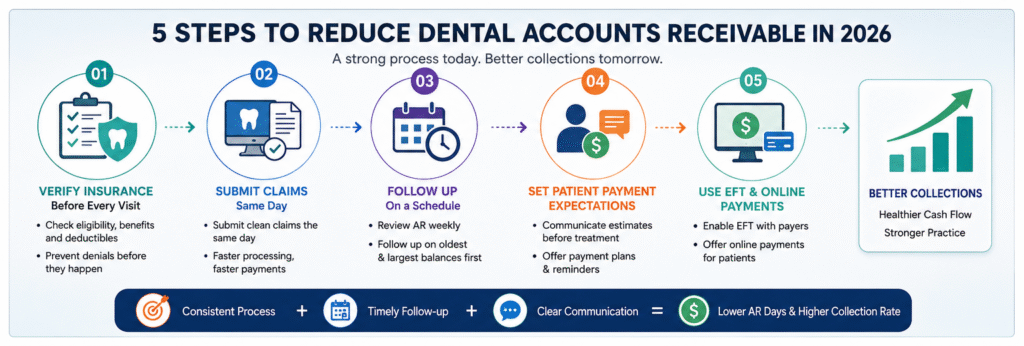
Verify Insurance Before Every Visit, Returning Patients Included
Checking coverage, deductibles, and remaining benefits 48 to 72 hours out catches most denials before they exist. A lot of practices only verify new patients on the assumption returning ones haven’t changed plans, and that assumption misses plan-year resets, job changes, lapsed coverage, constantly.
Get Claims Out the Same Day
Every extra day a claim sits before submission gets added onto everything downstream of it. Submitting same-day, with coding and documentation right the first time, shortens the whole cycle without a single collections call being made.
Actually Work the Aging Report, on a Schedule
Weekly, oldest and biggest balances first. That’s really it. Skip the schedule and follow-up becomes whatever’s easiest that day, which tends to mean newer, simpler balances get chased while the 90-day accounts just keep sitting there.
Set Patient Payment Expectations Before Treatment, Not After
Patients should hear their estimated portion before the appointment, not in a statement three weeks later. A financial policy that is genuinely enforced, not just drafted and then silently forgot, helps reduce the number of patients who sort of go off the grid on their statements.
Automate the Patient Side
Text reminders, email, an online payment link, card on file. These remove the friction that keeps a $150 balance unpaid for months. Paper statements alone are, frankly, one of the slower ways to collect from patients at this point.
Get EFT Set Up With Every Major Payer
It cuts out the check-clearing wait, which adds real days to every single insurance payment. One-time setup, permanent improvement on every claim with that payer afterward.
When AR Aging Needs More Than a Process Fix
Sometimes it’s not the workflow, it’s a backlog that’s been building for a year or two before anyone got around to it. A practice sitting on a large 90-plus bucket, especially one adding locations, usually needs someone working those old accounts specifically, separate from the regular day-to-day billing routine. And for practices being evaluated for financing or a partnership, aging AR isn’t just a cash flow annoyance anymore, it’s a number someone else is going to scrutinize directly.
How CEC Supports Dental Accounts Receivable Management
CEC folds dental accounts receivable management into a full dental RCM workflow rather than treating it as its own separate task, aging reports get worked on a set schedule, eligibility gets checked ahead of appointments, and insurance AR gets tracked apart from patient AR so each gets the follow-up it actually needs. A lot of aging balances trace back to a denial that never got resolved, so this work runs alongside our denial management process rather than as something bolted on afterward.
Final Thoughts
Dental AR aging rarely happens all at once. It builds slowly, through a missed verification, a claim that sat an extra day, a patient balance nobody clearly explained. Reducing it isn’t about one big fix. It’s tightening the front end, reviewing the aging report on a real schedule, and giving insurance and patient balances the separate attention each one actually needs.
CEC is a leading dental billing company in the USA, and accounts receivable management is a core part of how we support practices day to day, working aging reports on a fixed schedule, separating insurance AR from patient AR, and catching claims before they slip into the harder-to-collect buckets. If your practice’s AR aging report hasn’t been reviewed with that kind of structure in a while, our team can walk through where the current numbers stand and what’s realistic to recover.
Get a Free AR Aging Review
Find out where your dental accounts receivable is getting stuck. Our experts will review your AR aging report, identify collection gaps, and recommend practical steps to improve cash flow and recover more outstanding revenue.
Get a Free AR Aging Review →FAQs
1. What’s the difference between gross collection rate and net collection rate, and which one should a practice track for AR?
Gross collection rate compares collections to full fee-schedule charges, which makes it look artificially low for PPO-heavy practices due to contractual write-offs. Net collection rate compares collections to what’s actually allowed after those adjustments, and it’s the more accurate number for judging whether AR is being collected effectively.
2. Does a virtual credit card payment from an insurer count as collected the moment it’s received?
Not really. It shows up as a payment, sure, but there’s a processing fee eating into it, and if nobody runs the card in time, it can expire before the money’s actually deposited. A “collected” claim can quietly turn back into an open one this way.
3. Should AR follow-up stay in-house or move to an outside billing partner?
Depends mostly on volume, and honestly on whether the in-house team can actually stick to a schedule. Practices where follow-up keeps getting bumped for other front-desk work tend to do better handing it off rather than treating it as a side task squeezed in between everything else.
4. How does a payer’s timely filing limit change how a claim should be prioritized once it starts aging?
Every payer sets its own deadline for corrected claims or appeals, and it’s usually shorter than people assume. A claim getting close to that cutoff needs to jump the line ahead of older, bigger-dollar balances, because missing that window turns a collectable claim into a straight write-off.
5. Beyond the practice management system’s built-in report, what actually helps track AR aging?
Most PM systems give you a basic aging report and not much else. Dedicated RCM dashboards add payer-level breakdowns, flags for accounts nearing a deadline, and trend data over time, the stuff a static monthly report just doesn’t show.
6. Should a newer practice expect the same AR benchmarks as an established one?
No, not really. A practice in its first year or two usually runs higher AR days simply because credentialing and payer contracts are still settling in. The 30-to-45-day range makes more sense once payer relationships have had time to stabilize.