
How to Choose the Right Dental Billing Company for Your Practice

Most practices interview billing providers by asking what they do. Every dental billing company answers that question the same way: claims, verification, posting, appeals, and AR follow-up. The list is identical across the industry, which means it tells you almost nothing about who you are actually hiring. The difference between providers is not what they do. It is how they work. Who touches your account, what happens when a claim gets complicated, how quickly you hear about a problem, and what it takes to leave if it goes badly. Those things rarely come up in a sales call unless you raise them. Ten questions will surface most of it. Ask the same ten to every provider on your shortlist, get the answers in writing, and the differences become obvious fast. Why the Right Questions Matter More Than the Sales Pitch Billing is not a product you can inspect before you buy. You are hiring a process you cannot see, run by people you will probably never meet, on claims you will not review individually. By the time poor work shows up in your numbers, it has usually been happening for two or three months. That is why the selection conversation carries more weight here than in most vendor decisions. You are not comparing features. You are trying to work out whether a dental billing company in the USA will handle your claims the way you would handle them yourself, and the only evidence available before you sign is how they answer questions. If you are still weighing whether to outsource at all, it helps first to understand how outsourced dental billing works. 10 Questions to Ask Before Choosing a Dental Billing Company 1. What exactly is included, and what costs extra? “Full service” means something different at every company. Some quotes cover insurance claims only. Others include patient statements, payment plans, credentialing, and eligibility checks. A good answer comes as a written scope document listing what is in and what is out, with pricing for the add-ons. Worry if they describe the service verbally and move on. Anything not written down becomes a billable extra later. 2. How do you charge, and what does that work out to on our collections? Percentage of collections is the most common model, but flat monthly fees and per-claim pricing both exist and suit different volumes. A good answer includes a worked example using your actual monthly collections, plus any minimum charge. Worry if they quote a percentage without mentioning a floor. A monthly minimum can double your effective rate in a quiet month. Our guide on dental billing pricing models covers how the three compare on real numbers. 3. Which practice management systems do you work in? Most providers claim compatibility with everything. In practice, working daily in Dentrix is different from having seen it once. A good answer names your specific system and says how many current clients use it. Worry if the answer is “we work with all major systems” with no specifics. Ask how they access it, whether through remote login or a data bridge, and who holds the credentials. 4. Who handles our account, and can we speak to them? This is the question that separates providers more than any other. Some assign a named biller. Others use a pooled team where whoever is free picks up your claims. A good answer names a person, explains cover during leave, and offers a direct line. Worry if all contact routes go through an account manager who does not touch your claims. That layer slows every question down and usually means nobody owns the outcome. 5. What happens to our existing accounts receivable? Plenty of companies only work claims submitted after the go-live date. Everything older stays with your team, which is exactly the work you were trying to hand over. A good answer states clearly whether legacy AR is included, excluded, or priced separately and gives a plan for working it. Worry if they say they will “look at it” once you start. Aged claims lose value quickly past 90 days, and this needs settling before signature. 6. What does onboarding look like, and how long before we see results? A good answer is two to four weeks for setup covering system access, clearinghouse enrollment, and fee schedules, then 60 to 90 days before numbers stabilise enough to judge. Worry if they promise results in the first month. Claims submitted in week one do not pay until week five at the earliest, so anyone offering faster is describing activity rather than outcomes. 7. What do you report on, and can we see a sample? Reporting is where most dental billing service relationships quietly fail. You get a monthly summary that shows collections and nothing else, and you have no way to tell whether performance is good. A good answer is a sample report from a live client with the names removed, showing the clean claim rate, denial rate, AR aging, and days in AR. Worry if the only number they report is collections. Without the metrics underneath it, you cannot tell a good month from a lucky one. A provider offering proper dental revenue cycle management will report on the full cycle, not just the cash. 8. How do you handle denials and appeals? Submitting claims is the easy part. What happens to the 5% that come back is where the money is won or lost. A good answer describes a process: how quickly denials are worked, who writes appeals, how many attempts before a write-off, and what their overturn rate looks like. Worry if denial work is billed separately or capped. That creates an incentive to leave hard claims alone. Ask specifically how insurance verification feeds into this, since most denials are avoidable at that stage. 9. What are your data security arrangements, and will you sign a BAA? Your billing provider handles protected health information for every patient you treat. A business associate agreement is not optional;
A Comprehensive Guide to Behavioral Health Billing—Everything Your Practice Needs to Know

Is your behavioral health practice collecting everything it earns? For most mental health providers in the United States, the answer is no. Behavioral health billing is one of the most technically demanding specialties in medical billing. It is shaped by time-based coding rules, parity compliance requirements, prior authorization hurdles, and documentation standards that differ significantly from general medical billing. Mental health claim denial rates run higher than other medical specialties. In fact, there is a 30-50% rise in mental health-related claims over the past 2–3 years. So, how can you build a profitable revenue cycle with proper behavioral health billing services for your practice? Keep scrolling to find out. What Is Behavioral Health Billing and Why Is It Different from Regular Medical Billing? Behavioral health billing can be defined as the process by which submissions for claims for mental health services, such as a therapy session, a psychiatric treatment, or an addiction removal treatment, are made. Although the process is quite similar to submitting the claims for other medical bills, the process involves coding, submitting, and collecting payment for mental health, substance abuse, etc., thus making it complex. Here’s how it differs: Billing Factor Regular Medical Billing behavioral Health Billing How coding works Based on what the doctor did Based on how long the session lasted How CPT codes are picked Depends on the type of procedure Depends on the time spent with the patient What documentation covers Test results and clinical findings Session notes, care plans, and patient progress Parity compliance Not always a requirement Must follow mental health parity laws Telehealth rules One standard set of rules Rules change often and differ by state How complex claims are Manageable for most billers Harder to get right, more denials likely Training needed General medical billing knowledge Specific training in behavioral health billing Who Needs Medical Billing for Mental Health Services? Behavioral health billing applies across a wide range of providers. It includes: Psychiatrists and Psychologists Billing for psychiatrists includes evaluations, medication management, and psychotherapy, often within the same session. The interaction between E&M codes and psychotherapy add-on codes requires precise knowledge. Licensed Therapists and Counsellors Licensed clinical social workers (LCSWs), licensed marriage and family therapists (LMFTs), and licensed professional counselors (LPCs) make up the majority of the outpatient behavioral health community. Their billing is almost exclusively time-based psychotherapy codes. Therefore, the accuracy of the session length documentation is important. Substance Abuse and Addiction Treatment Centers Billing for substance abuse disorder programs involves individual therapy, group therapy, and medical services. This requires knowledge of Healthcare Common Procedure Coding Systems (HCPCS) codes as well as Current Procedural Terminology (CPT) codes and Medicaid billing rules. ABA Therapy Practices These involve one of the most document-heavy and complex billing environments in the behavioral healthcare industry. ABA therapy practices require detailed treatment plans, ongoing data collection, and ratio-based documentation of supervisors to technicians. Intensive Outpatient and Partial Hospitalisation Programs IOPs and PHPs have a per diem or per service-based coding system, which requires detailed documentation of the intensity of the programs and patient attendance. The pre-authorization process is highly stringent, and lapses in authorization often lead to denied revenues. Key CPT Codes Every Behavioral Health Billing Team Must Know Using the right CPT code for the right session length is the most fundamental billing practice in behavioral health. Individual Psychotherapy Codes — 90832, 90834, 90837 Document the exact start and end time of every session. Without the correct information, payers can downcode or deny the claim regardless of what occurred. CPT Code Session Length Common Use 90832 A 30-minute session with the patient Short follow-up sessions 90834 A 45-minute session with the patient Standard therapy sessions 90837 A 60-minute session with the patient Full-length therapy sessions Psychiatric Evaluation Codes — 90791 and 90792 CPT 90791 covers a psychiatric diagnostic evaluation without medical services used by non-prescribing clinicians. CPT 90792 includes medical services and is used by psychiatrists and nurse practitioners. Both are initial evaluation codes only and should never be billed for follow-up sessions. Family and Group Therapy Codes Family psychotherapy without the patient present uses 90846; with the patient, use 90847. Group psychotherapy bills under 90853 and require documentation of each participant’s attendance and therapeutic engagement. Crisis Psychotherapy — 90839 CPT 90839 covers the first 60 minutes of crisis psychotherapy. It requires documentation that the patient presented in a genuine psychiatric crisis, not simply a difficult session. Misuse of this code attracts payer audits. ABA Therapy Codes — 97151 to 97158 ABA codes cover behaviour identification assessments, protocol-based treatment, group sessions, and family guidance across both technician-administered and clinician-administered services. Each code requires specific documentation of who delivered the service and in what capacity. Why Behavioral Health Billing Has One of the Highest Denial Rates in Medical Billing The denial rates for behavioral health are much higher compared to other specialities. Here are some of the reasons why: Time-Based Coding Errors That Trigger Immediate Denials The most common cause of denial in medical billing for mental health services is the difference between the CPT code billed and the time of the session. If 90837 is billed for a session, but the note reflects 45 minutes of service, the claim is denied or downcoded. Missing or Incomplete Session Documentation It is essential to have documentation of medical necessity for each session, not just the first session. The note should have information on current symptoms, treatment goals, interventions, and patient response. Lack of clear documentation of sessions does not pass the payer’s audit. Prior Authorization Lapses and Session Limit Breaches Exceeding the number of sessions authorized by the payer, even by one, automatically denies the claim. Lack of a system to track the number of sessions can cause this type of denial. It is one of the most common errors in behavioral health billing. Wrong Place of Service Codes for Telehealth — POS 02 vs POS 10 POS 02 is used when the patient is in a healthcare facility. POS 10 is used when
Payment Posting In Medical Billing: How Does It Work and Why Is it Important?

Is your practice collecting payments but still struggling to understand where the money is going? In healthcare revenue cycle management, payment posting is the point where financial clarity begins. Even a small error in posting can disrupt cash flow, reporting, and patient trust. Read this blog to understand how payment posting in medical billing works and why it is important for maintaining accurate revenue tracking and improving cash flow. What is Payment Posting in Medical Billing and Why It Matters Payment posting is a medical billing process that is used to maintain the payments made by insurance companies and patients in the billing system. It includes matching payments to claims, rectifying accounts receivable, and detecting problems such as denials or underpayment. Billing and payment errors in healthcare cause major financial inefficiencies, leading to nearly $125 billion in annual losses for U.S. providers. This underscores the reason why payment posting is not only a bookkeeping activity but an important operation for financial transparency, revenue management, and operational efficiency. When properly implemented, it gives a clear visibility of the collected, outstanding, and lost revenue, minimizes revenue leakage, compliance risk, and patient dissatisfaction due to billing errors. Where Payment Posting Fits in the Medical Billing Revenue Cycle Posting payment is a very important process in the healthcare revenue cycle, and it follows the submission and adjudication of claims. It is the step in which payments are registered and financial information is put into action. The revenue cycle usually comprises: Patient registration and charge capture Coding and claim generation Payer adjudication Payment posting Denial management and follow-ups. Bills and collections of the patients. At this point, insurers and patient payments are correctly documented in the billing system, as well as adjustments, write-offs, and patient responsibility balances. Any exemptions like underpayments, refused, or partially paid claims are noted and highlighted to investigate further. This renders posting of payments beyond a transactional activity. It serves as an important bridge between reimbursement and revenue realization, where all the dollars are monitored, reconciled, and better financial performance is achieved. Types of Payment Posting in Medical Billing Here are the key types of payment posting in medical billing that ensure accurate recording and efficient revenue tracking: Insurance Payment Posting Insurance payment posting refers to the process of recording the payment that is received by the insurance companies according to the Explanation of Benefits or Electronic Remittance Advice. It contains the implementation of contractual changes, deductibles, copayments, and coinsurances, and verifies the allowed amounts with payer contracts. The process also aids in the detection of underpayments, denials, or discrepancies that need to be followed up on in order to safeguard revenue integrity. Patient Payment Posting Patient payment posting focuses on documenting payments made directly by patients through various modes such as cash, credit cards, checks, or online portals. It ensures proper updating of patient balances, accurate allocation of payments to individual encounters, and appropriate handling of overpayments or refunds. This increases billing transparency and improves the overall patient financial experience. ERA (Electronic Remittance Advice) Posting ERA posting is automated, and payments are posted based on electronic remittance files that are received by insurance payers. It saves on manual work, enhances accuracy and increases the speed of the posting cycle. Automation also reduces human errors and enables quicker determination of payment variances and denials. Around 80% of the healthcare providers are using ERA to accelerate payment posting. Manual Payment Posting Manual payment posting is performed when payments are recorded from paper EOBs or non-standard formats that cannot be automated. Though it is time-consuming, it is required in dealing with complex cases, secondary claims or exceptions, where automation cannot be done. Precision and keenness to detail are paramount in this process to prevent financial anomalies. Denial and Adjustment Posting Denial and adjustment posting is an accounting method where denied claims, partial payments and other adjustments, including write-offs or contractual differences, are recorded. It assists in classifying the reasons of denial, assists in the analysis of root causes, and allows taking effective follow-up measures. The denials are properly tracked to improve collections and minimize revenue leakage in the long run How Does Payment Posting Work in Medical Billing Step-by-Step Payment posting follows a structured workflow to ensure accuracy and completeness: Receive Payment Information: Payments are made through EOBs, ERAs, or patient transactions. These involve the payments of different types of payers, including commercial payers, government programs, and direct patient payments through different channels. Remittance advice is provided with every payment and includes claim status, adjustment codes, reasons for denial, and payment breakdowns. Validating file formats, segregating batches by payer, and making sure all remittance files are complete are also part of proper intake. The accuracy of capturing this information would mean that no payments would be missed and that all the transactions would be prepared to be processed downstream. Check Payment Accounts: The payment amounts are checked against claim charges and anticipated reimbursements. This involves verification of payer contracts, fee schedules, allowable amounts, and adjustment codes to achieve accuracy. Teams usually compare remuneration with the agreed rates to identify under-payments or over-payments. Any differences are recorded and tagged to be escalated or corrected so that financial integrity is maintained before posting. Post Payments in the System: Payments are recorded in the billing system against the respective claims. All entries are cross-linked to the appropriate patient account, encounter, date of service and procedure codes. High-volume transactions are normally handled using batch posting techniques in order to enhance efficiency. Proper posting of accounts keeps the account balances and financial statements accurate. Why Payment Posting in Medical Billing Is Critical for Cash Flow and Accuracy According to a study, most healthcare providers lose around 3-5% of their potential revenue because of payment posting errors alone. Here is why payment posting in medical billing is critical for maintaining cash flow stability and ensuring financial accuracy: Ensures Accurate Financial Reporting Posting of payments ensures that there is a clear record of the revenue collected and write-offs. This
How to Manage Accounts Receivable for Medical Practices and Stop Losing Revenue
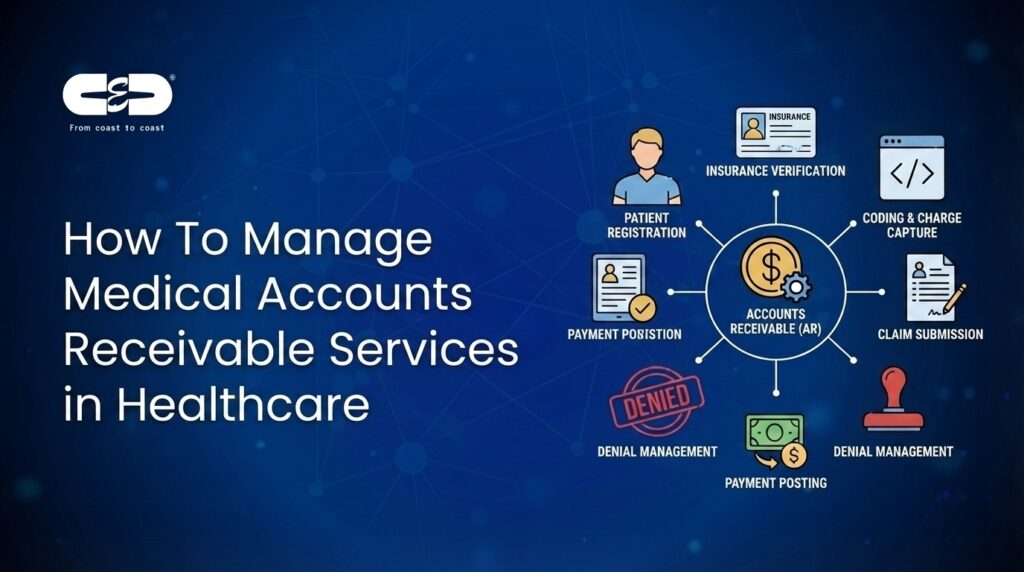
Are you reviewing your end-of-month reports and wondering where the revenue went? You are not alone. Millions of dollars of medical practices’ bills in the US are uncollectible, not because the services were not rendered. But because the processes behind medical billing and accounts receivable are broken, delayed, or simply not followed through on. Unpaid claims, aging balances, and unresolved denials quietly accumulate until the financial damage becomes impossible to ignore. In fact, the Healthcare Financial Management Association (HFMA) reports that the average physician practice leaves 3-5% of collectable revenue on the table every year. Due to poor AR management, meanwhile, claim denial rates average between 5–10% industry-wide, with many practices never reworking on those denied claims before they expire. The good news is that you can overcome these hurdles with effective accounts receivable management in healthcare. It ensures clean claim submission, structured follow-up, denial resolution workflows, and clear patient communication. So, how to build a proper medical billing and accounts receivable process that stops your revenue from leaking? Let’s find out. What Is Accounts Receivable in Medical Billing? Accounts receivable in healthcare or medical billing is the total sum of money owed to a particular medical practice for services already rendered, yet to be paid for. This mostly includes the insurance claims that are submitted but are under the processing stage, the denied claims, etc. Why Is Accounts Receivable Medical Billing More Complex Than Most Practices Realize? Healthcare accounts receivable sits at the intersection of clinical documentation, payer-specific rules, regulatory compliance, and patient financial responsibility, all of which interact in ways that create multiple failure points within a single claim’s lifecycle. Unlike standard invoicing in other industries, a single medical claim can be denied for dozens of distinct reasons, each requiring a different resolution path. For instance, Payer rules change constantly. Prior authorization requirements shift without notice. Coding standards are updated annually. Patient deductibles reset at the beginning of each year. Management of multiple payer contracts with different fee schedules. Timely filing deadlines vary by payer. Due to these reasons, many practices struggle to keep their AR under control without the right systems in place. Common Medical Billing and Accounts Receivable Challenges Draining Your Practice Most revenue loss is not caused by one large problem. It is the result of several smaller mistakes that grew over time. Let’s take a look at some of them: Claim Denials Piling Up Without a Clear Resolution Path Denial management decides the result of medical billing accounts receivable performance. When claims are denied, most practices log the denial and stop there. They lack a structured rework process that directs each denial to the right team member with a defined action and deadline. As a result, denied claims age out, timely filing windows close, and the revenue disappears permanently. Front-End Errors That Quietly Damage Your Medical Receivables The majority of claim denials originate at the front desk. Incorrect patient demographics, missing insurance information, unverified eligibility, and incomplete referral authorizations affect the medical receivables management as preventable denials. By the time your billing staff finds the error, it may already be weeks old. Patients Not Paying Because Nobody Made It Easy or Clear Patient accounts receivable is growing as the single fastest-increasing segment of medical AR. Yet most practices send a paper statement, wait 30 days, send another, and then write the balance off. There is no payment plan discussion at checkout, no digital payment option, and no clear explanation of what the patient actually owes and why. Patients refuse or simply forget to pay because the process is confusing. The bill arrives weeks after the visit, and no one ever makes it easy to settle the balance quickly. No Structured Follow-Up on Ageing Medical Accounts Receivable Aging healthcare receivables management requires a proactive outreach schedule instead of scrambling when a claim hits 90 days. Practices without defined workflows for 30, 60, 90, and 120-day AR buckets routinely find balances aging into the uncollectible range just because no one touched them in time. Proven Strategies for Medical Receivables Management That Actually Move the Needle Here are some operational changes that will reduce AR days, improve collection rates, and stop your revenue from being left on the table. Verify Insurance Eligibility Before Every Single Visit Eligibility verification is an important front-end action for any practice. Run verification 24–48 hours before every scheduled appointment. Confirm the patient’s coverage status, deductible balances, copay amounts, and prior authorization requirements before they arrive in person. Get Claims Out Clean the First Time—Every Time Clean claim submission is not negotiable in the context of accounts receivable in healthcare. All claims should be sent within 24 to 48 hours of the date of service. It should include all necessary documentation, coding, and attachments. Build an AR Aging Workflow Around 30, 60, 90, and 120+ Day Buckets. Arrange your AR by age and assign specific actions as follows: AR Age Priority Level Action Required 0–30 days Standard Confirm the claim was submitted Monitor payer acknowledgement 31–60 days Elevated Follow up with the payer Confirm claim status 61–90 days High Move to senior staff File an appeal if denied Document all contacts 91–120 days Urgent Begin the appeal process.Try secondary billing 120+ days Critical Bring in leadership Consider write-off or collections Make Denial Root-Cause Analysis Part of Your Monthly Medical Billing and Accounts Receivable Review Track medical billing and accounts receivable denial patterns monthly to prevent costly errors. Categorize every denial by root cause, like coding error, eligibility issue, missing authorization, and untimely filing, for easy tracking over time. Give Patients More Ways to Pay and Fewer Reasons to Delay If you want to improve patient accounts receivable collection, then you need to remove friction within it. Offer online payment portals, payment plans for balances above a defined threshold, text-to-pay options, and point-of-service collection at checkout. You can also send digital statements that link directly to payment. Automate Follow-Ups So Nothing in Your Medical Receivables Sits Idle Manual follow-up does not scale.
Revenue Cycle Management Best Practices for Multi-Specialty Medical Practices

If you are managing a multispecialty practice, you might already be juggling multiple billing codes, varying payer requirements, and specialty-specific regulations under one roof. These complex tasks make your revenue cycle even more complex as you operate cardiology, dermatology, and primary care side by side. The result? You will end up with inconsistent processes, mounting denials, or cash flow challenges. Now, how can you overcome the challenges of RCM as a multi-speciality medical practice? Keep on scrolling to find out! What are the Unique Challenges that Come in Multispecialty RCM? Multispecialty clinics have their own revenue cycle challenges, which single-specialty clinics do not have. Some of these challenges include: What are the Best Practices for RCM in Multispecialty Practices? Let us explore the proven strategies to implement in your multispecialty practice that will improve your financial performance. 1. Streamline, Centralize, and Standardize Processes Develop a standard process for patient registration, charge capture, billing, and collections across specialties. Centralizing these processes gives you better control, tracking, and reporting while reducing the chances of errors or duplication. 2. Implement Integrated Technology Systems Investing in an integrated system that includes practice management services and electronic health records. The technology ensures that disparate data sources are used to create a single platform for better revenue cycle management. For example, CEC has a proprietary dental RCM platform that automates claims, payment, and reporting with AI-powered analytics. 3. Build Specialty-Specific Expertise Develop specialized teams for billing or assign experts as different team members for different specialties. It will ensure that your coders are aware of the requirements for different departments while keeping processes standardized. 4. Establish Robust Denial Management Build a specialized denial management team to monitor, understand, and resolve denied claims in a timely manner. A cardiology denial problem will not look like an orthopaedic one. So, it is best to segment denial data by specialty, payer, and reason. Then, your team can fix root causes instead of reworking the same claims repeatedly. 5. Keep Clinical Documentation Clean From Day One Incomplete or unclear documentation is the number one reason for claim denials and delays. So, ensure that the documentation is clear, complete, and aligned with billing requirements from the first entry. It is better if you could provide specialty-specific template to help providers capture the right details. The templates should prompt for diagnosis linkage, procedure specifics, modifiers, and time-based elements where applicable. 6. Capture Charges at the Point of Care In multispecialty clinics, missed charges is a common issue because services are documented late or in some cases, they are not documented at all. So, when charge entry is delayed, details are forgotten, or modifiers are missed, then, claims might go incomplete or underpaid. So, it is recommended to embed charge capture directly into the clinical workflow. Record services during or immediately after the visit using structured templates and pick-lists that reflect specialty-specific services. Also, clinical documentation and billing systems should be integrated, so charges flow automatically without relying on manual handoffs. 7. Clear Communication with Patients To build trust with patients, it is important to set clear communication protocols for financial conversations. When patients don’t understand their financial responsibility upfront, it becomes harder to settle the collection. Multispecialty practices should explain expected costs before services whenever possible. This includes insurance coverage, co-pays, deductibles, and any out-of-pocket expenses. It would be best if you could hire a front-desk or financial counselling team that can assist the patient and their family regarding the expenses. Otherwise, you can outsource this task, and the service provider’s team will handle the communication with patients. 8. Get Eligibility and Authorization Right Everytime In multispecialty clinics, each specialty may have its own payer rules, so skipping verification once can result in full claim denial. So, ensure that all the insurance eligibility, benefit coverage, referrals, and prior authorisations are verified before the visit, not after services are rendered. This process must be built into scheduling and registration workflows, with clear ownership assigned to front-office teams. You can even integrate automated eligibility tools and platforms that help in flagging coverage gaps early, and set up checklists so that no specialty bypasses the process. Conclusion Revenue Cycle Management in a multispecialty medical practice is a process that needs your complete dedication, appropriate technology, and proven best practices. The best way to ensure a smooth billing experience is to partner with the best RCM company, incorporate AI and technology, and monitor key metrics. The thought of managing revenues in a multispecialty medical practice can be a daunting one. But that doesn’t have to come at the expense of your financial success. You need smart strategies and a better partner. Are you ready to start your multispecialty revenue cycle optimization? Outsource the manual, time-consuming, but important tasks to CEC, a leading offshore RCM service provider. We provide complete services, focused on multi-department medical practices, and reduce A/R aging by 50% within 6 months. FAQs Q: What sets multispecialty RCM aside from single-specialty practice? Multispecialty clinics have to contend with diverse coding requirements, multiple contracts, and authorization needs simultaneously. Such processes require centralized oversight. Each specialty may have different and distinct workflow needs. Q: How can we minimize our denial rates? It’s also possible to leverage AI-driven claims prior to submission. In addition, it’s an added advantage if you have a dedicated denial management partner to help you verify your eligibility and provide accurate documentation prior to submission. Q: Should the RCM be outsourced, or should it remain in-house? This will depend on your resources and skills. Many multispecialty clinics prefer outsourcing, where there is access to specialized skills, expertise, and advanced technology at cheaper costs compared to maintaining an in-house team. Q: What RCM metrics should be monitored? Monitor the clean claim rate, days in accounts receivable, denial rate, collection rate, and cost to collect. All of this should be compared against industry benchmarks to improve revenue. Q: How long does it take to notice improvement from RCM? Most practices will experience noticeable gains