
Most practices interview billing providers by asking what they do. Every dental billing company answers that question the same way: claims, verification, posting, appeals, and AR follow-up. The list is identical across the industry, which means it tells you almost nothing about who you are actually hiring.
The difference between providers is not what they do. It is how they work. Who touches your account, what happens when a claim gets complicated, how quickly you hear about a problem, and what it takes to leave if it goes badly. Those things rarely come up in a sales call unless you raise them.
Ten questions will surface most of it. Ask the same ten to every provider on your shortlist, get the answers in writing, and the differences become obvious fast.
Why the Right Questions Matter More Than the Sales Pitch
Billing is not a product you can inspect before you buy. You are hiring a process you cannot see, run by people you will probably never meet, on claims you will not review individually. By the time poor work shows up in your numbers, it has usually been happening for two or three months.
That is why the selection conversation carries more weight here than in most vendor decisions. You are not comparing features. You are trying to work out whether a dental billing company in the USA will handle your claims the way you would handle them yourself, and the only evidence available before you sign is how they answer questions. If you are still weighing whether to outsource at all, it helps first to understand how outsourced dental billing works.
10 Questions to Ask Before Choosing a Dental Billing Company

1. What exactly is included, and what costs extra?
“Full service” means something different at every company. Some quotes cover insurance claims only. Others include patient statements, payment plans, credentialing, and eligibility checks.
A good answer comes as a written scope document listing what is in and what is out, with pricing for the add-ons.
Worry if they describe the service verbally and move on. Anything not written down becomes a billable extra later.
2. How do you charge, and what does that work out to on our collections?
Percentage of collections is the most common model, but flat monthly fees and per-claim pricing both exist and suit different volumes.
A good answer includes a worked example using your actual monthly collections, plus any minimum charge.
Worry if they quote a percentage without mentioning a floor. A monthly minimum can double your effective rate in a quiet month. Our guide on dental billing pricing models covers how the three compare on real numbers.
3. Which practice management systems do you work in?
Most providers claim compatibility with everything. In practice, working daily in Dentrix is different from having seen it once.
A good answer names your specific system and says how many current clients use it.
Worry if the answer is “we work with all major systems” with no specifics. Ask how they access it, whether through remote login or a data bridge, and who holds the credentials.
4. Who handles our account, and can we speak to them?
This is the question that separates providers more than any other. Some assign a named biller. Others use a pooled team where whoever is free picks up your claims.
A good answer names a person, explains cover during leave, and offers a direct line.
Worry if all contact routes go through an account manager who does not touch your claims. That layer slows every question down and usually means nobody owns the outcome.
5. What happens to our existing accounts receivable?
Plenty of companies only work claims submitted after the go-live date. Everything older stays with your team, which is exactly the work you were trying to hand over.
A good answer states clearly whether legacy AR is included, excluded, or priced separately and gives a plan for working it.
Worry if they say they will “look at it” once you start. Aged claims lose value quickly past 90 days, and this needs settling before signature.
6. What does onboarding look like, and how long before we see results?
A good answer is two to four weeks for setup covering system access, clearinghouse enrollment, and fee schedules, then 60 to 90 days before numbers stabilise enough to judge.
Worry if they promise results in the first month. Claims submitted in week one do not pay until week five at the earliest, so anyone offering faster is describing activity rather than outcomes.
7. What do you report on, and can we see a sample?
Reporting is where most dental billing service relationships quietly fail. You get a monthly summary that shows collections and nothing else, and you have no way to tell whether performance is good.
A good answer is a sample report from a live client with the names removed, showing the clean claim rate, denial rate, AR aging, and days in AR.
Worry if the only number they report is collections. Without the metrics underneath it, you cannot tell a good month from a lucky one. A provider offering proper dental revenue cycle management will report on the full cycle, not just the cash.
8. How do you handle denials and appeals?
Submitting claims is the easy part. What happens to the 5% that come back is where the money is won or lost.
A good answer describes a process: how quickly denials are worked, who writes appeals, how many attempts before a write-off, and what their overturn rate looks like.
Worry if denial work is billed separately or capped. That creates an incentive to leave hard claims alone. Ask specifically how insurance verification feeds into this, since most denials are avoidable at that stage.
9. What are your data security arrangements, and will you sign a BAA?
Your billing provider handles protected health information for every patient you treat. A business associate agreement is not optional; it is a legal requirement.
A good answer is yes to the BAA without hesitation, plus detail on where data is stored, who has access, and whether any work is subcontracted offshore.
Worry if offshore delivery is not disclosed upfront. Offshore is not a problem in itself, and plenty of reputable providers use it. Not telling you is the problem.
10. What are the contract terms, and how do we leave?
A good answer is a stated notice period, a clear exit clause, and confirmation that your data and claim records come with you.
Worry if there is a long lock-in with no termination clause, or if they cannot say who works claims in flight during the notice period. That gap is where practices lose the most money when switching.
Red Flags in How a Dental Billing Company Answers
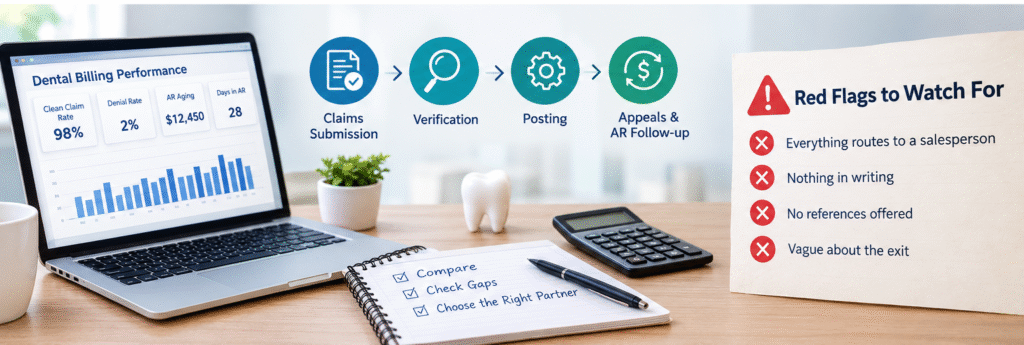
Individual answers matter less than the pattern across all ten. Four things worth watching for:
Everything routes to a salesperson. If nobody from the delivery side joins the conversation, you are being sold to rather than shown how the work happens.
Nothing in writing. Verbal assurances about scope, pricing, and turnaround do not survive a staff change on their side.
No references offered. Any established provider has clients willing to speak. Reluctance here is the clearest signal on the list.
Vague about the exit. A company confident in its work does not need to trap you. Difficulty answering question ten usually says more than the other nine combined.
How to Compare Dental Billing Providers Once You Have the Answers
Shortlist three. Two gives you no real comparison, and five turns into a project nobody finishes.
Send the same ten questions to each in writing before any call. Written answers are comparable side by side, and they commit the provider to something. A call alone leaves you with an impression and no record.
Score each answer as clear, partial or evasive, and pay more attention to the evasive ones than the clear ones. Every provider on your shortlist will answer most questions well. The ones they dodge are where the actual differences sit.
Then take the top two to a call and ask the same follow-up to both: what goes wrong most often with new clients in the first 90 days. Providers who have done this properly have a real answer. Those who say nothing goes wrong have either not been doing it long or are not being straight with you.
Choosing a Dental Billing Partner: Final Thoughts
The right provider for a solo practice is rarely the right one for a 12-location group, and no amount of reputation makes up for a poor fit with your software, your specialty, or your working style.
Ask all ten. Get the answers written down. Compare the gaps rather than the strengths, because every provider leads with the same strengths, and only the gaps tell you anything.
If you would like to put these questions to us, or you want a look at your current numbers before deciding anything, get in touch with CEC. We will answer all ten questions before asking you to commit to anything, including our dental billing services.
Put These 10 Questions to CEC
Get straight, written answers before you commit to anything. We’ll walk you through our scope, pricing, reporting, and exit terms, and take a look at your current numbers along the way.
Talk to CEC →