How Dental Insurance Annual Maximums and Year-End Rushes Affect Practice Cash Flow
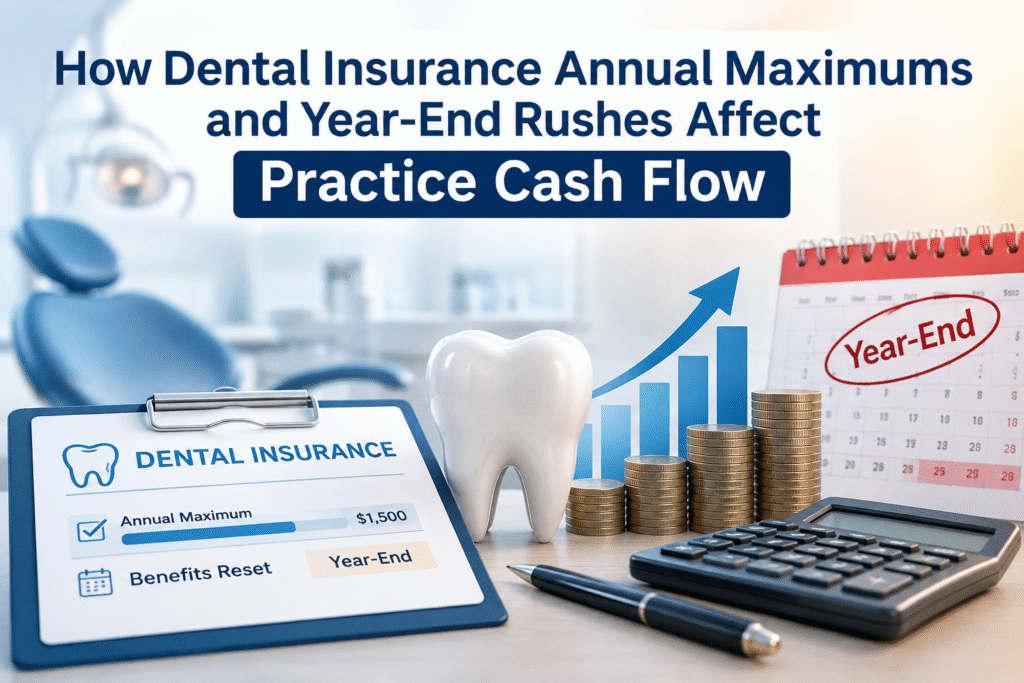
Only 3.4% of dental patients actually reach their annual maximum in a given year. Another 3.3% come within $100 of it. That’s it, roughly one in fifteen patients. And yet nearly every dental practice in the country still feels a real, measurable scheduling crunch every October through December. If the “use it or lose it” panic only applies to a small slice of patients, what’s actually driving the year-end rush, and why does it hit cash flow so hard when it arrives? What a Dental Insurance Annual Maximum Actually Is A dental insurance annual maximum is the total dollar amount a plan will pay toward covered care in a benefit year, typically the calendar year. Common maximums run $1,000 to $2,000, and according to National Association of Dental Plans data, roughly a third of in-network maximums sit specifically in the $1,000-$1,500 range. Unused benefit dollars don’t roll over. Once December 31 passes, whatever wasn’t used against that maximum is gone, the patient starts over at zero in January. That’s the mechanic everyone knows. What gets missed is who it actually applies to. The Year-End Rush Isn’t About Patients Maxing Out Here’s the part worth sitting with: if only about 7% of patients are anywhere near their annual maximum, the Q4 rush can’t be explained by a wave of patients racing to spend down a number they’re about to lose. Something else is happening, and it’s mostly behavioral, not mathematical. Patients who’ve been putting off treatment all year suddenly feel the calendar pressure in November and December, whether or not they’re actually close to their cap. Front desk teams push harder to fill the schedule before the holidays slow everything down. Practices themselves often run year-end promotions or reminder campaigns that create urgency independent of whether a given patient’s benefits are actually at risk. The result is a genuine production spike concentrated into two months, driven more by psychology and scheduling behavior than by the insurance math underneath it. What Q4 Actually Does to a Dental Practice’s Numbers October through December typically brings a real production peak as patients come in to use whatever benefit room they believe they have left. Collection rates tend to improve during this window too, motivated patients pay more promptly. Aging accounts receivable, the 90-plus day bucket specifically, often shrinks during this period as practices push year-end billing cleanup alongside the scheduling push. That dip doesn’t stay small for long. AR typically shrinks through October and November as practices push year-end collections, then creeps back up in January and February as the newer wave of Q4 claims ages past the point where a first submission should have cleared. That’s not a red flag by itself, it’s the same seasonal lag showing up in a different number. The number worth watching is how much of that January and February AR growth is genuinely new claims still working through the normal cycle, versus older claims that stalled somewhere in the process. A practice that can’t tell the difference ends up either underreacting to a real backlog or overreacting to a normal one. Accounts receivable management built around this seasonal pattern, rather than a flat month-to-month view, catches a stalling claim early enough to act on it. CEC’s Accounts Receivable Management Services track AR against this kind of seasonal baseline instead of a generic aging report, so a real problem doesn’t get lost in the normal Q4-to-Q1 noise. Why This Creates a Cash Flow Problem, Not Just a Scheduling One The core issue isn’t the production spike itself. It’s timing. Payroll, rent, lab fees, and supplier invoices leave a practice’s account on a fixed schedule regardless of season. Insurance reimbursements and patient payments arrive on their own, separate cycle, one that doesn’t necessarily sync up with when the work actually got done. A practice that produces heavily in November and December but doesn’t see that revenue land as cash until claims process weeks later can end up cash-poor in January and February, precisely the months when production naturally slows and that cushion is needed most. Dental insurance timing compounds this. Claims submitted at the height of the Q4 rush compete with every other dental practice’s Q4 claims for the same payer processing capacity, which can slow turnaround exactly when volume is highest. The Other Q4 Risk: Denial Rates Climb With Volume More claims moving through at once means more chances for something to get flagged. A missing pre-authorization. A coding mismatch. An eligibility detail that changed since the patient’s last visit. Payers work through claims in the order they come in, so when Q4 submissions pile up, it doesn’t just slow things down. It also means a rushed or incomplete claim is more likely to get denied outright. (Flag: needs a real stat on Q4 denial rate increases before publishing, don’t leave this as an unverified claim.) A denial in November or December costs more than one delayed payment. The claim has to be fixed, resubmitted, and it goes right back into the same backlog that caused the problem the first time, often not clearing until February or March. For a practice already dealing with the January cash flow gap, a batch of Q4 denials makes that gap bigger and harder to plan around. This is where denial management matters most, not as cleanup after claims bounce back, but as a check before they go out. Catching a missing document or an eligibility mismatch before submission is a lot cheaper than fixing it after a denial. CEC’s Denial Management Services build that check into the claims process itself, so a busier Q4 doesn’t mean more denials. An Actual Worked Example Consider a patient needing $3,200 in major treatment with a $1,000 annual maximum and 50% coinsurance on major procedures. If the full treatment gets done in December, insurance pays $1,000 and the patient covers the remaining $2,200 out of pocket, a significant, possibly treatment-declining number to present to a patient right before the holidays. Split the same treatment
Cross-Coding Dental Claims to Medical Insurance: When and How It Works
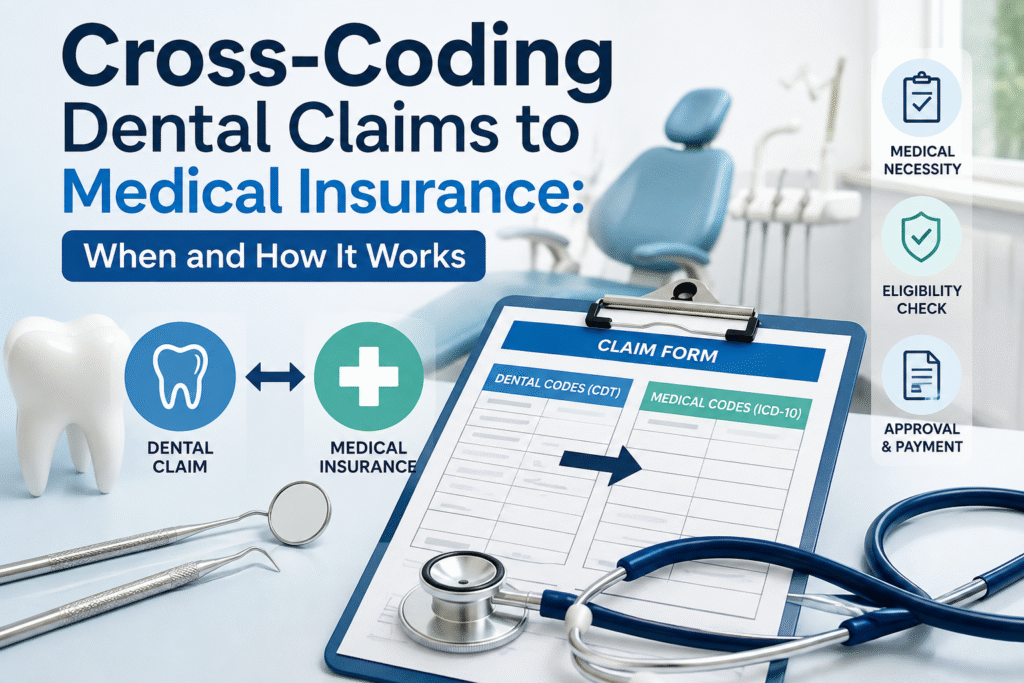
A custom oral appliance for sleep apnea gets billed under CDT code D9947. Submit that same code to a medical payer, and it goes nowhere; medical insurers don’t recognize dental procedure codes at all. Submit HCPCS code E0486 instead, the code that actually describes a custom oral device for obstructive sleep apnea, and the same appliance can get paid by the patient’s medical plan. That single code swap is the entire difference between a denied claim and real revenue most dental practices leave sitting on the table. What Is Dental-Medical Cross Coding? Cross-coding is the practice of billing a dental procedure to a patient’s medical insurance instead of, or alongside, their dental plan, using medical code sets rather than CDT codes alone. Dental claims run on CDT and, for some payers, ICD-10-CM, submitted through the ADA dental claim form. Medical claims are based on an entirely different set: CPT, HCPCS Level II, and ICD-10-CM, submitted on the CMS-1500 form. Dental medical billing isn’t a gray-area workaround; it’s a legitimate, established process for a specific category of procedures that treat a diagnosed medical condition rather than routine dental disease. Which Dental Procedures Actually Qualify for Medical Billing Obstructive sleep apnea appliances. A custom oral device (CDT D9947, adjustment D9948) can be billed to medical insurance under HCPCS code E0486, provided there’s a physician’s diagnosis, generally backed by a sleep study, and a prescription for the appliance. One detail that trips up practices new to this: E0486 is specifically for a custom device treating diagnosed OSA. A different code, A9270, covers non-covered devices, like an appliance addressing snoring alone without an OSA diagnosis. Submit the wrong one and the claim gets denied regardless of how well everything else was documented. TMJ and TMD treatment. Splint therapy for temporomandibular disorders (CDT D7880) crosses over to CPT 21085 for splint fabrication, sometimes alongside 97014 for electrical stimulation or 20605 for arthrocentesis. TMD is classified as a musculoskeletal condition under ICD-10 (the M26.6x series), which is exactly why medical plans, not dental ones, typically cover it. Trauma and oral surgery. Procedures addressing an injury rather than routine dental disease, alveoloplasty with extractions (D7310), incision and drainage of an intraoral abscess, and similar oral surgery codes each map to a specific CPT equivalent. Bone grafts related to trauma or head and neck cancer treatment (D4263, D7953) fall into this category too. Congenital and developmental conditions. Procedures like orthognathic reconstruction for congenital jaw deformities (D7940) can also cross over, since they’re addressing a diagnosed medical condition rather than elective dental work. Frenectomies. Common in newborns with tongue-tie or feeding difficulty, these can qualify for medical billing when there’s a documented functional impairment, not simply a preference for the procedure. Why the CDT Code Isn’t Enough on Its Own Here’s the part a lot of dental-only content misses entirely: the CDT code tells the story of what happened in your office, but it isn’t what decides medical coverage. The medical payer makes that decision based on the ICD-10 diagnosis and the specific HCPCS or CPT code submitted, not the CDT code sitting in your practice management system. A practice can document a procedure perfectly on the dental side and still get denied on the medical side if the crosswalk to the correct medical code, and the diagnosis code that justifies it, wasn’t done correctly. The rule worth remembering: translate CDT to CPT only when there’s a genuine matching or equivalent medical procedure. Not every dental code has one, and forcing a crosswalk where none legitimately exists is how a practice ends up with a pile of denied medical claims instead of the revenue it was hoping to capture. What Medical Payers Actually Require That Dental Payers Don’t Medical claims carry a meaningfully higher documentation bar than dental claims. A diagnosis alone rarely carries a claim, medical payers want to see the clinical evidence that supports it: photographs of pathology, measured range of motion for a TMJ claim, the patient’s own described symptoms in their own words, and documentation of any conservative treatment that was tried and failed before the current procedure. A narrative report tying the specific diagnosis to the specific procedure, explaining why this treatment is medically necessary rather than elective, matters more on the medical side than almost anywhere in dental billing. Prior authorization is common for oral surgery, sleep apnea appliances, and TMJ treatment specifically, and most carriers take five to fifteen business days to process it. Treating before authorization comes through is a real risk, a claim denied for missing prior auth generally can’t be appealed after the fact, the procedure has to have waited for approval in the first place. CPT modifiers matter here too. Modifier -25 signals a separate, significant evaluation on the same day as a procedure. Modifier -59 signals a distinct procedural service. Missing or misusing these is a common, avoidable reason a technically correct claim still gets denied. Common Mistakes That Get Cross-Coded Claims Denied Submitting a medical claim with only dental-style clinical notes attached, no narrative, no diagnosis-to-procedure justification, is close to guaranteed denial on the medical side, even when the same documentation would have been perfectly fine for a dental claim. Missing the required physician referral or diagnosis for conditions like sleep apnea, where medical payers specifically require it before an oral appliance claim will be considered at all. Using an outdated CDT-to-CPT or CDT-to-HCPCS mapping. These crosswalks get updated as code sets change annually, and a mapping that was accurate two years ago isn’t guaranteed to be accurate today. Treating medical eligibility verification as an extension of dental eligibility, rather than its own separate check. A patient’s medical and dental plans are frequently different insurers entirely, with different verification processes and different portals. Skipping the sleep study or supporting diagnostic evidence a specific payer requires, and assuming a prescription alone will be sufficient. A Basic Process for Cross-Coding Dental Claims Where Dental-Medical Billing Fits Into a Practice’s Revenue Strategy Cross-coding done well is genuine, recoverable
Write-Offs and Adjustments in Dental Billing: What Should and Shouldn’t Be Written Off
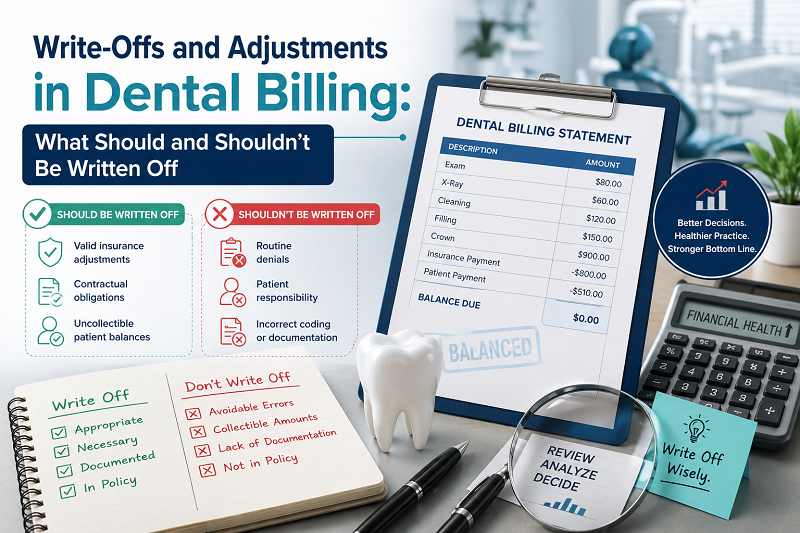
A $1,200 crown gets billed. The PPO contract says $850 is the real number. That $350 gap disappears from the books as a contractual adjustment, and it should. Nobody’s arguing that one. The problem shows up somewhere else entirely: in the account that got zeroed out last month because nobody had time to figure out why it was never paid. Contractual Adjustments vs. Bad Debt vs. Courtesy Write-Offs: What’s the Difference? Most practices talk about “write-offs” like they’re a single thing. They’re not. There are three, and mixing them up is where the real money leaks out. Contractual adjustments are the automatic, expected gap between your office fee and whatever rate you agreed to with an in-network payer. On that $1,200 crown, the $350 difference isn’t optional, you signed a contract that says so. It should post every single time, consistently, for every claim with that payer. Bad debt is different. It’s money you earned, billed, tried to collect, and never got. A patient balance that sits past 120 to 180 days with no payment, after genuine collection attempts, generally gets classified as bad debt and removed from your books as a loss. In dental specifically, bad debt tends to run somewhere between 1% and 5% of net production. If your practice is running well above that range, something in collections is broken, not just unlucky. Courtesy write-offs are the third category, and the one most practices never separate out at all. These are discretionary, a manager deciding to forgive a balance because a patient had a bad experience, or a small residual amount isn’t worth chasing. There’s nothing wrong with using these occasionally. The problem is when they become the default instead of the exception, because every one of them is a dollar that just quietly walked out the door with nobody deciding it should. How Mixing Write-Off Types Distorts Your Dental Practice’s Financial Reports Here’s the part that doesn’t get said enough: if your chart of accounts only has one bucket, “Adjustments” or “Write-Offs”, every contractual reduction, every uncollected balance, and every courtesy discount pours into the same number. Once that happens, no report can ever separate them out again. You can’t tell whether your production is shrinking because of normal PPO contracts or because your collections process is failing, because both look identical on paper. The fix is structural, not procedural. Contractual adjustments should reduce production directly, gross production minus contractual adjustments equals net production, the number your practice actually runs on. Bad debt should never touch that calculation. It belongs in its own expense account, tracked separately, so it shows up on your P&L as a cost of doing business, something you can watch trend over time and investigate the moment it spikes. What Do CO, PR, OA, and PI Mean on a Dental EOB? Every adjustment on an EOB carries a reason code, and the one to actually pay attention to is “CO”, Contractual Obligation. That code means the payer is telling you: this reduction is based on your contract, it’s not up for appeal, don’t bill the patient for it. Staff who don’t check the reason code sometimes write off amounts that were never contractual at all, treating a processing error or an underpayment as if it were routine, simply because the number looked like every other adjustment on the page. CO isn’t the only code that shows up next to a reduced payment, and lumping all of them into “write it off” is where things go wrong. PR means Patient Responsibility, that portion isn’t yours to write off at all, it belongs on the patient’s bill unless your practice has a documented reason to waive it. OA, Other Adjustment, and PI, Payer Initiated Reduction, both signal something worth a second look before assuming they’re routine, since these sometimes indicate a processing decision the payer made unilaterally, not one your contract actually requires. Treating every non-payment on an EOB as an automatic write-off, regardless of which code produced it, is exactly how legitimate patient balances and appealable underpayments both end up disappearing into the same “adjustment” bucket. This is a distinct problem from an underpayment, worth being precise about. An underpayment is money the payer owes you under the contract and simply paid incorrectly, something to catch and appeal. A contractual write-off is money you never had a claim to in the first place. Confusing the two in either direction costs money, either chasing something you were never owed, or writing off something you actually were. Common Dental Write-Off Mistakes That Cost Practices Revenue Writing off a balance without checking whether it was actually contractual, versus something that should have been appealed instead. No approval step before a write-off. If any staff member can zero out any balance on their own, you’ll never get a consistent number, and you won’t be able to tell later which write-offs were legitimate and which were just convenient. Batch-clearing small balances at month-end without spot-checking a sample first. Efficient, sure. It also means real errors get cleared right alongside legitimate adjustments, with nobody the wiser. Courtesy discounts getting logged in the same place as contractual adjustments, rather than tracked on their own. Different animal, different account. Nobody ever pulling a report of write-offs by payer or by staff member. Without that, a pattern, one biller writing off too readily, one payer whose claims keep getting cleared instead of followed up, stays invisible indefinitely. Is Waiving Dental Copays and Deductibles Illegal? Here’s the piece that most write-off advice skips entirely, and it’s the one with the most legal exposure. Routinely waiving a patient’s copay or deductible as a courtesy isn’t just generous, it can be considered insurance fraud. The logic is straightforward once it’s spelled out: if you bill an insurer $850 for a crown but never actually intend to collect the patient’s $170 coinsurance, the $850 you billed doesn’t reflect what you actually charge for that procedure. Federal guidance has treated routine waivers exactly this way for