

Only 3.4% of dental patients actually reach their annual maximum in a given year. Another 3.3% come within $100 of it. That’s it, roughly one in fifteen patients. And yet nearly every dental practice in the country still feels a real, measurable scheduling crunch every October through December. If the “use it or lose it” panic only applies to a small slice of patients, what’s actually driving the year-end rush, and why does it hit cash flow so hard when it arrives?
What a Dental Insurance Annual Maximum Actually Is
A dental insurance annual maximum is the total dollar amount a plan will pay toward covered care in a benefit year, typically the calendar year. Common maximums run $1,000 to $2,000, and according to National Association of Dental Plans data, roughly a third of in-network maximums sit specifically in the $1,000-$1,500 range. Unused benefit dollars don’t roll over. Once December 31 passes, whatever wasn’t used against that maximum is gone, the patient starts over at zero in January.
That’s the mechanic everyone knows. What gets missed is who it actually applies to.
The Year-End Rush Isn’t About Patients Maxing Out
Here’s the part worth sitting with: if only about 7% of patients are anywhere near their annual maximum, the Q4 rush can’t be explained by a wave of patients racing to spend down a number they’re about to lose. Something else is happening, and it’s mostly behavioral, not mathematical. Patients who’ve been putting off treatment all year suddenly feel the calendar pressure in November and December, whether or not they’re actually close to their cap. Front desk teams push harder to fill the schedule before the holidays slow everything down. Practices themselves often run year-end promotions or reminder campaigns that create urgency independent of whether a given patient’s benefits are actually at risk.
The result is a genuine production spike concentrated into two months, driven more by psychology and scheduling behavior than by the insurance math underneath it.
What Q4 Actually Does to a Dental Practice’s Numbers
October through December typically brings a real production peak as patients come in to use whatever benefit room they believe they have left. Collection rates tend to improve during this window too, motivated patients pay more promptly. Aging accounts receivable, the 90-plus day bucket specifically, often shrinks during this period as practices push year-end billing cleanup alongside the scheduling push.
That dip doesn’t stay small for long. AR typically shrinks through October and November as practices push year-end collections, then creeps back up in January and February as the newer wave of Q4 claims ages past the point where a first submission should have cleared. That’s not a red flag by itself, it’s the same seasonal lag showing up in a different number.
The number worth watching is how much of that January and February AR growth is genuinely new claims still working through the normal cycle, versus older claims that stalled somewhere in the process. A practice that can’t tell the difference ends up either underreacting to a real backlog or overreacting to a normal one.
Accounts receivable management built around this seasonal pattern, rather than a flat month-to-month view, catches a stalling claim early enough to act on it. CEC’s Accounts Receivable Management Services track AR against this kind of seasonal baseline instead of a generic aging report, so a real problem doesn’t get lost in the normal Q4-to-Q1 noise.
Why This Creates a Cash Flow Problem, Not Just a Scheduling One
The core issue isn’t the production spike itself. It’s timing. Payroll, rent, lab fees, and supplier invoices leave a practice’s account on a fixed schedule regardless of season. Insurance reimbursements and patient payments arrive on their own, separate cycle, one that doesn’t necessarily sync up with when the work actually got done. A practice that produces heavily in November and December but doesn’t see that revenue land as cash until claims process weeks later can end up cash-poor in January and February, precisely the months when production naturally slows and that cushion is needed most.
Dental insurance timing compounds this. Claims submitted at the height of the Q4 rush compete with every other dental practice’s Q4 claims for the same payer processing capacity, which can slow turnaround exactly when volume is highest.
The Other Q4 Risk: Denial Rates Climb With Volume
More claims moving through at once means more chances for something to get flagged. A missing pre-authorization. A coding mismatch. An eligibility detail that changed since the patient’s last visit. Payers work through claims in the order they come in, so when Q4 submissions pile up, it doesn’t just slow things down. It also means a rushed or incomplete claim is more likely to get denied outright. (Flag: needs a real stat on Q4 denial rate increases before publishing, don’t leave this as an unverified claim.)
A denial in November or December costs more than one delayed payment. The claim has to be fixed, resubmitted, and it goes right back into the same backlog that caused the problem the first time, often not clearing until February or March. For a practice already dealing with the January cash flow gap, a batch of Q4 denials makes that gap bigger and harder to plan around.
This is where denial management matters most, not as cleanup after claims bounce back, but as a check before they go out. Catching a missing document or an eligibility mismatch before submission is a lot cheaper than fixing it after a denial. CEC’s Denial Management Services build that check into the claims process itself, so a busier Q4 doesn’t mean more denials.
An Actual Worked Example
Consider a patient needing $3,200 in major treatment with a $1,000 annual maximum and 50% coinsurance on major procedures. If the full treatment gets done in December, insurance pays $1,000 and the patient covers the remaining $2,200 out of pocket, a significant, possibly treatment-declining number to present to a patient right before the holidays. Split the same treatment plan across two benefit years instead, and the patient can draw on two separate $1,000 maximums, cutting their out-of-pocket exposure roughly in half. This is exactly the kind of planning conversation that has to happen well before December, not during it, and it’s a scheduling and financial-coordination problem as much as a clinical one.
How to Actually Plan Around the Year-End Rush
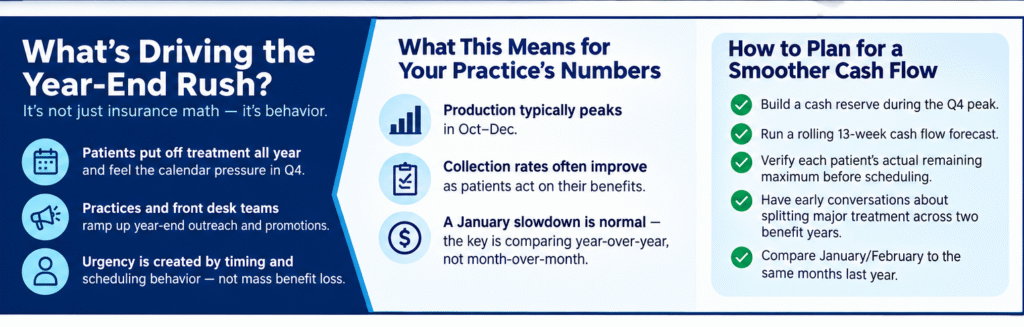
Build a cash reserve deliberately during the Q4 peak rather than treating the spike as spendable the moment it lands. The revenue that arrives in November and December needs to carry the practice through the naturally slower January-February stretch.
Run a rolling cash flow forecast, a 13-week view is a common standard, rather than reacting month to month. This surfaces a January shortfall while there’s still time to plan around it, instead of discovering it as it happens.
Verify each patient’s actual remaining maximum before scheduling year-end treatment, not just their general eligibility. Scheduling based on assumed benefit room, when only a small share of patients are genuinely near their cap, wastes urgency on patients who don’t need it and misses the ones who do.
Have the split-treatment-plan conversation early with patients facing major procedures, October at the latest, not the first week of December when there’s no longer enough runway to spread treatment across two benefit years.
Compare January and February performance to the same months in the prior year, not to the December peak, so a normal seasonal dip doesn’t get misread as a billing or collections failure.
Where Dental RCM Planning Fits Into This
A predictable dental insurance cash flow pattern isn’t something most practices build by accident, it comes from treating revenue cycle management as a planning discipline, not just a claims-processing function. Dental billing decisions made in October, which patients to prioritize, how aggressively to verify remaining benefits, how claims get queued during the highest-volume weeks of the year, directly shape how smooth or how rough January and February end up being.
CEC’s Dental Revenue Cycle Management Services build seasonal planning into the broader billing process, forecasting the Q4 production surge against the claims processing delay that typically follows it, so the cash flow dip in early Q1 is anticipated rather than discovered. On the front end, CEC’s Dental Insurance Billing and Verification Solutions confirm each patient’s actual remaining annual maximum before treatment is scheduled, so the year-end conversation is grounded in real numbers rather than a general sense of urgency.
Get a Free Q4 Cash Flow Plan
Find out how ready your practice actually is for the January-February slowdown. Our experts will forecast your Q4 production surge against the claims cycle that follows it, so the cash flow gap is anticipated, not discovered.
Get a Free Q4 Cash Flow Plan →The Bottom Line
The dental insurance year-end rush is real, but it’s largely a scheduling and behavioral phenomenon, not a mass event driven by patients genuinely about to lose meaningful benefit dollars. The actual financial risk sits on the other side of it: the cash flow gap between a heavy Q4 production month and the slower claims and collections cycle that follows into January. Planning for that gap ahead of time, not reacting to it in February, is what separates a practice that handles the seasonal swing smoothly from one that scrambles every year. Contact CEC to build a year-end cash flow plan before the Q4 rush hits.
FAQs
Do most dental patients actually reach their annual insurance maximum?
No, and this surprises most practice owners. ADA Health Policy Institute data shows only about 3.4% of patients reach their annual maximum in a given year, with another 3.3% coming within $100 of it. The year-end rush is driven more by scheduling behavior and calendar urgency than by a large share of patients genuinely maxing out their benefits.
Why does dental practice cash flow get tight in January and February after a strong Q4?
Because production and cash collection run on different timelines. Heavy November and December production doesn’t turn into deposited cash until claims process, often weeks later, while fixed costs like payroll and rent continue on their normal schedule. Practices that don’t reserve part of their Q4 revenue specifically for the slower months that follow can end up cash-strained right when production naturally dips.
Do unused dental insurance benefits roll over to the next year?
No. Nearly all dental plans reset the annual maximum at the start of each new benefit year, and any unused amount from the prior year is simply gone. This is the mechanic behind the “use it or lose it” messaging, even though it applies to a smaller share of patients than most practices assume.
Is splitting a treatment plan across two benefit years actually worth it for patients?
Often, yes, particularly for major procedures that exceed a single year’s maximum. Spreading treatment across two calendar years lets a patient draw on two separate annual maximums instead of one, which can meaningfully reduce out-of-pocket cost. This only works as a strategy if the conversation happens early enough, typically by October, to actually plan the treatment timeline around it.
How should a dental practice compare its January production to know if something’s actually wrong?
Compare it to January of the previous year, not to the December peak that came before it. A drop from December to January is a normal seasonal pattern that repeats annually and isn’t itself a sign of a billing or collections problem. A meaningful decline compared to the same month a year earlier is the more reliable signal that something has actually changed.