Dental insurance verification in New Jersey takes more than a quick eligibility check. NJ practices deal with a payer mix that includes large regional carriers, self-funded employer plans, state Medicaid managed care, and two separate public employee programs, and each one has its own rules about what’s covered, who administers it, and what the patient will owe. Miss one detail and the claim comes back denied weeks later.
This guide is for New Jersey practice owners and office managers who want fewer surprises at checkout and fewer denials in the mail. It walks through what to confirm for each type of plan your patients are likely to carry and when it makes sense to bring in a New Jersey dental insurance verification service or a full-service dental billing company.
Why Dental Insurance Verification Is Different for New Jersey Practices

Most of the basics are the same everywhere: confirm the patient is active, check benefits, and note limitations. What changes in New Jersey is the mix of plans walking through the door and how many of them look alike on the surface.
A Payer Mix Led by a Few Large Dental Carriers
A handful of carriers cover a big share of NJ patients. Delta Dental of New Jersey describes itself as the state’s largest dental benefits company, and Horizon, Aetna, Cigna, MetLife, Guardian, and UnitedHealthcare all have a strong presence too. The catch is that the same carrier logo can sit on very different plans. Two patients with Horizon cards might have a fully insured small group PPO, a self-funded employer plan, a state employee plan, or Medicaid coverage through Horizon NJ Health. Each of those follows different rules, so the card alone tells you very little.
Patients Covered by New York and Pennsylvania Plans
Practices in Bergen, Hudson, and Essex counties see a lot of patients who work in New York. South Jersey offices see the same with Pennsylvania employers. Those patients often carry plans issued out of state, with different networks and fee schedules. Delta Dental is a good example: the Delta member companies in each state operate separately, so a patient’s plan may be administered by Delta Dental of New York or Pennsylvania rather than New Jersey. If your office is in-network with one and not the other, the patient’s estimate can be off by a wide margin.
What to Verify for Commercial PPO Patients in New Jersey
For commercial plans, the goal of dental insurance verification is to know what the plan will pay before you start treatment, not after the EOB arrives. Covering the standard items on a dental insurance verification checklist for front desk teams is the starting point. NJ practices should then pay extra attention to two areas.
State-Regulated vs Self-Funded Employer Dental Plans
Fully insured plans sold in New Jersey fall under state insurance regulation. Self-funded plans, which many larger employers use, are governed by federal ERISA rules instead, and the employer decides the benefit design. The carrier just administers it. That means two patients with the same carrier and the same employer size can have very different coverage. When you verify, ask whether the plan is fully insured or self-funded, and don’t assume a plan follows a benefit rule just because another plan from the same carrier does.
Frequencies, Downgrades, and Waiting Periods That Vary by Plan
These three details cause more surprise balances than anything else. Confirm whether cleanings are limited to two per calendar year or one every six months, since a patient seen in January and June may hit the limit differently depending on the wording. Check whether the plan downgrades posterior composites to amalgam fees, and whether crowns fall under a waiting period for new enrollees. Also note how much of the annual maximum is left, especially in the last quarter of the year when many patients schedule treatment before benefits reset.
Verifying State Medicaid Dental Eligibility for NJ Patients
If your practice accepts NJ FamilyCare, verification looks different. NJ FamilyCare is the state’s Medicaid and CHIP program. Most members are enrolled in a managed care organization, and dental benefits run through that plan. Some members still have benefits through the state’s fee-for-service Medicaid program instead.
Confirming the Patient’s Medicaid Managed Care Plan
The first step is finding out which managed care plan the patient is enrolled in, and then which dental administrator handles claims for that plan. Several MCOs use a separate dental vendor, so the payer ID and claim address may not match the health plan name on the patient’s card. Next, confirm that each treating provider in your office is actually enrolled with that specific plan. Being enrolled with one MCO doesn’t mean you’re in-network with the others, which is why the dental credentialing process for New Jersey providers needs to be current for every plan you accept.
Eligibility can also change month to month. The state has announced changes to NJ FamilyCare qualification rules starting in fall 2026, so checking status close to the appointment matters more than it used to.
Prior Authorization Rules for Medicaid Dental Procedures
NJ FamilyCare uses a single clinical criteria policy that the state and all MCOs follow for frequencies and medical necessity reviews. Some procedures require prior authorization, and orthodontic treatment is generally limited to members under 21 with documented medical necessity. Pull the current criteria before scheduling anything beyond routine care. Keep in mind that NJ FamilyCare is the payer of last resort, so if the patient has any other dental coverage, that plan has to be billed first.
Verifying New Jersey Public Employee Dental Plans
State and local government workers, teachers, and school staff often carry dental coverage through the State Health Benefits Program (SHBP) or the School Employees’ Health Benefits Program (SEHBP). These plans come with a few details that trip up offices unfamiliar with them.
Since January 2025, the Dental Expense Plan has been administered by both Horizon and Aetna, depending on which option the member picked. So you need to confirm which administrator handles the patient’s plan before you submit anything. The Dental Expense Plan allows out-of-network care, but the patient pays whatever the dentist charges above the reasonable and customary allowance. That affects how you quote the patient’s share.
The Dental Plan Organization option works differently. It’s administered by Aetna as an in-network-only DMO, and members have to select a primary dentist. If the patient hasn’t chosen your office, or your office doesn’t participate, the plan may not pay at all. For retirees, check the benefit tier too, since retiree plan tiers depend on whether the member had prior group dental coverage.
Common Denial Triggers From Missed Dental Insurance Verification in NJ
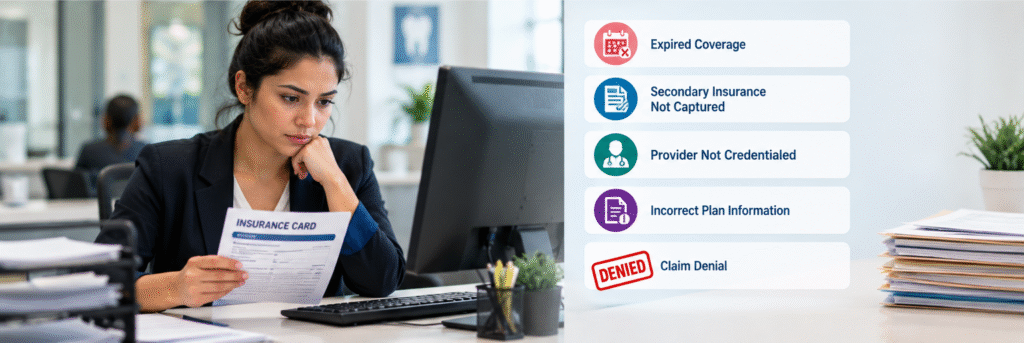
Most verification-related denials come from a short list of problems. Ask any experienced dental billing company and you’ll hear the same three again and again. Knowing them makes it easier to catch them before the claim goes out.
Terminated or Changed Coverage After a Job Switch
Patients rarely tell the front desk when they change jobs or when their employer switches carriers at renewal. The old card still looks valid, the claim goes to the old plan, and it comes back denied for termed coverage. By then, timely filing clocks with the new carrier are already running. This is especially common around January 1, when many group plans and the SHBP/SEHBP plan year renew.
Secondary Coverage That Was Never Captured
Married patients, patients with dependents on a parent’s plan, and Medicaid members with other coverage all create coordination of benefits situations. If the secondary plan isn’t on file, you either lose that payment or bill the plans in the wrong order and get a denial from both. Getting dental coordination of benefits for patients with dual coverage right starts at verification, when you ask about other coverage and record the subscriber details for each plan.
Provider Not Credentialed With the Patient’s Plan
A practice can be in-network while a newly hired associate or hygienist isn’t yet enrolled with that payer. The claim goes out under the new provider, and the plan processes it as out-of-network or rejects it outright. This happens a lot with Medicaid MCOs and with DMO plans that restrict care to enrolled providers. Verification should confirm the treating provider’s status, not just the practice’s.
When to Use a New Jersey Dental Insurance Verification Service
Verifying all of this for every patient takes time, which is why many practices hand it to a team that offers dental billing services alongside verification. Carrier calls often mean long hold times, portals don’t always show full benefit details, and the front desk still has patients to check in. When verification gets rushed, the denials show up a few weeks later.
What an Outsourced Dental Insurance Verification Service Covers
A verification team checks eligibility and pulls the full benefit breakdown for each scheduled patient, including frequencies, downgrades, waiting periods, remaining maximums, and secondary coverage. For Medicaid and public employee plans, they also confirm the plan administrator and provider enrollment. Practices that use dental insurance verification services for NJ dental offices typically get verified benefits back before the patient arrives, so estimates are accurate and treatment isn’t held up at the chair.
Why a New Jersey-Based Verification Partner Helps
A team that works with NJ carriers every day already knows which plans use separate dental administrators, how SHBP and SEHBP plans are split, and what NJ FamilyCare requires for authorizations. CEC is a dental billing company in the USA headquartered in East Rutherford, New Jersey. Its team verifies dental benefits for practices across the state and handles the rest of the revenue cycle through its dental RCM services, so practices that want to outsource dental billing later don’t have to switch partners. That local experience cuts down the back-and-forth with payers and helps catch the plan details that out-of-state teams tend to miss.
Conclusion
Good dental insurance verification in New Jersey comes down to knowing exactly which plan the patient has, who administers it, and what it will pay before treatment starts. That’s harder in NJ than in many states because of the mix of regional carriers, self-funded plans, NJ FamilyCare managed care, and state employee programs. Practices that treat verification as a detailed step instead of a quick yes-or-no check see fewer denials and fewer awkward conversations at checkout. For practices that want billing handled end to end, CEC also provides dental billing services in New Jersey for growing practices.
If your team is spending too much time on insurance calls, contact CEC to talk about how a New Jersey dental insurance verification service can fit your practice.
Talk to a New Jersey Verification Team
From NJ FamilyCare managed care to SHBP/SEHBP plans and out-of-state Delta Dental cards, CEC’s East Rutherford-based team knows the local payer mix. Let us verify your patients’ benefits before they hit the chair.
Talk to CEC →Frequently Asked Questions
How far in advance should NJ practices verify dental insurance?
Many offices verify two to three business days before the appointment. That leaves enough time to call the carrier if the portal is missing details, and to reach the patient if there’s a coverage problem. New patients and patients scheduled for major treatment are worth verifying earlier.
Do returning patients need insurance re-verified before every visit?
It’s safest to confirm eligibility before each visit and pull a full benefit breakdown at least once per plan year or whenever the patient reports a change. A quick eligibility check catches terminated coverage, while the full breakdown catches updated frequencies and remaining maximums.
Can a verification service update benefits directly in Dentrix, Eaglesoft, or Open Dental?
Yes, most verification teams work directly in your practice management system. They enter the verified benefits, limitations, and notes into the patient’s insurance record, so your front desk and treatment coordinators see the same information when they build the estimate.
Does insurance verification include pre-treatment estimates?
Verification gives you the benefit details needed to build an accurate patient estimate, but it isn’t the same as a formal pre-treatment estimate from the carrier. For larger cases, many practices still submit a pre-treatment estimate, and some verification services can prepare and send those as well.
What information does a verification team need from the front desk?
At minimum, they need the patient’s name, date of birth, subscriber name and date of birth, member ID, group number, and carrier. A copy of the front and back of the insurance card helps, along with details on any secondary coverage and the procedures scheduled for the visit.