
What is Denial Management in Medical Billing? A Complete Process
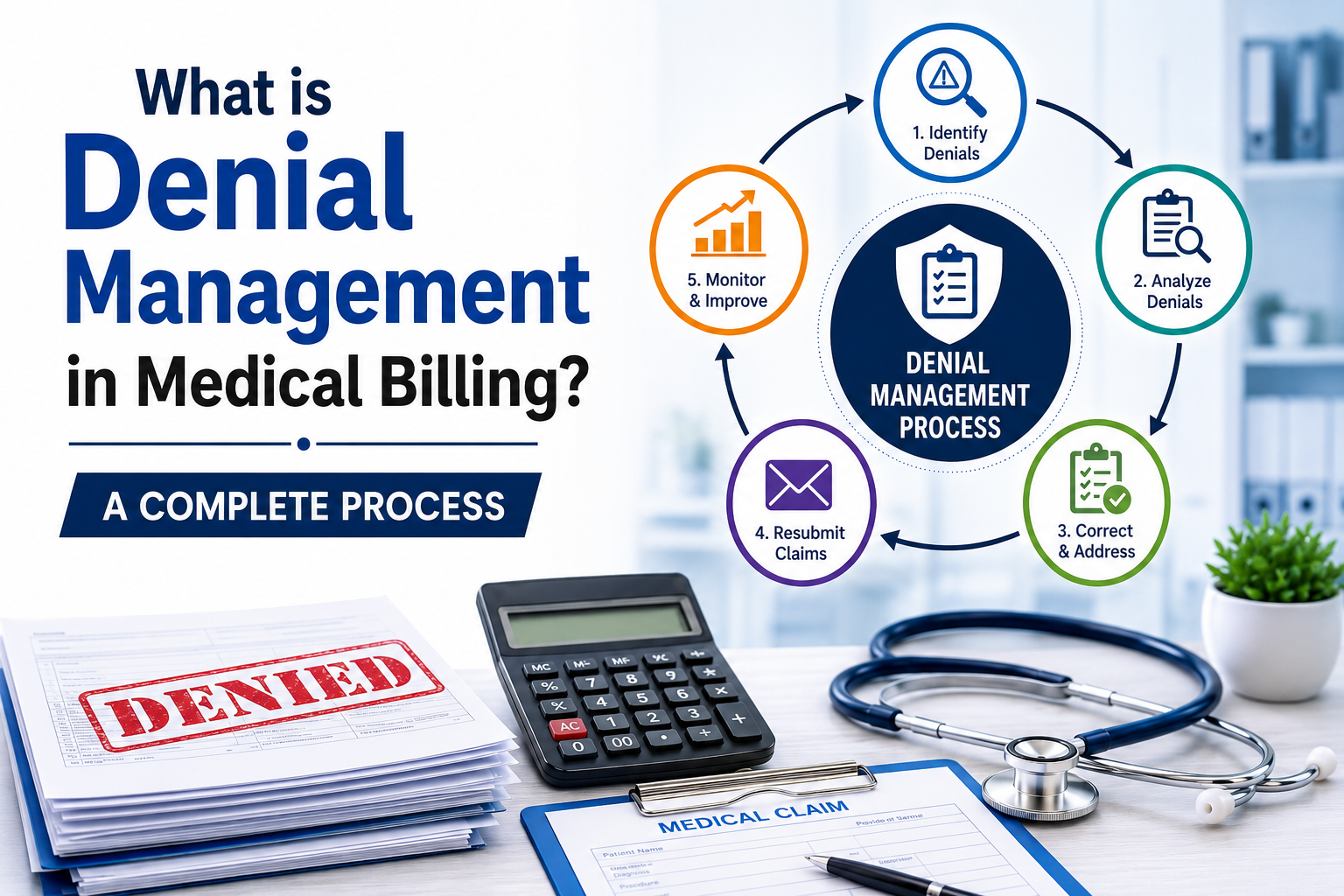
Claim denials remain one of the largest sources of preventable revenue loss in healthcare billing. Despite that, many practices still handle them reactively, correcting and resubmitting one claim at a time without asking why the denial happened in the first place. A claim reworked without understanding its root cause tends to come back denied again. A claim that misses its appeal window doesn’t get a second chance at all. Managing denials well takes more than persistence. It takes a defined sequence: catching the issue accurately, tracing it to its cause, choosing the correct path to resolution, and applying what’s learned so the same denial stops recurring. Below is a breakdown of what the denial management process looks like from the point a claim is rejected to the point it’s either paid or closed out, along with where medical and dental practices most commonly lose ground in between. What is Denial Management in Medical Billing? Denial management in medical billing covers the work of figuring out why a claim was rejected, correcting whatever caused it, resubmitting or appealing it to the payer, and using that outcome to reduce future denials of the same kind. Practices frequently handle the first three steps and skip the fourth. That’s how the same three or four denial reasons keep showing up month after month without any real progress against them. This also isn’t work that belongs to a single person. Front desk registration affects it. Coding affects it. Billing affects it. Occasionally the provider’s own documentation is the actual source of the problem, since a missing clinical note can trigger a denial just as easily as an incorrect billing code can. Denial Management vs. Denial Prevention The two terms get used as if they mean the same thing, and they don’t. Management happens after a claim has already been denied. Prevention happens before submission, through eligibility verification, accurate coding, and confirmed authorizations. Both matter. A practice that only manages denials after they happen, without investing in prevention, will always be working from behind. What Counts as a Denial in Medical Billing? A denial is a payer’s formal, documented refusal to pay a claim as submitted. It’s not the same as a rejection, which usually happens earlier, often at the clearinghouse level, before a payer ever reviews the claim’s substance. A denial means the payer looked at the claim and declined it for a specific reason, tied to a specific code. Soft Denials and Hard Denials Some denials are minor and some aren’t, and lumping them together slows everything down. A soft denial can typically be fixed and resubmitted without a formal appeal, a missing modifier, an incorrect date of birth, something in that range. A hard denial holds unless the practice files a proper appeal backed by documentation, and in certain cases the decision can’t be reversed at all, such as a service that genuinely wasn’t covered. What Actually Causes Claims to Get Denied The exact reasons shift by payer and specialty, but a handful of categories account for most of them. Coverage that lapsed or changed before the visit. Prior authorization that was missing or incorrect. Coding that doesn’t line up with the documentation on file. Claims filed past a payer’s deadline. Duplicate submissions flagged during processing. None of these are unusual, and most trace back to something in the front-end workflow that could have been caught earlier. The Denial Management Process, Step by Step Step 1: Identifying and Categorizing the Denial Every denial arrives with a reason code attached, and reading it correctly matters more than most billers give it credit for. Payers sort denials into groups, eligibility, authorization, coding, documentation, and sorting incoming denials the same way is what makes it possible to spot patterns later. Skip this step and a practice ends up reworking claims one by one forever, with no sense of whether the same problem keeps repeating. Reading the Code Before Acting on It A CO-16, missing information, needs a very different response than a CO-50, not medically necessary. Treating both the same way, correcting and resending without checking what the code actually says, wastes effort on claims that needed a documentation review or a conversation with the payer instead of a simple resubmission. Step 2: Root Cause Analysis Once a denial is sorted, the next question is why it happened. Was this a one-time data entry slip, or is a specific payer denying the same CPT code for the same reason for the fourth time this quarter? The answer changes everything downstream. A one-time error just gets corrected. A repeating pattern points to something structural, an outdated authorization workflow, a coding habit that’s slightly off, a documentation gap at the point of care, and until that gets addressed, the denial keeps coming back regardless of how quickly it’s resubmitted. Step 3: Correcting, Resubmitting, or Appealing This step splits depending on the type of denial involved. Choosing Between Resubmission and Appeal A soft denial usually just needs the error fixed, a corrected modifier, updated patient information, and a clean resubmission through the clearinghouse. A hard denial calls for a formal appeal: written justification, supporting clinical records, and occasionally a peer-to-peer discussion between the provider and the payer’s medical director. Treating a hard denial like a routine resubmission is a common misstep, and it almost never results in payment the second time either. Step 4: Tracking the Claim Until It Closes A denial that’s been corrected and resubmitted still needs to be tracked, because payers set firm windows for resubmission or appeal, sometimes as short as 30 days, occasionally stretching closer to 90. A claim sitting untouched past that window stops being a delay. It becomes a permanent loss. This is where a surprising amount of revenue disappears at smaller practices, not because the denial couldn’t have been won, but because nobody was watching the calendar. Step 5: Turning the Result Into Prevention The final step is what separates practices that actually improve from practices that stay busy forever.
What Is Ophthalmology Medical Billing? Everything You Need to Know

Ophthalmology billing is one of the most complex specialities in medical billing. It sits at the intersection of medical and surgical specialities, vision and medical insurance. Eye care practices deal with a wider range of CPT codes, ICD-10 requirements, and payer-specific rules than most other specialities. A single modifier error, a missing laterality code, or a timely filing lapse can result in a denial that takes weeks to resolve. In fact, Studies from the Medical Billing Advocates of America have consistently found that roughly 8 out of 10 medical bills contain at least one error. And ophthalmology practices, with their high procedure volume and payer-specific rules, are particularly exposed to these errors. Keep scrolling to find out how to get the fundamentals of ophthalmology medical billing services right from submission to reimbursement. What Is Ophthalmology Medical Billing? Ophthalmology medical billing is the process of coding and submitting insurance claims for services provided by ophthalmologists and eye care practices. It includes office visits, diagnostic testing, medical management, and surgical procedures. The plan covers everything from a routine comprehensive eye exam to complex retinal surgery, as well as both medical insurance and vision plan billing, depending on the nature of the service. Unlike general medical billing, ophthalmology billing involves a unique set of CPT code series (the 920xx range for eye-specific exams and the 66xxx–67xxx range for surgical procedures), a laterality requirement on most ICD-10-CM codes. It also determines when a service falls under a patient’s medical plan versus their vision benefit. Why Is Ophthalmology Billing More Complex Than General Medical Billing? Ophthalmology medical billing is more demanding than billing in general medicine. It is due to the following factors: Key Components of Ophthalmology Medical Billing A complete ophthalmology billing workflow involves six stages. Let’s take a look at them below: CPT Code Selection for Eye Care Services CPT code selection in ophthalmology begins with identifying the type of patient (new or established) and the level of service provided. The codes covered are: Accurate CPT codes require proper documentation that supports the level of service billed. Upcoding (selecting a higher-complexity code) could lead to unnecessary audits. On the other hand, downcoding reduces the revenue of your practice. ICD-10 Diagnosis Codes in Ophthalmology ICD-10-CM codes in ophthalmology are highly specific. Most require laterality, including right eye (suffix 1), left eye (suffix 2), or bilateral (suffix 3). Severity staging is also required for conditions like glaucoma. Here, the code must reflect whether the disease is mild, moderate, severe, or indeterminate. A diagnosis code that doesn’t match the documented findings or lacks required specificity might lead to denial. Use of Modifiers in Ophthalmology Claims Modifiers are important in ophthalmology, but are often misapplied. The most commonly used modifiers include: Insurance Eligibility and Coverage Verification Before you offer any service, confirm active coverage, identify the correct plan (medical or vision), and check whether the planned procedure requires prior authorisation. In recent days, payers have increased prior authorization requirements for repeat diagnostic testing, particularly for glaucoma and diabetic retinopathy follow-ups. If you miss the step, the claim will be denied, even though you have the accurate codes. Claims Submission and Clearinghouse Processing Claims are submitted electronically through a clearinghouse, where it be checked for formatting errors before forwarding to the payer. A clean claim, one that passes scrubbing without corrections, reaches the payer faster and gets processed sooner. If the claim scrubbing protocols at the submission stage are weak or inconsistent, then your practice may end with high denial rates. Payment Posting and Denial Follow-Up Payment posting confirms that ERA (Electronic Remittance Advice) amounts match the contracted fee schedule. If any discrepancies like payer underpayments, incorrect adjustments, or contractual write-offs are applied incorrectly in ophthalmology medical billing, they might lead to revenue leakage. Review the denied claims promptly, find the root causes, correct them and resubmit them within the time period. Most Commonly Used Ophthalmology Billing Codes Here’s a quick overview of common CPT codes used in ophthalmology medical billing services: Service Category CPT Code(s) Description New Patient Eye Exam 92002 / 92004 Intermediate/comprehensive (new patient) Established Patient Eye Exam 92012 / 92014 Intermediate/comprehensive (existing patient) Cataract Surgery with IOL 66984 One-stage cataract removal with lens implant Trabeculostomy (Glaucoma) 66174 Minimally invasive glaucoma surgery (MIGS) Intravitreal Injection 67028 Anti-VEGF therapy, retinal conditions OCT (Optic Disc) 92133 Optical coherence tomography, anterior segment OCT (Retina) 92134 OCT for retina and posterior segment Fundus Photography 92250 Retinal imaging for ongoing disease monitoring Visual Field Testing 92081 – 92083 Threshold/peripheral visual field (severity-based) Routine Eye Exam CPT Codes (92002, 92004, 92012, 92014) These four codes cover the standard ophthalmology office visit. The difference between intermediate and comprehensive is based on the breadth of the examination. It depends on how many elements of the eye are evaluated and documented. Surgical Procedure Codes (Cataract, Glaucoma, Retinal) Cataract surgery (CPT 66984) is the most commonly performed ophthalmic procedure and falls under a 90-day global surgical package. The package includes pre-operative care, the procedure itself, and all routine post-operative care within the global period. It means billing separately for routine follow-up visits within 90 days makes an mproper billing. Glaucoma surgery (66174 for trabeculostomy ab interno) and intravitreal injections (67028) are also high-volume codes with their own global period and documentation requirements. Diagnostic Testing Codes (OCT, Fundus Photography, Visual Field) Diagnostic code tests need to have two ICD-10 codes that justify their medical necessity. 92250 and 92134 can be denied by insurance companies when filed together unless the documentation justifies the need for both services. Common ICD-10 Codes for Ophthalmology Diagnoses Let’s take a look at the ICD-10-CM codes in ophthalmology billing: ICD-10 Code Condition Notes H26.x Cataract (various types) Specify: nuclear, cortical, posterior subcapsular H40.x Glaucoma Specify type and severity stage H33.x Retinal detachment/breaks Requires laterality documentation H35.31 Exudative AMD Macular degeneration, specify laterality H52.x Refractive errors Billed to Vision Plans H35.00 Diabetic retinopathy (background) Must link to diabetes code (E11.x) Common Ophthalmology Claim Denials and How to Prevent Them Denial rates in
Types of Medical Billing Systems in Healthcare

Is your practice’s billing system actually built for how you work, or is it just what came with the software? Many healthcare providers use medical billing systems that don’t match their patient volume, data-sharing needs, or compliance structure. And they’re losing revenue because of it. In fact, healthcare practices lose a major part of their revenue to billing inefficiencies, claim errors, and poorly integrated systems. The right healthcare billing system matched to your practice type can improve your cash flow and reduce administrative friction. There are four core types of healthcare billing systems in use today: closed, open, isolated, and cloud-based. Each is built around a different model for storing, sharing, and processing patient and billing data. Keep scrolling to find out which one fits your practice. What Are Medical Billing Systems and Why Do They Matter? Medical billing systems are the software frameworks that manage the financial side of patient care. It includes recording charges, coding diagnoses, submitting claims, posting payments, and tracking outstanding balances. They play an important role in a practice’s revenue cycle and determine how efficiently every billing task gets done. The type of system a practice runs also determines how patient data is stored, who can access it, and how billing integrates with clinical workflows. Those factors have compliance, security, and operational implications that go well beyond the billing department itself. How Many Types of Medical Billing Systems Are There? There are four primary types of medical billing systems: closed, open, isolated, and cloud-based. Let’s understand them in detail: Type 1. Closed Medical Billing Systems What is a closed system? A closed medical billing system keeps all patient health records and billing data within the boundaries of a single practice or facility. Records stay internal, and no external sharing with other providers, payers, or third parties is built into the system’s design. Role of Electronic Medical Records (EMR) The core tool of a closed system is the Electronic Medical Record (EMR). An EMR is a digital version of a patient’s chart; it records visits, diagnoses, prescriptions, and treatment history within the practice. It can be shared between providers in the same office but lacks external access. Some EMR functions in a closed billing system: Best Fit: Who Should Use a Closed System? Closed systems suit: Type 2. Open Medical Billing Systems An open medical billing system is built for collaboration. They are designed for healthcare environments where multiple providers need access to the same patient information. A patient seeing a primary care physician, a specialist, and a hospital billing team might have their data handled across all three points in an open system. Role of Electronic Health Records (EHR) Open systems run on electronic health records (EHR). Unlike EMRs, EHRs are designed for cross-organization access. They store comprehensive health histories, allergies, medications, lab results, imaging reports, and billing records. They can be accessed and updated by multiple authorized providers across different locations. Key functions of EHRs in an open billing system: Best Fit: Who Should Use an Open System? Open systems are the right fit for If your medical billing services involve sharing data across departments or external billing teams, an open EHR-based system is the right choice. Type 3. Isolated Medical Billing Systems In an isolated medical billing system, health records are not held by a practice or hospital. Instead, the patient manages their own data through a personal record system. Providers contribute data to that record only when the patient chooses to share it. It gives patients full control, but they have to deal with the burden of record-keeping. Role of Personal Health Records (PHR) The defining tool of an isolated system is the Personal Health Record (PHR). PHRs allow patients to compile their own health data from different providers, health apps, and wearable devices into a single patient-managed record. Examples include Apple Health, Microsoft HealthVault, and Google Health. Roles of PHR in billing: Best Fit: Who Should Use an Isolated System? Isolated systems aren’t typically used as the primary billing infrastructure for a practice. They’re most relevant for Type 4. Cloud-Based Medical Billing Systems A cloud-based medical billing system delivers billing software as a service (SaaS). The vendor hosts the platform, manages updates and security, and provides access through a web browser or app. The practice doesn’t own the infrastructure; it subscribes to it. It lowers the upfront cost of advanced billing technology and makes enterprise-grade features accessible to small and mid-size practices. Role of Practice Management Systems (PMS) Most cloud-based billing systems operate through a practice management system (PMS). It is a platform that combines scheduling, patient registration, charge capture, claims submission, payment posting, and reporting in one environment. Cloud PMS platforms often integrate with EHRs to create a unified clinical and billing workflow. A cloud PMS typically handles the following: Best Fit: Who Should Use a Cloud-Based System? Cloud-based systems suit practices of all sizes. But they’re well-suited to growing practices and multi-location groups. These systems also simplify compliance maintenance for providers considering outsourcing their medical billing services. The vendor manages the security updates and HIPAA-related patches. Key Differences Between All Four Medical Billing Systems Factor Closed Open Isolated Cloud-Based Record Type EMR EHR PHR PMS / Cloud EHR Data Sharing Internal only Multi-org Patient-controlled Internet-accessible Best For Solo/small practice Multi-dept / large org Patients managing own data Any size, scalable Setup Cost Moderate Higher Low Low upfront (SaaS) HIPAA Compliance Practice-managed Shared responsibility Patient-managed Vendor + practice shared Scalability Limited Moderate Low High How to Choose the Right Healthcare Billing System for Your Practice If you want to choose the right medical billing system, you need to do more than compare software features. Here’s how to get it right from the start: Practice Size and Volume Considerations Smaller practices with one or two providers and limited patient volume can operate on a closed system. But as volume increases and referral relationships become more complex, you need to opt for an open or cloud-based platform. Data Sharing and Integration
AI in Medical Billing: Trends, Challenges, and What to Expect in 2026 and Beyond

What if your billing system could identify errors before claims are submitted and predict revenue risks in real time? AI in medical billing makes this and a lot more possible. It is precisely the application of machine learning, natural language processing, and automation tools to streamline billing workflows. The article explains how AI in medical billing is transforming the healthcare revenue cycle. Let us explore more: Did you know? 94% of healthcare organizations affirm that AI finds a non-negotiable place in their fundamental operations. Medical billing automation with AI lowers the number of manual errors by 60-80%. Artificial intelligence is transforming medical billing by reducing coding errors by 38 percent and 25 percent of administrative expenses. What is AI in Medical Billing and Why It Matters in 2026 Medical billing AI can be defined as the use of modern technologies, including machine learning, natural language processing, and rule-based automation, to streamline the overall billing process in healthcare systems. AI in medical billing is of significant importance in 2026 as it caters to numerous perks. It allows smart clinical data mining of electronic health records, automated medical coding in accordance with both ICD and CPT standards, real-time claim verification, and predictive denial control depending on past payer behavior. AI medical billing solutions can detect anomalies, predict reimbursements, and constantly increase billing accuracy. How AI in Medical Billing Is Reshaping Healthcare Revenue Cycles AI is transforming the meaning of AI in revenue cycle management as it is turning processes into corrective actions rather than proactive optimization. Rather than detecting problems once a claim has been submitted or rejected, AI can provide real-time intelligence throughout the entire billing lifecycle, which is faster and more accurate. According to McKinsey, AI can optimize revenue cycles with a 30-60% decrease in cost to collect, quicker cash realization, and an enhanced patient value. Automated Coding: Natural language processing is used by AI systems to retrieve structured information in clinical documentation and translate it to correct ICD and CPT codes. AI algorithms are trained on millions of records and can explicitly scan clinical documentation and suggest or assign codes. This minimizes coding errors, enhances compliance, and reduces reliance on manual review of codes, particularly in high-volume settings. Real-Time Claim Scrubbing: Claim scrubbing engines are AI-driven to confirm claims prior to their submission by verifying the absence of data, use of incorrect codes, and payer-specific regulations. This pre-submission validation will greatly lower the rejection rates and also speed up the first-pass claim acceptance. Denial Prediction: Through historical claims data analysis and payer behavior patterns, AI can determine high denial claims. This will enable billing teams to act proactively to correct the situation, increase approval rates, and minimize rework. Payment Forecasting: With the help of AI models, previous reimbursement patterns, payer schedules, and claim statuses are analyzed to forecast future cash flow more precisely. This assists the providers in improving their financial planning and having better control over the revenue cycles. Workflow Automation: AI automates routine processes, including checking eligibility, tracking claim status, and follow-ups. This saves on the administrative load, enhances turnaround time, and enables the billing teams to concentrate on high-value tasks that are complex. Key Regulatory Changes Impacting AI in Medical Billing in 2026 Here are the key regulatory changes impacting AI in medical billing: CMS Regulations Starting in 2026 The regulatory frameworks in 2026 are exerting more pressure on transparency, auditability, and standard reporting across healthcare billing systems. The providers now have to keep meticulous audit trails, support their coding choices, and prove that they adhere to the payer-specific instructions. WISeR Model Launch and Its Impact on Billing The WISeR model proposes tightening the process of prior authorization and making the data submission more structured and quicker in responding. This complicates the operations, particularly among the multi-specialty providers. Services and States Affected by New Authorization Rules Authorization requirements are increasingly becoming fragmented depending on the type of service, payer policies, and geographic regions. This brings discrepancies in the billing processes of providers that are working in more than one state. AI supports the standardization of these processes by dynamical application of payer-specific rules, which will ensure that claims meet both the regional and service-level requirements without human intervention. Critical Prior Authorization Deadlines Providers Must Track Failure to meet the authorization deadlines is one of the major reasons claims are denied. The tighter schedules in 2026 render manual tracking unreliable. The systems are automated to deliver AI-driven notifications, deadlines, and workflow prioritization to guarantee timely submissions. This goes a long way to minimize unnecessary denials and increase rates of claim approvals. 2026 CPT Code Updates and Their Billing Impact Medical coding and billing are becoming more complex due to frequent changes in CPT codes. These changes may result in compliance risks and errors during manual adaptation. The AI systems constantly revise the coding logic, confirm the use of codes with the current standards, and help the billers with correct code recommendations. This enhances the accuracy of coding and decreases rework. The Rise of Agentic AI in Medical Billing The concept of agentic AI is a transition from assistive automation to autonomous decision-making in billing systems, in which intelligent systems can autonomously perform tasks, modify workflows, and optimize results based on real-time data. It audits claims prior to their submission with a view to detecting mistakes, provides follow-ups on rejected or slow claims, optimizes workflows according to the behavior and response trends of payers, and aligns the work of billing, coding, and accounts receivable teams. Such freedom eliminates the need to rely on manual control and speeds up the whole billing process. According to Deloitte, around 80% and more healthcare systems are investing in agentic AI for revenue cycle management, everyday operations, and patient care. What Providers Experienced with AI in Medical Billing in 2025 The Benefits of AI in Reducing Manual Work Repetitive administrative work was substantially reduced in 2025 among the providers. Coding validation, eligibility checking, and tracking claims were automated with AI, and
Payment Posting In Medical Billing: How Does It Work and Why Is it Important?

Is your practice collecting payments but still struggling to understand where the money is going? In healthcare revenue cycle management, payment posting is the point where financial clarity begins. Even a small error in posting can disrupt cash flow, reporting, and patient trust. Read this blog to understand how payment posting in medical billing works and why it is important for maintaining accurate revenue tracking and improving cash flow. What is Payment Posting in Medical Billing and Why It Matters Payment posting is a medical billing process that is used to maintain the payments made by insurance companies and patients in the billing system. It includes matching payments to claims, rectifying accounts receivable, and detecting problems such as denials or underpayment. Billing and payment errors in healthcare cause major financial inefficiencies, leading to nearly $125 billion in annual losses for U.S. providers. This underscores the reason why payment posting is not only a bookkeeping activity but an important operation for financial transparency, revenue management, and operational efficiency. When properly implemented, it gives a clear visibility of the collected, outstanding, and lost revenue, minimizes revenue leakage, compliance risk, and patient dissatisfaction due to billing errors. Where Payment Posting Fits in the Medical Billing Revenue Cycle Posting payment is a very important process in the healthcare revenue cycle, and it follows the submission and adjudication of claims. It is the step in which payments are registered and financial information is put into action. The revenue cycle usually comprises: Patient registration and charge capture Coding and claim generation Payer adjudication Payment posting Denial management and follow-ups. Bills and collections of the patients. At this point, insurers and patient payments are correctly documented in the billing system, as well as adjustments, write-offs, and patient responsibility balances. Any exemptions like underpayments, refused, or partially paid claims are noted and highlighted to investigate further. This renders posting of payments beyond a transactional activity. It serves as an important bridge between reimbursement and revenue realization, where all the dollars are monitored, reconciled, and better financial performance is achieved. Types of Payment Posting in Medical Billing Here are the key types of payment posting in medical billing that ensure accurate recording and efficient revenue tracking: Insurance Payment Posting Insurance payment posting refers to the process of recording the payment that is received by the insurance companies according to the Explanation of Benefits or Electronic Remittance Advice. It contains the implementation of contractual changes, deductibles, copayments, and coinsurances, and verifies the allowed amounts with payer contracts. The process also aids in the detection of underpayments, denials, or discrepancies that need to be followed up on in order to safeguard revenue integrity. Patient Payment Posting Patient payment posting focuses on documenting payments made directly by patients through various modes such as cash, credit cards, checks, or online portals. It ensures proper updating of patient balances, accurate allocation of payments to individual encounters, and appropriate handling of overpayments or refunds. This increases billing transparency and improves the overall patient financial experience. ERA (Electronic Remittance Advice) Posting ERA posting is automated, and payments are posted based on electronic remittance files that are received by insurance payers. It saves on manual work, enhances accuracy and increases the speed of the posting cycle. Automation also reduces human errors and enables quicker determination of payment variances and denials. Around 80% of the healthcare providers are using ERA to accelerate payment posting. Manual Payment Posting Manual payment posting is performed when payments are recorded from paper EOBs or non-standard formats that cannot be automated. Though it is time-consuming, it is required in dealing with complex cases, secondary claims or exceptions, where automation cannot be done. Precision and keenness to detail are paramount in this process to prevent financial anomalies. Denial and Adjustment Posting Denial and adjustment posting is an accounting method where denied claims, partial payments and other adjustments, including write-offs or contractual differences, are recorded. It assists in classifying the reasons of denial, assists in the analysis of root causes, and allows taking effective follow-up measures. The denials are properly tracked to improve collections and minimize revenue leakage in the long run How Does Payment Posting Work in Medical Billing Step-by-Step Payment posting follows a structured workflow to ensure accuracy and completeness: Receive Payment Information: Payments are made through EOBs, ERAs, or patient transactions. These involve the payments of different types of payers, including commercial payers, government programs, and direct patient payments through different channels. Remittance advice is provided with every payment and includes claim status, adjustment codes, reasons for denial, and payment breakdowns. Validating file formats, segregating batches by payer, and making sure all remittance files are complete are also part of proper intake. The accuracy of capturing this information would mean that no payments would be missed and that all the transactions would be prepared to be processed downstream. Check Payment Accounts: The payment amounts are checked against claim charges and anticipated reimbursements. This involves verification of payer contracts, fee schedules, allowable amounts, and adjustment codes to achieve accuracy. Teams usually compare remuneration with the agreed rates to identify under-payments or over-payments. Any differences are recorded and tagged to be escalated or corrected so that financial integrity is maintained before posting. Post Payments in the System: Payments are recorded in the billing system against the respective claims. All entries are cross-linked to the appropriate patient account, encounter, date of service and procedure codes. High-volume transactions are normally handled using batch posting techniques in order to enhance efficiency. Proper posting of accounts keeps the account balances and financial statements accurate. Why Payment Posting in Medical Billing Is Critical for Cash Flow and Accuracy According to a study, most healthcare providers lose around 3-5% of their potential revenue because of payment posting errors alone. Here is why payment posting in medical billing is critical for maintaining cash flow stability and ensuring financial accuracy: Ensures Accurate Financial Reporting Posting of payments ensures that there is a clear record of the revenue collected and write-offs. This
What is authorization in medical billing? Learn the types, process, and working
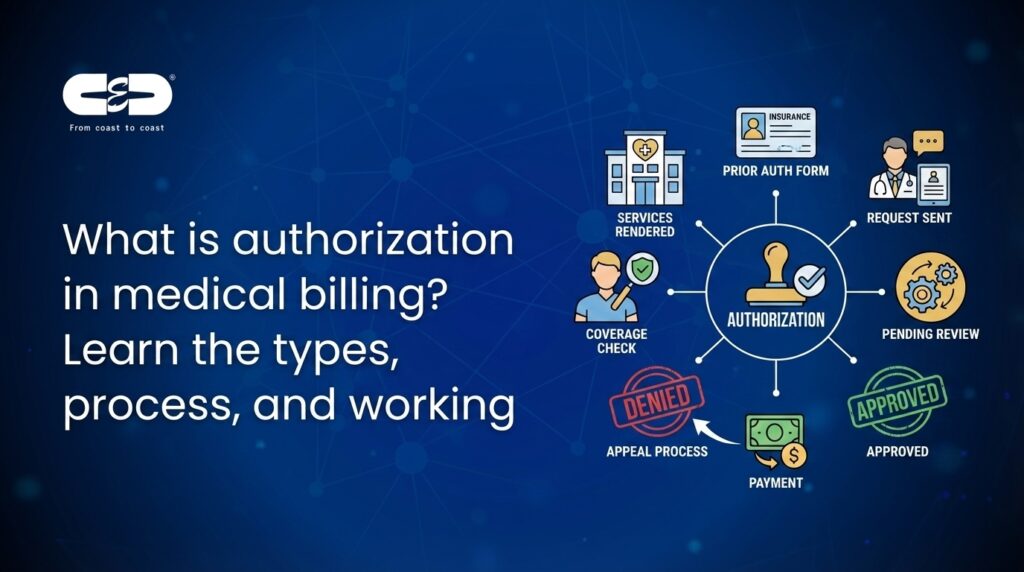
Have you ever had a claim denied simply because approval was not obtained before the patient walked in? It happens across US practices every single day. Authorization in medical billing is the process insurers use to approve services before or, in some cases, after they are delivered. When managed well, it protects reimbursement. When mismanaged, it creates denials that are difficult to overturn and revenue that is rarely recovered. The AMA reports that physicians now complete nearly 40 prior authorizations per week. In fact, nine in 10 physicians (93%) say authorization delays have negatively impacted their patient care. So what is authorization in medical billing, and how does the process help in the revenue cycle of your practice? Let’s understand. What is authorization in Medical Billing, and why does it directly impact Claim Approval Authorization in medical billing is the process of obtaining approval from the medical insurance provider before a service is delivered. The main goal is to inform and get confirmed approval that the insurance claim for the necessary medical service will be provided. In most cases, if the authorization for medical billing is not performed, the insurance company has the right to deny or reject the claim, which can result in the patient paying the full cost of the medical treatment or service. This authorization process also directly impacts the claim approval process: 90% of the doctors agree that prior approval slows down patient care. Incorrect prior authorizations can result in a 20% delay in reimbursements. Moreover, errors in eligibility and authorization can result in 35% of the claim denials. Thus, ensuring an accurate and optimized authorization in medical billing is necessary to boost the claim acceptance rate. Types of Authorizations in Medical Billing Used by Insurance Providers In medical billing, the authorization for claims can be of different types, depending on the urgency of the treatment, the type of medical care required, the healthcare service provider, etc. Prior authorization (pre-authorization) in Medical Billing A healthcare RCM specialist, ‘Gett Johnson,’ said that, “Prior authorization increases collection and reduces denials. “It also helps healthcare providers to enhance their focus on patients.” Prior authorization—also called pre-authorization or pre-cert—is the most common and most operationally demanding type. It requires the provider to obtain approval from the insurer before the service is delivered. The insurer reviews clinical documentation, applies its medical necessity criteria, and either approves, modifies, or denies the request. But how does prior authorization work in practice? Here’s the workflow: The provider submits a request — including CPT codes, diagnosis codes, clinical notes, and supporting documentation — typically by phone, fax, or through the payer’s online portal. Turnaround times vary by payer and urgency, ranging from 24 hours for urgent cases to 10–14 business days for non-urgent elective procedures. Concurrent authorization During Ongoing Treatment Concurrent authorization applies to ongoing or inpatient care—situations where treatment is already underway, and continued coverage must be approved in real time. This type is most common in hospital inpatient settings, intensive outpatient programs, and skilled nursing facilities. The insurer’s utilization review team evaluates whether continued treatment remains medically necessary, typically on a daily or per-episode basis. Missing a concurrent review window can result in the denial of coverage for days of care already delivered. Retrospective authorization for Emergency Cases Retrospective authorization, also called post-service authorization, is requested after a service has already been delivered, typically because the clinical situation was urgent and there was no time for prior approval. Most payers allow a defined window, commonly 24 to 72 hours after the emergency encounter, for retrospective authorization requests. Outside that window, the claim is typically denied. Practices that handle emergency care must have a clear protocol for initiating retrospective authorization requests promptly after every unplanned admission or emergency procedure. Referral-Based authorization for Specialist Care Referral authorization is a specific subtype used primarily by health maintenance organizations (HMOs) and some preferred provider organizations (PPOs) plans, where a patient must obtain a referral from their primary care physician before seeing a specialist. The referral generates an authorization number that must appear on the specialist’s claim. Billing without a valid referral authorization—or with an expired one—results in denial. How Does Prior Authorization Work in Medical Billing Step-by-Step Here’s a step-by-step process of how prior authorization works in medical billing: Identification of the Medical Services Required: At first, a detailed analysis of the patient’s insurance plan and the CPT details mentioned are verified and confirmed. The eligibility of the patient for the claim is also validated. Collection of the Documents: All the necessary and supporting documents, including the test results, doctor’s note, and treatment history, are collected. Authorization Request Submission: Finally, the request for medical billing authorization is submitted, whether online, telephonically, or through email or fax. Request Follow-up: The authorization request is followed up on regularly before the scheduled medical service. Authorization Number Tracking: After the approval is received, the details of the approval, including the CPT codes, authorization number, etc., are recorded and updated in the billing system. Verification of the Authorization at the Time of Medical Procedure: The validity of the authorization is again verified when the medical service is about to be availed. Adding Authorization Details in the Claim: The complete authorization details, along with the number, are added to the claim form Services That Commonly Require Authorization in Medical Billing It is not necessary that for every medical treatment or service you will be required to follow the authorization medical billing process. Here are some of the most common services that require authorization: High-Cost Procedures and Surgeries Major surgeries like transplants, orthopedic surgeries, and cardiac procedures, which often require high-cost medical services, require authorization. Diagnostic Imaging and Lab Tests Advanced imaging services like MRI, CT, and PET scans require authorization because of their high use and cost. Specialty medications and behavioral health services Behavioral health treatments, like therapies, psychiatric treatment, and counseling sessions, mostly require authorization. Similarly, to ensure cost management for several medications, authorization is mandatory. Why authorization in Medical Billing Has
Do Medical Bills Affect Your Credit? Why Do Proper Billing Services Matter?
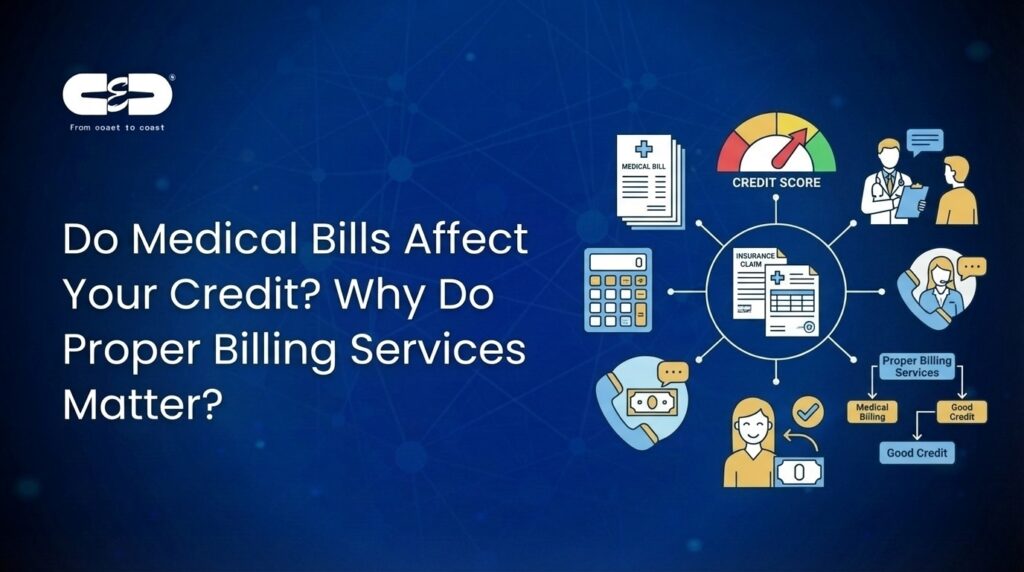
Healthcare expenses remain one of the leading causes of financial strain in dental clinics and hospitals. Unexpected medical costs, insurance disputes, and delayed reimbursements create billing complications that extend from healthcare facilities to personal credit profiles. Medical bills can significantly affect your credit. According to Consumer Financial Protection Bureau CFPB data, medical debt accounts for a significant portion of collection items on consumer credit reports. Credit reporting reforms have decreased some of the effects of recent years on medical bills, which remain unpaid or wrongly processed because they still enter collection systems. The article demonstrates the connection between medical bills and credit reporting systems while showing that medical billing services protect patients from financial damage and healthcare providers from losing revenue. How Can Medical Bills Affect Your Credit? Medical providers do not directly report unpaid bills to credit bureaus. A collection agency may receive the bill after it remains unpaid for an extended period. The account enters collections, allowing it to appear on a credit report. Recent credit reporting changes include the following: Unpaid balances that exceed reporting thresholds continue to harm credit scores despite these changes. Collection accounts function as financial risk indicators that credit scoring models use to assess creditworthiness. The scoring system reduces scores by 50 to 100 points because of this financial risk assessment. Medical Debt and Credit Reporting Rules Scenario Credit Impact Bill paid before 365 days No impact Paid medical collection Removed from credit report Unpaid under $500 Not reported Unpaid over $500 after 365 days Reported to credit bureaus These updates reduce consumer harm but do not eliminate risk. The Role of Professional Medical Billing Services The professional medical billing services deliver accurate claim submission together with their services, which guarantee timely insurance follow-up and an accurate payment posting system. Their function helps stop billing errors, causing patients to accumulate unnecessary debt. The main functions of the system include: The industry benchmarks show that almost 20% of medical claims receive their first denial because of administrative mistakes, which do not involve clinical problems. The effective billing services help organizations to reduce their denial rates while achieving faster payment processing times. The billing professionals achieve their task of settling claim disputes because they handle all issues before accounts reach their aging period, which creates risk for collection activities. Common Billing Problems That Affect Credit Healthcare revenue cycle studies estimate that up to 65% of denied claims are recoverable. This means that proper billing intervention can prevent many financial escalations. How Can Patients Protect Their Credit? Patients can reduce their credit risk by following these specific steps, which include: The process of checking credit reports at regular intervals enables people to find false medical debt collections that require correction through their credit reports. Federal law permits consumers to dispute credit report errors directly with credit bureaus. How Do Proper Billing Services Help Providers? The use of medical billing services enables providers to enhance their revenue cycle performance while maintaining positive relationships with their patients. The system offers multiple advantages, which include: Table: Impact of Structured Billing Services Metric Without Professional Billing With Professional Billing Initial Denial Rate 15 – 20% 5 – 8% Average AR Days 45 – 60 25 – 35 Collection Escalations High Reduced Patient Satisfaction Variable Improved Billing systems that providers establish for their operations enable them to maintain their financial operations correctly while they provide treatment to their patients. Importance of Transparent Billing The need for transparency exists because it helps prevent situations that lead to people experiencing financial problems. The best practices should include: Patients are more likely to pay bills on time when they receive transparent explanations of charges. Customers experience difficulties when they receive confusing bills because it causes them to dispute their charges and pay their bills later. The method of transparent billing allows healthcare providers to establish stronger relationships with their patients while diminishing the risks to their professional reputation. Steps to Ensure Accurate Medical Billing The healthcare industry needs to execute these security measures: The use of automation tools leads to a 30% reduction in claim errors, which results in lower unpaid balances that go to collections. The healthcare facilities experience direct financial relief through accurate billing, which benefits both patients and their operations. How do multi-location practices benefit? Large healthcare networks and multi-location practices face increased billing complexity due to Centralized medical billing services provide the following: The healthcare system can save between 2 – 3% in denial rates, which results in annual revenue recovery that reaches hundreds of thousands of dollars through multi-site systems. The process of efficient billing helps to maintain steady cash flow while it decreases the number of collection cases that can harm patient credit. The Bottom Line The relationship between medical billing and personal finance health is undeniable. Unpaid medical bills can end up in an agency’s collection as sold, and this can appear in a consumer’s credit report, which can negatively impact the consumer’s credit score. However, much of this financial harm is preventable, and it is only possible through accurate medical billing. Service providers, like CEC, can help in streamlining the medical billing tasks as an expert team utilizes advanced and proprietary dental billing software to automate repetitive tasks. This ensures that all the billing inaccuracies are sorted before the final claim submission. Besides, the team handles the process end-to-end, including patient communication. Hospitals and clinics can reduce the denial rate and improve processing time, and patients can get structured billing to prevent all financial harm. FAQs No. The credit reporting system requires a 365-day period during which unpaid medical collections stay hidden from credit reports. Medical collection accounts under $500 are not reported to credit bureaus. Yes. Paid medical collections are removed from credit reports. They reduce billing errors, leading to faster insurance payments while protecting patients from accumulating unnecessary debt.

From Manual to Intelligent: The Evolution of Medical and Dental Billing Outsourcing Medical billing is the backbone of the healthcare system, ensuring providers get paid for their services. Billing’s shift from manual, paper-based processes to the digital world reflects years of regulatory change and technological improvement. Outsourcing billing, however, has become strategic for hospitals, clinics, and private practices. It reduces administrative load, increases revenue cycle efficiency, and lets teams focus on what really matters in the long run: patient care and the organization’s financial health. But this change took time. We will focus on the journey of medical billing and the role of technology throughout the journey. The Early Days: Manual Medical & Dental Billing From 17th-century disease record keeping to today’s fully-fledged global health standards, international collaboration and continuous innovation have shaped the frameworks behind modern healthcare data systems. Medical coding has a long history. It traces back to William Farr’s advocacy for global disease classification in the 19th century, followed by Jacques Bertillon’s system of international classification, which gained rapid global traction in 1893. It made consistent mortality statistics possible, which laid the groundwork for evidence-based medicine, standardized coding, and contemporary epidemiology. Moving forward, global health data standardization began in 1948 with the World Health Organization’s formalization of the International Classification of Diseases. This significant advancement made medical coding a single, global language of health rather than a collection of regional systems. Why Manual Billing Didn’t Scale? Before computerized systems were developed, medical billing was a laborious process that involved a lot of paperwork, manual record-keeping, and a higher frequency of errors. Healthcare providers used handwritten notes to record patient visits, treatments, and billing information. This approach increased the likelihood of errors and data loss in addition to wasting a significant amount of time and money. Additionally, the drawn-out process of filing claims with insurance carriers causes medical practices to experience financial difficulties and payment delays. The First Shift: Outsourcing Medical & Dental Billing When the Regenstrief Institute created the first electronic medical record (EMR) in 1972, the 1970s saw a change. It was expensive, but it paved the way for digitization. Coding speed was increased, and claim errors were decreased with the use of personal computers and encoder software. Leapfrog Group accelerated the digitization of healthcare by promoting computer-based order input. Outsourcing growth and billing efficiency were enhanced by digital records, standardized coding, and insurance expansion. EHR systems became widely used in 2009 thanks to the HITECH Act and ARRA. In order to cut expenses and increase accuracy, healthcare providers started outsourcing billing. With scalability, quicker claims processing, and better revenue cycles, offshore outsourcing grew. Next Shift: Automation Enters Billing Revenue cycle management transformed as a result of the use of technology in medical and dental billing outsourcing. But because of developments like cloud-based solutions, robotic process automation (RPA), and AI-powered billing software, billing businesses can now process claims more quickly, accurately, and with less administrative strain on healthcare providers. Automation benefited the overall procedures by: The adoption of automated claim processing is one of the biggest developments in medical billing outsourcing. Automation has decreased claim denials by 30%, while traditional billing techniques often resulted in delays and inaccuracies. Outsourced companies used cloud tools for instant eligibility checks. Results? Reduced errors, workloads, and rapidly processed claims. Blockchain technology and HIPAA-grade encryption safeguard data. RPA reduced errors by automating billing operations. This led to stronger security, more precision, and improved regulatory compliance. Present Era: Intelligent, AI-Powered RCM Outsourcing The way billing companies function has changed due to the integration of cloud-based platforms, robotic process automation (RPA), and AI-driven billing software. Another game-changer is outsourcing dental insurance verification, which guarantees real-time eligibility checks and reduces approval waits. AI expedites reimbursements, lowers errors, and automates claims. It increases first-pass approvals, detects problems early, and enhances cash flow. Outsourced RCM agencies use machine learning that examines claim data and forecasts denials. Teams reduce revenue loss by correcting errors before submission. Chatbots manage insurance verification, billing inquiries, and claim tracking. This enhances patient satisfaction and reduces workload. AI-powered systems lower fraud risks and fines by spotting odd billing trends and guaranteeing regulatory compliance. Healthcare providers can now anticipate quicker payments, better compliance, and less administrative work as medical billing outsourcing firms continue to use AI-powered solutions. How Intelligent Outsourced RCM Transformed Billing? AI-driven RCM outsourcing removes tedious activities and uses predictive analytics to enable revenue forecasting. You get industry experts who regulate the RCM process and ensure that it always stays in line by automating repetitive tasks. Intelligent Outsourced RCM services also offer: AI expedites approvals, reduces errors, and automates billing activities. Delays are decreased, and accuracy is increased with real-time insurance verification. Real-time access to records, reports, and claims is provided by cloud platforms. They lower IT expenses and enhance collaboration and scalability. Blockchain, MFA, and HIPAA encryption safeguard patient information. Robust structures guarantee both regulatory compliance and privacy. AI maximizes revenue by analyzing claims and denials. It assists in determining losses, enhancing reimbursements, and improving billing tactics. For quicker, error-free workflows, billing systems seamlessly interface with practice management and EHR systems. Medical vs Dental Billing: How Evolution Played Out Differently Dentistry and medicine have traditionally been distinct fields. That’s not unusual, though, since optometry, podiatry, and chiropractic are also taught independently. Naturally, the evolution of the billing systems also differed. Factor Medical Billing Dental Billing Evolution Rapid, driven by complex healthcare systems Gradual, shaped by simpler treatment models Coding Systems ICD, CPT, HCPCS with frequent updates CDT codes with fewer revisions Claim Complexity Multi-diagnosis, multi-procedure claims Procedure-focused, simpler claims Insurance Coverage Broad, multi-payer coverage Limited coverage, higher out-of-pocket costs Technology Adoption Early adoption of EHR, AI, automation Slower adoption, now accelerating Bottom Line The evolution of medical billing reflects humanity’s enduring desire to comprehend, classify, and enhance healthcare through methodical data collecting and analysis. Medical coding changes to capture new complexities while preserving the accuracy and integrity necessary for the best possible patient outcomes as healthcare continues to evolve
Medical & Dental Billing Outsourcing: How AI-Powered RCM Helps Practices Reduce Costs? As healthcare practices grow and the regulations tighten, managing revenue cycle management in-house becomes more complex and expensive. And billing is one of the areas in medical and dental practice where small efficiencies quietly turn into major costs. That’s why most of the healthcare practices are rethinking traditional billing models. Medical and dental practices are outsourcing billing to service providers that use an AI-powered RCM platform to automate the manual, time-consuming tasks and have experts to review the claims, documentation, patient communication, and exceptions to ensure accuracy. And this can help in reducing costs as well. Let’s understand how. What is AI-Powered Revenue Cycle Management? AI-powered revenue cycle management is the use of AI-driven systems to automate, analyze, and optimize every aspect of the healthcare revenue cycle, from patient elibility verification and charge capture to claim posting and denial management. AI-powered RCM combines automation with data intelligence to reduce manual effort, improve claim accuracy, and shorten the reimbursement timelines. According to a Gartner, up to 90% of finance analytics will use AI by 2027 to automate procedures. AI has the capacity to coordinate various tasks, cutting down on rework and speeding up revenue recognition. How AI-Powered RCM Reduces Costs? AI-powered automation has the ability to significantly lower operating costs. Rule-based, data-intensive operations that need a lot of manual labor and are prone to human mistakes can be streamlined by providers. This results in quantifiable increases in production and cost. 1. Cut Revenue Cycle Expenses One of the highest costs in the revenue cycle is labor, and a direct way to reduce these expenses is through automation. Teams are able to concentrate on higher-value, patient-facing, and analytical tasks by automating procedures that previously required human labor. 2. Reduced Administrative Costs AI reduces the need for manual labor and staffing expenditures by automating repetitive billing operations. 3. Simplify Important RCM Processes Many crucial RCM procedures are repetitive and manual, which makes them perfect for automation. To increase productivity and accuracy, healthcare executives are giving automation top priority for a number of crucial operations. 4. Reduced Rework and Correction Expenses AI reduces follow-ups and claims resubmissions by identifying problems early, which saves time and operating costs. 5. Predictive Information for Underpayments and Denials According to a recent survey, 67% of healthcare finance executives think automation and artificial intelligence have a lot of promise for better handling of underpayments and denials. How AI-Powered RCM Works? Let’s see how outsourcing your billing operations to an AI-powered RCM service provider benefits your practice. Consider the example of an insurance eligibility check and claim submission. Manually, the front-desk staff verify coverage by logging into multiple payer portals, billing teams re-enter patient and visit details, and errors are often discovered only after a claim is denied. However, when you outsource these tasks to a service provider with an automated RCM platform, like CEC, the entire workflow changes. Here’s how the process changes when an automated RCM platform coes into the picture: The billing and coding specialists review exceptions, complex cases, and flagged claims to ensure accuracy, compliance, and correct reimbursement. The human oversight ensures automation improves efficiency without sacrificing control, compliance, and accuracy. How Does This Help in Saving Costs? Here’s how the costs are saved, not only in terms of money, but also in other aspects, like time, resources used, etc. Cost Comparison: Traditional Billing vs AI-Powered Outsourced RCM This comparison demonstrates that while AI increases RCM efficiency, it does not completely replace the requirement for seasoned experts. Cost Factors Traditional Billing AI-Powered Outsourced Billing Overall Cost Efficiency Lower efficiency with higher long-term costs Higher efficiency with optimized and predictable costs Staffing Costs High costs for hiring, training, and salaries Significantly lower due to automation and outsourcing Technology & Software Expensive billing software and regular upgrades Included in outsourcing with AI-driven tools Claim Error & Rework Costs Frequent errors lead to higher rework expenses AI reduces errors, lowering rework and correction costs Operational Overheads High infrastructure and administrative expenses Minimal overhead with outsourced operations Denial Management Costs Manual follow-ups increase time and expenses AI predicts and reduces denials, cutting costs Security, Compliance & Data Protection in AI-Powered RCM Even while AI has the potential to improve processes and financial transactions, its application necessitates careful consideration of the regulatory environment. RCM is mostly concerned with financial operations, which facilitates integration, in contrast to clinical applications. How to Choose the Right AI-Powered RCM Outsourcing Partner Common billing errors that can prevent you from succeeding include staff opposition, integration with outdated systems, and unclear governance. Success depends on working with a knowledgeable RCM technology partner. Beyond technology, the ideal partner offers: The Final Thought A systematic approach to compliance will be essential for long-term adoption as AI continues to transform the financial foundation of healthcare. So, you’re not the only one attempting to determine when, how, and where to integrate AI into your healthcare RCM ecosystem. The stakes are so great that this choice is challenging. CEC provides end-to-end AI-powered RCM automation, offering decreased staff workload, enhanced claim and billing accuracy, and improved forecasting. FAQs Why does AI matter for Revenue Cycle Management in Healthcare? By simplifying procedures, cutting expenses, boosting accuracy, and enhancing both profitability and patient satisfaction, AI has the potential to completely transform RCM in the US healthcare sector. Healthcare businesses may generally compete more successfully in the market. How does AI-powered RCM lower billing staffing costs? AI eliminates the need for sizable internal billing teams and lowers personnel costs by automating processes like code checks, claim confirmation, and follow-ups. Can AI prevent practices from losing money on rejected claims? Yes, AI helps procedures avoid expensive rejections and rework by identifying possible problems prior to submission and predicting denial risks. How can long-term cost effectiveness be enhanced by outsourcing AI-driven RCM? Workflows are optimized, cash flow is improved, and operational waste is decreased with outsourced AI-powered RCM, which eventually results in long-term cost savings.
What is EMR in Medical Billing?

Implementing EMR in Medical Billing can turn clinical data into billing-ready records, reducing errors and missed information. Research shows that about 88.2% of office-based physicians use an EMR/EHR system. Providers that implement smart EMR integration solutions report upto 40% in manual coding errors and 25% faster billing cycles. When patient data, diagnosis, and treatment details get logged accurately in a digital system, billing teams gain clarity, and providers avoid lost revenue and administrative headaches. With EMR in medical billing, practices can keep up with clinical care and secure timely payments without affecting the billing. What is an EMR? Electronic Medical Records digitize your patient charts and form the basis for modern billing operations. An Electronic Medical Record is the electronic version of your patient’s paper chart. It contains all the clinical information that is collected during patient visits. This would include medical history, diagnoses, medications, treatment plans, immunization dates, allergies, radiology images, and laboratory test results. Your EMR system lives within your practice’s internal network. It is designed for your clinical team to document patient care. The system enables you to monitor patient data over time, identify patients due for preventive screenings, and track health parameters, such as blood pressure or vaccination status. Why EMR Matters in Medical Billing? Your EMR documentation directly determines whether the insurance companies approve or deny your claims. Your EMR forms the backbone of every claim you submit. The clinical documentation that you input into your system becomes the justification for billing codes, claims for procedures, and reimbursement requests. Your entire billing process falls apart without correct EMR data. Insurance companies do not take your word for it that you have done a particular service. They want documented proof of medical necessity, with appropriate diagnoses and treatment protocols. Your EMR provides that evidence through detailed clinical notes, test results, and treatment plans. Improved Workflows EMR systems eliminate paper-based inefficiencies in billing. Your billing team now has instant access to patient information without having to dig through filing cabinets, reducing claim submission time from days to hours. Reduced Errors Manual data entry invites unlimited opportunities for error. EMRs avert these situations with structured data entry and automated checks. Your EMR checks information as you input it, warning you about drug interactions, duplicate orders, or diagnoses that are inconsistent. Improved Documentation Complete clinical documentation is directly related to reimbursement rates. EMR templates walk you through thorough documentation and cue you to capture all clinical data relevant to your billing codes. Denial Reduction Claim denials cost time and money for your practice. EMR systems minimize denials by making sure that claims are clean from the very beginning. With built-in coding assistance, you select appropriate diagnosis and procedure codes by cross-referencing your clinical documentation with the requirements for billing. Key Benefits of Using EMR for Billing EMR integration revolutionizes your revenue cycle by accelerating payments and reducing administrative burdens. You will benefit from: Faster Claim Submission Your billing cycle significantly speeds up with EMR integration. Electronic claims are submitted within hours of patient visits. The direct connections from EMR to the clearinghouse eliminate the need for any manual preparation of claims. Real-Time Eligibility Verification EMR systems connect directly with insurance databases for instant eligibility checks. You confirm their coverage status prior to the arrival of patients for appointments. Real-time verification also uncovers coverage limitations, prior authorization requirements, and benefit restrictions before you extend services. Improved Revenue Capture Many practices are losing revenues due to poor documentation and undercoding. Your EMR helps you in capturing all billable services with complete encounter documentation. It will, in fact, prompt you to document each procedure, consultation, and service rendered, making sure you do not forget billable elements. Compliance Assurance Healthcare regulations become increasingly complicated with each passing year. It helps you to stay in compliance with HIPAA, CMS guidelines. Electronic records will also protect you during audits and any legal investigations, if any. Challenges and Pitfalls in EMR Implementation for Billing Possible challenges you could face during the implementation phase include: High Initial Costs Setting up an EMR system requires a substantial upfront investment in terms of software licensing, hardware upgrades, training, and implementation support. More comprehensive EMR systems are correspondingly more expensive per provider. Staff Training Needs Your team needs very intensive training to use the EMR systems effectively. That means they must take some time off from patient care. Furthermore, every time there are updates to the system, or the addition of new features, and even staff turnover, you must follow up with regular training programs. Workflow Disruption Implementation of EMR temporarily disrupts established workflows as your staff learns new ways of doing things. The providers initially often report spending more time on documentation at first. You might expect to see some decrease in your productivity level the first 3-6 months. Limitations of the Template Prebuilt EMR templates may not fit your specific specialty needs. Generic templates lack important clinical details or include fields that aren’t relevant. Customizing templates requires technical expertise and a substantial time investment, which is difficult for most practices to provide. Data Migration Issues Transferring patient data from paper or old systems into the new one is very difficult. In addition, incomplete migrations leave gaps in patient history. Problems with the quality of data from legacy systems flow into your new EMR unless you clean the data before the migration. Resistance to Change Some providers may resist the switch to EMR technology and may be more comfortable with traditional workflows on paper. This resistance may undermine the success of implementation and could even lead to team conflicts. Address resistance with early involvement, clear communication about benefits, and responsive support during transition periods. How Does EMR Work with the Medical Billing Process? EMR in Medical Billing connects every part of the workflow, from patient check-in to reimbursement, so nothing gets missed. Let’s understand how: The patient arrives for care, and the clinician documents the visit in the electronic medical record, including the diagnosis, procedures, test orders, and