
New Jersey Dental Insurance Verification: What NJ Practices Should Check Before Every Appointment
Dental insurance verification in New Jersey takes more than a quick eligibility check. NJ practices deal with a payer mix that includes large regional carriers, self-funded employer plans, state Medicaid managed care, and two separate public employee programs, and each one has its own rules about what’s covered, who administers it, and what the patient will owe. Miss one detail and the claim comes back denied weeks later. This guide is for New Jersey practice owners and office managers who want fewer surprises at checkout and fewer denials in the mail. It walks through what to confirm for each type of plan your patients are likely to carry and when it makes sense to bring in a New Jersey dental insurance verification service or a full-service dental billing company. Why Dental Insurance Verification Is Different for New Jersey Practices Most of the basics are the same everywhere: confirm the patient is active, check benefits, and note limitations. What changes in New Jersey is the mix of plans walking through the door and how many of them look alike on the surface. A Payer Mix Led by a Few Large Dental Carriers A handful of carriers cover a big share of NJ patients. Delta Dental of New Jersey describes itself as the state’s largest dental benefits company, and Horizon, Aetna, Cigna, MetLife, Guardian, and UnitedHealthcare all have a strong presence too. The catch is that the same carrier logo can sit on very different plans. Two patients with Horizon cards might have a fully insured small group PPO, a self-funded employer plan, a state employee plan, or Medicaid coverage through Horizon NJ Health. Each of those follows different rules, so the card alone tells you very little. Patients Covered by New York and Pennsylvania Plans Practices in Bergen, Hudson, and Essex counties see a lot of patients who work in New York. South Jersey offices see the same with Pennsylvania employers. Those patients often carry plans issued out of state, with different networks and fee schedules. Delta Dental is a good example: the Delta member companies in each state operate separately, so a patient’s plan may be administered by Delta Dental of New York or Pennsylvania rather than New Jersey. If your office is in-network with one and not the other, the patient’s estimate can be off by a wide margin. What to Verify for Commercial PPO Patients in New Jersey For commercial plans, the goal of dental insurance verification is to know what the plan will pay before you start treatment, not after the EOB arrives. Covering the standard items on a dental insurance verification checklist for front desk teams is the starting point. NJ practices should then pay extra attention to two areas. State-Regulated vs Self-Funded Employer Dental Plans Fully insured plans sold in New Jersey fall under state insurance regulation. Self-funded plans, which many larger employers use, are governed by federal ERISA rules instead, and the employer decides the benefit design. The carrier just administers it. That means two patients with the same carrier and the same employer size can have very different coverage. When you verify, ask whether the plan is fully insured or self-funded, and don’t assume a plan follows a benefit rule just because another plan from the same carrier does. Frequencies, Downgrades, and Waiting Periods That Vary by Plan These three details cause more surprise balances than anything else. Confirm whether cleanings are limited to two per calendar year or one every six months, since a patient seen in January and June may hit the limit differently depending on the wording. Check whether the plan downgrades posterior composites to amalgam fees, and whether crowns fall under a waiting period for new enrollees. Also note how much of the annual maximum is left, especially in the last quarter of the year when many patients schedule treatment before benefits reset. Verifying State Medicaid Dental Eligibility for NJ Patients If your practice accepts NJ FamilyCare, verification looks different. NJ FamilyCare is the state’s Medicaid and CHIP program. Most members are enrolled in a managed care organization, and dental benefits run through that plan. Some members still have benefits through the state’s fee-for-service Medicaid program instead. Confirming the Patient’s Medicaid Managed Care Plan The first step is finding out which managed care plan the patient is enrolled in, and then which dental administrator handles claims for that plan. Several MCOs use a separate dental vendor, so the payer ID and claim address may not match the health plan name on the patient’s card. Next, confirm that each treating provider in your office is actually enrolled with that specific plan. Being enrolled with one MCO doesn’t mean you’re in-network with the others, which is why the dental credentialing process for New Jersey providers needs to be current for every plan you accept. Eligibility can also change month to month. The state has announced changes to NJ FamilyCare qualification rules starting in fall 2026, so checking status close to the appointment matters more than it used to. Prior Authorization Rules for Medicaid Dental Procedures NJ FamilyCare uses a single clinical criteria policy that the state and all MCOs follow for frequencies and medical necessity reviews. Some procedures require prior authorization, and orthodontic treatment is generally limited to members under 21 with documented medical necessity. Pull the current criteria before scheduling anything beyond routine care. Keep in mind that NJ FamilyCare is the payer of last resort, so if the patient has any other dental coverage, that plan has to be billed first. Verifying New Jersey Public Employee Dental Plans State and local government workers, teachers, and school staff often carry dental coverage through the State Health Benefits Program (SHBP) or the School Employees’ Health Benefits Program (SEHBP). These plans come with a few details that trip up offices unfamiliar with them. Since January 2025, the Dental Expense Plan has been administered by both Horizon and Aetna, depending on which option the member picked. So you need to confirm which
Dental RCM Services vs. Dental RCM Software: What Your Practice Actually Needs
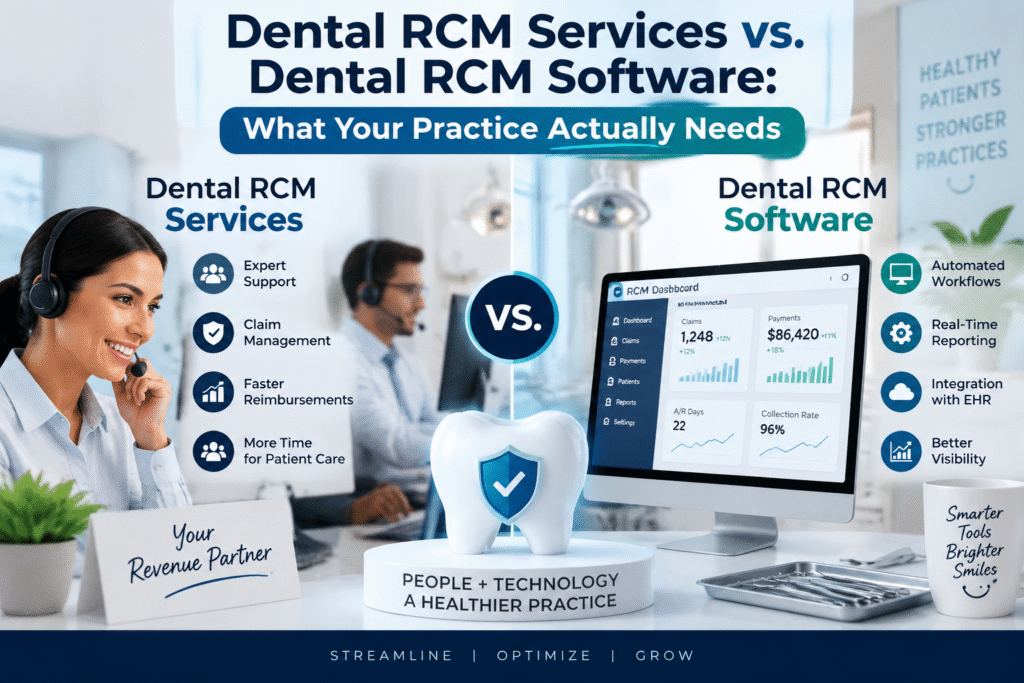
Most dental practices hit a point where the PMS and a busy front desk can’t keep up with billing anymore. From there, you have two realistic options. You can buy dental RCM software and keep billing in-house, or you can outsource dental billing to a company that provides dental RCM services and runs the revenue cycle for you. Vendors on both sides promise fewer denials and faster payments. They get there in very different ways, though. Below, we break down what each option covers, where software runs out and a person has to step in, what each one really costs, and which makes sense for your practice. It applies whether you’re comparing software, a dental RCM company, or a dental billing company, and whether you have one office or ten. What Are Dental RCM Services? Dental RCM services handle the money side of patient care, from the moment an appointment is booked to the day the last dollar is posted. Insurance verification, coding, claim submission, payer follow-up, denials, payment posting, and reporting all fall under it. How a Dental RCM Provider Manages the Full Revenue Cycle A dental RCM provider works inside your practice management system, usually through secure remote access, and does the billing work your team would otherwise squeeze in between patients. The provider is also on the hook for results, things like clean claim rate and days in A/R. You’re no longer relying on one biller who also answers the phones. Different people handle verification, claims, and follow-up, and each of them does that job all day. Dental Revenue Cycle Management Services vs Basic Dental Billing Services Plenty of companies sell dental billing services that amount to sending claims and chasing a few of them. Dental revenue cycle management services cover more ground. Work starts before the patient sits in the chair, with eligibility and benefit checks, and it doesn’t stop when the check arrives, because someone still has to reconcile that payment and report on it. A lot of denials trace back to front-end mistakes like a wrong subscriber ID or a frequency nobody checked. Billing that only begins at claim submission is already a step behind. What Dental RCM Software Does and Where It Falls Short Dental RCM software, often sold as dental billing software, speeds up the work your in-house team already does. It doesn’t do that work for them. Somebody on staff still has to log in and run it every day. Core Features of Dental Revenue Cycle Management Software Most dental revenue cycle management software comes with some mix of these: A few newer platforms add AI that predicts which claims are likely to be denied. That helps, as long as someone acts on the warning. The Work RCM Software Still Leaves With Your Billing Team This is where expectations and reality tend to split. The software will tell you a D4341 scaling and root planing claim came back denied for missing perio charting. It won’t pull the chart, attach it, and resubmit. It will show a crown claim stuck in pending for 45 days, but a person still has to call the payer, sit on hold, and find out the narrative never made it through. Eligibility works the same way. A portal check can show the patient as active and still miss that the plan covers only two cleanings per calendar year, or downgrades posterior composites to amalgam. Someone has to read the full breakdown or pick up the phone. So the software makes each task quicker. The number of tasks stays about the same. What a Dental RCM Company Handles That Software Cannot A dental RCM service provider, or a dental billing company if that’s the term you’re more used to, picks up the tasks software leaves undone and answers for the outcome. Dental Insurance Verification and Eligibility Checks Before each visit, the provider pulls the patient’s full benefits, not just a yes on active coverage. That includes frequencies, waiting periods, missing tooth clauses, downgrades, and how much of the annual maximum is left. Your treatment plan and patient estimate end up based on what the plan will actually pay. Many practices outsource this piece first, because dental insurance verification services for busy front offices take hours of hold time off the front desk every week. Claim Submission, Denial Management, and A/R Follow-Up Claims go out with the right CDT codes, X-rays, perio charts, and narratives attached. The provider tracks each one until it’s paid, works denials as they come back, and appeals where it makes sense. Follow-up runs on a set schedule instead of whenever someone has a free hour. That consistency is what good accounts receivable management for dental practices really comes down to. Once a claim passes 90 days, the odds of collecting it drop, and timely filing deadlines start to come into play. Payment Posting and Revenue Reporting Every payment gets posted against its EOB. When a payer pays less than the contracted fee or applies the wrong adjustment, it gets flagged and disputed instead of written off. Each month you get reports that break down collections, denial reasons, and aging by payer, so you know which insurers are slow to pay and why. Dental RCM Services vs RCM Software: Side-by-Side Comparison Factor Dental RCM Software Dental RCM Services (Outsourced Dental Billing) What you get A tool your team operates A team that runs the revenue cycle for you Cost structure Subscription or license fees plus staff salaries Flat monthly fee, percentage of collections, or per-claim rate Billing staff needed In-house billers to run the system Little to no dedicated billing staff Who answers for collections Your team The provider, measured against agreed KPIs Payer calls and appeals Your staff The provider’s billing specialists Adding locations Usually means hiring more billers The provider adds capacity as volume grows When a biller leaves Billing slows until you rehire and train Work continues without a gap Cost of Dental Revenue Cycle Management Services vs In-House Software The
Healthcare Revenue Cycle Management Trends 2026: What Practices Need to Know
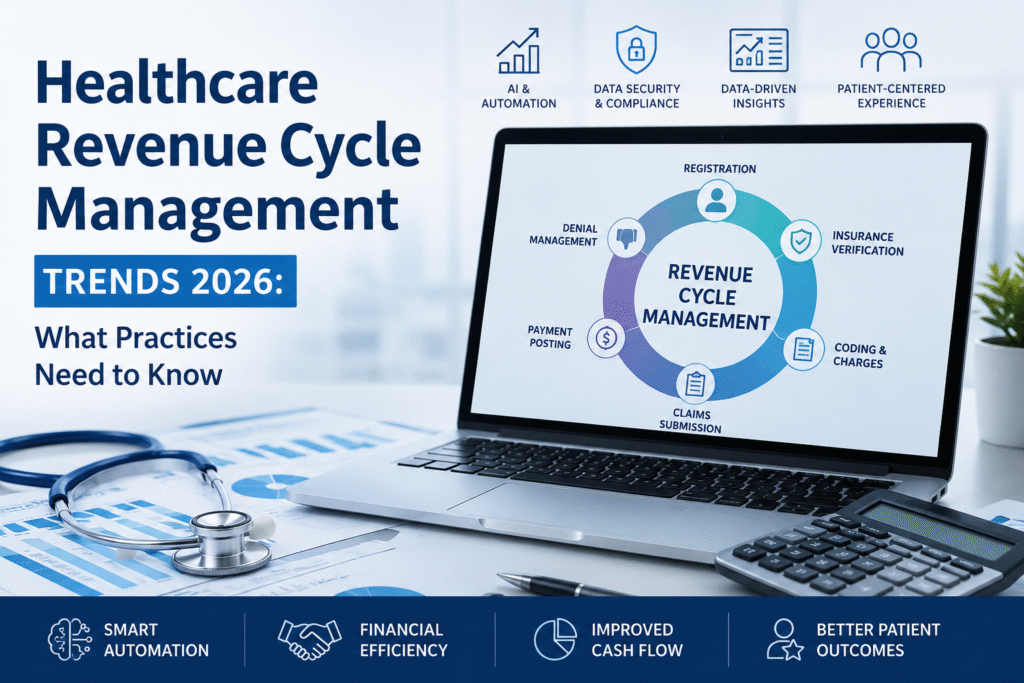
Denial rates are up. Billing staff are stretched thinner than they were two years ago. And patients, used to knowing exactly what they owe on every other purchase they make, are starting to expect the same from their medical bill. None of this is news to anyone running a practice right now, but it’s worth naming, because it’s exactly what’s pushing healthcare revenue cycle management to change faster than it has in a long time. Most conversations about healthcare revenue cycle management trends in 2026 are aimed at hospitals and large health systems, and honestly, that’s a problem. A solo dental office or a five-provider medical group is dealing with a lot of the same pressure without any of the same resources. So this piece is written for that side of the industry: what’s actually changing, what’s overhyped, and what a smaller practice can realistically do about it. Why Things Are Moving So Fast Right Now Revenue cycle management, at its core, is everything between a patient booking an appointment and a claim finally getting paid: registration, eligibility, coding, submission, follow-up, and collections. None of that is new. What’s changed is how much pressure sits on each of those steps. Payers keep tightening prior authorization rules. Patients, thanks to high-deductible health plans, now owe a bigger chunk of the bill directly, which means collecting from them isn’t a side task anymore. And AI-based tools have gotten good enough that they’re catching real errors before a claim goes out, not just flagging them after the fact for a biller to sort through later. The result: RCM has stopped being a back-office job nobody thinks about. It’s become one of the clearer signals of whether a practice is actually healthy. Top Healthcare Revenue Cycle Management Trends to Watch in 2026 1. Automation Is Doing More Than Eligibility Checks Now A few years ago, “automation” in billing basically meant checking insurance eligibility automatically. That’s table stakes now. Current tools flag likely coding errors, predict which claims are at risk of denial before submission, and pull together documentation without requiring manual assembly. If your practice is still keying most of this in by hand, this is probably the single revenue cycle management trend worth acting on first, since fewer manual touches usually means a better clean claim rate almost immediately. 2. Prevention Is Winning Over Cleanup The old model: submit the claim, wait, fix whatever comes back denied. That’s backwards now. Real-time eligibility checks, pre-claim validation, and tighter documentation at the point of care these all happen before the claim ever leaves the building. Call it denial prevention if you want the industry term for it. Either way, it’s cheaper and faster than fixing a denial after the fact, which is really the whole argument for it. 3. Patients Want Their Medical Bill to Feel Like an Online Order This one’s less technical and more about expectations. Patients compare their statement to whatever else they paid for that week, not to a hospital bill from a decade ago. Upfront estimates. A payment link that actually works on a phone. Some flexibility if they can’t pay it all at once. Practices that get the insurance side right but ignore this piece of healthcare revenue cycle management trends still end up with slow patient collections and a lot of confused phone calls. 4. More Practices, Not Just Hospitals, Are Outsourcing Staffing is hard to find and harder to keep, and that’s pushing smaller practices toward outsourced healthcare revenue cycle management services in a way that wasn’t as common five years ago. The appeal isn’t complicated: dedicated coders, someone actually following up on aging claims every week, and a cost you can predict instead of a hiring cycle you have to keep repeating. 5. Practices Finally Have Real Numbers to Look At Days in accounts receivable, denial rate by payer, collection rate, these used to be dashboards only a hospital’s finance team had access to. Now a mid-sized practice can see the same thing, which means catching a problem while it’s small instead of noticing it three months later when the bank account tells you. 6. Compliance and Security Aren’t a Line Item Anymore Billing systems hold exactly the kind of data cybercriminals want, and payer audits aren’t getting rarer. HIPAA compliance, secure handling of patient data, and documentation that would hold up under review these belong at the center of how a practice runs its revenue cycle management, not tacked on afterward because someone mentioned it in a meeting. 7. Value-Based Contracts Are Changing What Counts as “Accurate” As more payer contracts tie reimbursement to outcomes instead of volume, documentation has to prove something beyond “this happened.” It has to support a quality metric. That’s pushing healthcare RCM to get more data-driven every year, whether a practice is ready for it or not. What Most 2026 RCM Reports Get Wrong for Smaller Practices Here’s the thing most trend reports skip: they’re written assuming you have a compliance department, a six-figure automation budget, and maybe an offshore team already in place. Useful if you’re a 400-bed hospital. Not so useful if you’re a dental practice with two billers and a front desk that’s already juggling three other jobs. That’s exactly the gap CEC’s dental RCM services are built to close. The realistic move for a smaller practice in 2026 isn’t a full technology overhaul. It’s picking two or three things, proactive eligibility checks, clearer patient payment options, actually following up on aging AR, and doing them consistently. That’s usually where working with a healthcare revenue cycle management services partner who understands practice-level operations, not just hospital-scale RCM, actually pays off. How CEC Helps Practices To Stay Ahead Of Trends? We work with dental and medical practices on exactly this: eligibility verification before the visit happens, coding checks that catch mistakes before submission, billing support patients can actually understand, and reporting that tells you where your revenue stands without needing a finance degree to read it. There’s
Denial Management in RCM

In healthcare billing and RCM services, precision is always non-negotiable. Even a small mistake in coding, eligibility issues, or inconsistencies in the insurance verifications can lead to RCM denials. According to recent data, an average physician practice spends $25 in administrative work per claim denial. Moreover, providers never rework 65% of denied claims at all. Denials in medical billing are not random events; in fact, they can an effective RCM denial management process can easily predict, trace, and prevent them. By following a structured process of denial management in RCM, practitioners can recover the lost revenue while also preventing any recurring issues that might be disrupting the cash flow. What Is Denial Management in Revenue Cycle Management? Denial management in revenue Cycle Management refers to the process a healthcare organization uses to manage claim denials from initial identification through resolution and trend-based prevention. The process identifies what happened and why it happened, corrects the issue, and adopts measures to prevent the same failure in future claims when a payer rejects or denies a claim. The difference between denial management and simple claim rework is important. Rework assesses individual denied claims. Denial management finds the system that produced those denials. If you only rework claims without analyzing patterns, then you are not resolving the issue at its root. Who Is Responsible for Denial Management in Healthcare Billing? Denial management is not one person’s job. Here are some roles involved in the process: Billing Teams Billing staff receive remittance advice from payers, identify denied claims, and initiate the rework process. In an RCM denial management system, billing teams arrange every denial by type and root cause at the point of receipt. Clean, consistent data supports downstream analysis instead of relying on retroactive reconstruction. Coding Specialists A large number of RCM denials happen due to coding errors, including incorrect procedure codes, mismatched diagnosis codes, unbundling, or the use of deprecated codes. Coding specialists review denied claims, correct the code set, and ensure that the documentation reflects the correction. Revenue Cycle Managers Revenue cycle managers set denial rate targets, review monthly trend reports, and escalate issues to department heads. They also make decisions about process changes, staff training, and invest in technology based on denial pattern data. Without this ownership, denial management will not work, no matter how well the operational team performs. Types of Claim Denials in RCM Not all denials are the same. If you misidentify a denial type, it can lead to wasted rework effort and missed appeal windows. Let’s take a look at the types: Hard Denials Hard denials are claim rejections that cannot be corrected and resubmitted as a new claim. They require a formal appeal or write-off. Common causes for these denials are: Experienced billers should be assigned to hard denials in denial management in RCM. Soft Denials You can resolve soft denials by correcting an error and resubmitting the claim without a formal appeal. Common causes include: Soft denials actually cause most RCM denials. But they are correctable, recoverable, and largely preventable with front-end process improvements. Common Causes of Claim Denials Most claim denials are entirely preventable. However, you need to know the causes upfront to make timely decisions. Here are some causes of claim denials: Incorrect Coding and Documentation Errors Coding errors are the most common cause of denial in medical billing. These include: Insurance Eligibility Issues Billing a service against a lapsed, inactive, or incorrect insurance plan leads to immediate denial and is often non-recoverable. These happen particularly at the start of the calendar year when deductibles reset, and during open enrollment periods when patients change employers or coverage plans. Real-time eligibility verification from 24 to 48 hours before every appointment reduces such risks before they reach the payer. Missing or Incomplete Information Clearinghouses or payers can deny or reject claims if they are submitted without required attachments, have missing referring provider NPI numbers, incomplete patient demographic fields, or lack prior authorization reference numbers. These are soft denials and are correctable with a pre-submission claim scrubbing process. Timely Filing Errors Each payer sets a time window, which defines the period within which a claim must be submitted from the date of service. These windows range from 90 days to 365 days, depending on the payer and plan type. The system denies claims submitted outside the timeline. A submission workflow can avoid timely filing violations. Impact of Claim Denials on Healthcare Revenue Cycle Claim denials are not just a billing problem. They also cause indirect financial consequences for a practice. Step-by-Step Denial Management Process The goal of the denial management process is to generate the data that prevents the issue from happening in the next batch. Here is the step-by-step guide for the process: Identify and Categorise Denials Categorize the claims on the basis of denial types (hard vs soft denials) and the root cause (coding, eligibility, missing information, timely filing, authorization). This categorization helps in root cause analysis and trend reporting of denial management in RCM. Perform Root Cause Analysis For each denial category, trace the failure back to its origin point in the revenue cycle. For instance, Correct and Resubmit Claims Once you identify the root cause and correct the error, you should resubmit the claim within a defined SLA. For instance, the timeline is five business days for soft denials. Similarly, assign hard denials that require a formal appeal to an experienced biller who has direct knowledge of the payer’s appeal process. Track and Monitor Denial Trends Perform monthly denial trend reporting — by category, by payer, by provider, and by denial code. It can help in converting individual claim data into an actionable report. For example: Here, the trend data is the principle behind denial management that gets better over time. Proven Strategies to Prevent Claim Denials Claim denials can be prevented. Here are some proven strategies that you must consider: Accurate Coding and Documentation Accurate coding and complete documentation play an essential role in preventing claim denials. For example, even
How much do dental RCM services cost in 2026?
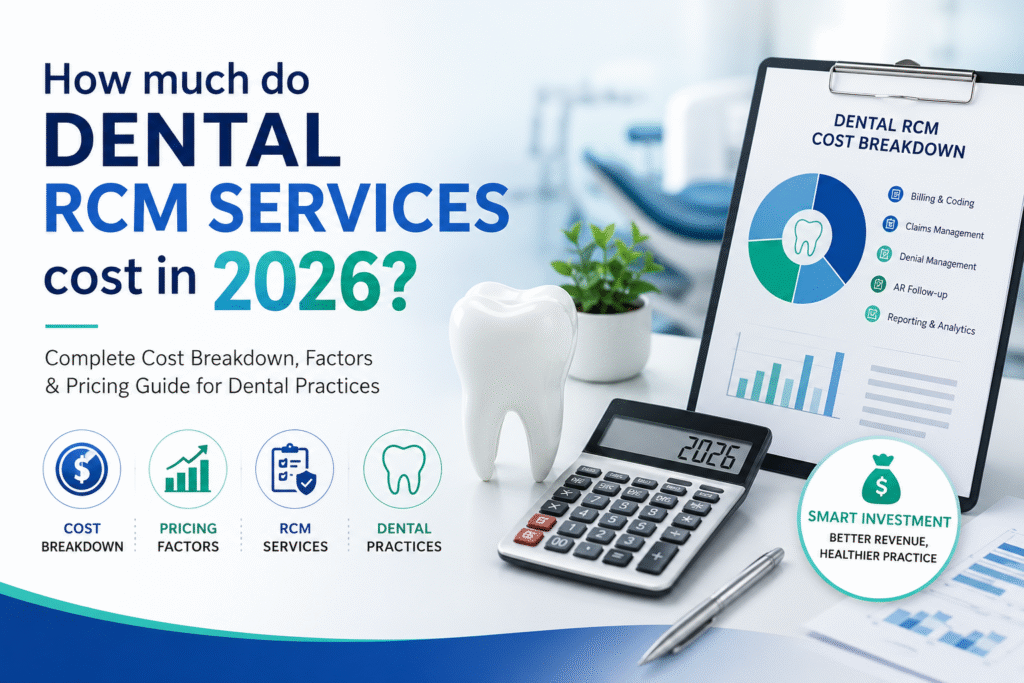
If your dental practice is doing great in terms of services and patients, but struggling financially, then there is a problem with your revenue cycle. Several challenges, such as claim denials, payment delays, and increasing administrative tasks, if left unaddressed, often disrupt cash flow, leading to revenue cycle inefficiencies and limited growth. To address this issue, several practitioners are turning to dental RCM services to achieve financial stability with an improved revenue cycle process. In fact, 62% of dental practices now partially or fully outsource their revenue cycle processes with a reliable dental RCM company. Within a short period, they see improvement in first-pass claim acceptance rates and net collection ratios. But before making a switch, most practitioners ask the obvious question: How much do they actually need to pay for dental RCM services in 2026? Well, this guide is actually going to break down everything you need to know about the average pricing to ROI for dental RCM services. What Are Dental Revenue Cycle Management (RCM) Services? Dental RCM (Revenue Cycle Management) refers to the end-to-end process to manage the financial lifecycle of a dental practice. The process begins from the moment a patient schedules an appointment to the moment the final payment clears. A full-service dental RCM services provider handles the following functions: • Patient scheduling and pre-registration data collection • Insurance eligibility verification and benefits breakdown • CDT coding and documentation review • Claim submission and clearinghouse processing • Payment posting and reconciliation • Accounts receivable follow-up and denial management • Patient statement processing and balance collection • Reporting and performance analytics The type of services varies by vendor. Some offer full-cycle management; others focus on specific functions such as billing and AR management. Who Needs Dental RCM Services? Dental RCM outsourcing does not limit itself to large practices. You might need the services if you belong to one of the following facilities: Small and Mid-Sized Dental Practices Solo practitioners and small group practices often carry the highest administrative burden relative to their team size. A dental RCM company gives these practices access to dedicated billing expertise. Multi-Speciality Clinics Multi-speciality clinics that offer general dentistry with orthodontics, endodontics, periodontics, or oral surgery face challenges in billing. A specialist dental RCM services provider with multi-speciality experience manages these challenges better than a generalist in-house team. High-Volume Dental Offices Practices processing 30 or more appointments per day have to claim volumes that are difficult to manage at the in-house level. In such practices, outsourcing dental RCM services reduces the risk in billing operations and gaps caused by staff turnover. Average Cost of Dental RCM Services in 2026 The price for dental RCM varies by model, type of service, and practice. Always compare total cost against the full cost of in-house billing, not just the vendor fee. Here’s a quick overview to help you out: Pricing Model Typical Range Best Suited For Percentage-Based Pricing 4%–10% of monthly collections Most practices that seek better revenue Flat Monthly Fee $1,000–$5,000+ per month High-volume practices seeking affordable service Per-Claim Pricing $3–$8 per claim submitted Lower-volume practices seeking to outsource one or two functions Percentage-Based Pricing (4%–10%) The dental RCM company charges a percentage of what the practice actually collects, not what it bills. For example, if your practice is collecting $100,000 per month, then the price for RCM will be $4,000–$10,000. Flat Monthly Pricing The practice has to pay a fixed monthly fee for the agreed services, no matter how much it collects for the month. It works well for practices with stable, high claim volumes. Per-Claim Pricing Model The company charges a per-claim fee for each claim submitted. This model is most common when a practice outsources dental insurance verification for a single billing function and not a full-cycle RCM. It provides flexibility for practices with different claim volumes. Key Factors That Affect Dental RCM Costs No two dental practices have the same revenue cycle requirements. Here are some factors that affect the costs: Practice Size and Patient Volume The number of patients you see every day and the size of the practice have a direct impact on the overall dental RCM cost. Since a large practice processes more claims, it pays high total fees. However, mostly the dental RCM service providers offer improved pricing structures to high-volume practices, this benefits them to achieve low percentage rates. Claim Complexity and Specialities The type of dental services your provide also affects how much you will have to spend for dental RCM services. If you offer multi-speciality practices or specisalized treatments, then your team must be managing detailed documentation, coding requirements, and accruate verification. Such added efforts increase the overall cost of the RCM services. Denial Rates and AR Backlog If your practice experiences frequent claim denials or delays in the payments, then the dental RCM services provider will have to work extensively on identifying the root cause of delays and denials, claim resubmissions, and recovering the unpaid revenue. This can lead to additional charges for cleanups and revenue recovery efforts. Software and Integration Requirements For your dental practices if you need advanced integrations and modern EHR platforms, then your dental RCM company will have to configure, customize, and maintain these systems according to your services. Such technical requirements usually increase the pricing plan for your dental RCM services. Hidden Costs in Dental RCM Services You Should Know The quoted service fee is not always the total cost. Some vendors include additional charges that are easy to miss in a proposal. Here’s what you need to know about the hidden costs to avoid last-minute surprises before signing a contract. Setup and Onboarding Fees Some vendors charge a one-time setup fee to cover account configuration, software integration, staff training, and workflow mapping. Clearinghouse Charges Claim submission through a clearinghouse typically carries a per-transaction fee. Some vendors include clearinghouse costs in their service fee; others pass them through as
How Small Practices Benefit from a Healthcare Revenue Cycle Management Company?
If you are running a small medical practice, it means you have to juggle patient care with the endless paperwork, billing codes, and insurance claims that keep your doors open. Even though you are passionate about treating people, chasing payments, or decoding the codes often become part of your job. Now, you have two options: hire an in-house team for RCM operations. Or partner with a healthcare revenue cycle management company that takes care of the operations while you stay focused on patient care. While both options are good, partnering with an RCM company offers benefits in terms of cost-efficiency, expertise, and efficiency. Wondering how? Keep on scrolling to find out! The Unique Challenges Faced by Small Practices Small medical practices face financial and operational challenges when compared to established healthcare systems. For example, your small practice operates on a limited budget with fewer staff who have to handle multiple responsibilities from scheduling to claims submission. At the same time, large hospital and dental systems can hire certified coders and financial analysts to handle the entire billing department. Here are some problems that your internal team might face: For small practices, managing billing internally can quickly become overwhelming, given the problems. That’s why many of the small medical and dental practices prefer to outsource the billing and RCM tasks to an offshore team that manages these responsibilities on their behalf. What Does a Healthcare Revenue Cycle Management Company Do? An RCM company handles your entire financial cycle, right from when a patient schedules a medical or dental appointment until you receive the final payment. Here are the key services that RCM companies provide: Benefits for Small Practices when Partnering with an RCM Company When you decide to work with the RCM firm, it has the potential to benefit your practice’s financial well-being through: 1. Low Overhead Costs When you outsource RCM, you immediately save on overhead costs. It includes salaries, benefits, and payroll taxes for the entire billing department staff handling medical and dental billing. You won’t have to spend the money allocated in the budget on staff training and further education for dental coding updates, CDT changes, or payer-specific dental policies. Equipment costs, including expensive billing software, practice management systems, dental clearinghouses, upgrades, and IT support, are also avoided. 2. Better Cash Flow With the right experts in charge of the revenue cycle, your cash flow increases. Expert RCM companies know how to accelerate the reimbursement process for both medical and dental claims. They know how to submit claims faster and understand dental-specific requirements such as tooth numbers, surfaces, narratives, X-rays, and pre-authorizations. They are also aware of the importance of submitting the claim correctly and following up on medical and dental denials, helping increase your revenue streams in the right manner. 3. Access to Specialized Expertise RCM companies have experts who have experience of several years in this field and have handled hundreds of clients. This implies that they have an insider understanding of complex medical contracts and dental insurance fee schedules, annual maximums, waiting periods, and frequency limitations. They also understand how to leverage AI automation technology for claims scrubbing, dental eligibility checks, pre-treatment estimate analysis, and predictive analytics on denial patterns. 4. Improved Compliance RCM companies try to stay updated on the latest changes in the regulations. They will ensure that the billing practices adopted and implemented by them will be in accordance with the latest and current standards.They remain up to date with ICD-10, CPT, CDT codes, HIPAA guidelines, payer-specific dental documentation rules, and policy updates. This significantly reduces your risk of audits, penalties, and revenue loss. When Outsourcing RCM Makes the Most Sense? Outsourcing makes sense when: In-House vs Outsourced RCM: A Quick Comparison The choice between in-house and outsourcing often depends on dental and medical practice size, budget, and your preference for control or efficiency. In fact, many practices use an outsourcing model, especially for coding or denials management. Here’s a brief comparison of in-house vs outsourced RCM: Factor In-House RCM Outsourced RCM Cost Pay salaries, benefits, and software every month Pay based on collections or per claim Setup Need to hire and train staff, buy software Vendor is ready to start right away with team and necessary software Control You manage everything directly Vendor handles the work for you Expertise Depends on your team’s knowledge Get access to billing experts Flexibility Hard to add more staff quickly Easy to scale up or down as needed Technology You buy and update your own systems Vendor provides all the technology Conclusion Revenue cycle management is important to ensure your practice’s growth in a competitive healthcare industry. You deserve financial stability, with less administrative stress, and the freedom to concentrate on what you do best: caring for patients. A trusted RCM partner will make the complex billing into a streamlined process that protects your revenue and supports your mission. If you’re ready to transform your practice’s financial health, contact CEC. We offer complete healthcare revenue cycle management services, specifically for small practices. FAQs Q: Will I lose my dental billing control if I outsource it? Of course not. Genuine RCM companies offer transparency through their reports and updates. The control will be yours, while experts take care of everything for you. Q: How much can I expect to save through outsourcing RCM? Small dental and medical centers may benefit from a decrease of 30-50% on billing expenses while experiencing an increase in revenue collection. The extent of the savings varies based on the partner you select. Q: How long does it take to transition to an outsourced RCM company? It takes about 30 to 90 days, depending on the complexity of your practice. Your partner will walk you through each of these steps. Q: Does the RCM company specialize in my healthcare specialty? Some RCM firms specialize in given specialties, such as dermatology, anesthesiology, or primary care. Make sure to pick one that provides expertise in the chosen specialty. Q: What if my patient
The Hidden Revenue Leak in Medical and Dental Practices (And How AI Fixes It)
You’re working harder than ever, seeing more patients, and delivering exceptional care. Yet your bottom line doesn’t reflect your efforts. Well, you are not alone! Most hospitals lose between 5 and 10% of their revenue annually just through routine blind spots. For instance, in one department, documentation is delayed by a shift change. In another, billing waits for missing codes. Now, what if you could plug these leaks without any complex process or long hours? AI solutions ensure your practice’s long-term financial growth and help you focus on better patient care. Keep scrolling to find out how AI can recover your lost revenue! What Is a Revenue Leak? Revenue leakage is money you’ve legitimately earned but are never able to collect due to errors, inefficiencies, or oversights in your billing and collection processes. These are preventable losses caused by internal operational gaps. Revenue leakage typically includes coding errors, underbilling, missed charges, untimely claim submissions, unnoticed denied claims, unclear communication with patients regarding financial responsibilities and poor follow-up on unpaid accounts. Where Hidden Revenue Leakage Happens (Medical + Dental)? Revenue leakage often goes unnoticed in your financial reports, quietly affecting your profit margins while you focus on clinical care. Here are some areas where revenue leakage could happen: Your front office staff collects patient demographics and insurance information during scheduling and check-in. Any mistakes, like omissions or wrong data feeding, will create disruptions in the system. Ultimately, it will lead to claim denials and delayed payments down the line. When you fail to verify patient insurance eligibility or obtain pre-authorization, it can result in revenue leakage. When patients’ services are not covered in their insurance, you may not be able to collect the payment from the firm. Sometimes, revenue problems happen because clinical notes are incomplete. Without proper documentation, you cannot code the procedures correctly or ensure appropriate billing. Even small coding mistakes cause claim denials, delayed payments, or underpayments. For instance, data entry errors can result in poor financial consequences, which is particularly high in emergency departments and specialty practices. Claims that are neither paid nor denied might get lost until they appear on an Aging Report 60 or 90 days from the date of service. By then, payers have grounds to refuse payment. Most denied claims are never reworked. Even if they are reworked, manual processes could be expensive per denied claim. It will overwhelm your staff and pile up the denied claims over time. Most dental practices say delayed or rejected claims are their primary reason for lost revenue. Additionally, patients delay or decline treatment when they don’t understand what they have to pay. This way, it will hinder your revenue gain. AI – The Solution to Hidden Revenue Leak Artificial intelligence transforms your revenue cycle management, converting constant losses into a profit gain for every claim. Hospitals and health systems now use AI in their RCM operations in the following ways: 1. Automated Coding and Claims Scrubbing AI-driven systems automatically assign billing codes from clinical documentation. It helps you to reduce manual effort and errors. These systems scan claims for inconsistencies before submission and reduce denial rates. 2. Predictive Denial Management AI assesses historical denial patterns, so that you will know which claims are more likely be rejected. This way, you can fix the errors or any issues before submission, and improve first-pass acceptance rates. 3. Real-Time Eligibility Verification AI-powered systems link directly to payer databases to verify coverage instantly. It will prevent eligibility issues before you provide services to the patients. 4. Intelligent Revenue Cycle Monitoring AI provides real-time dashboards so that you will have complete visibility into every claim, payment, and denial. You can also track key performance indicators and resolve any problems before they become an expensive revenue leak. How to Identify Revenue Leak in Your Practice? Here’s how you can find hidden leaks that are hindering your revenue. Debunking Common Misconceptions About AI in Billing Don’t let myths stand in the way of resolving your lost revenue. Here’s the truth about AI in healthcare billing. Myth: AI will replace our billing personnel Reality: AI will automate repetitive tasks so that your staff can concentrate on more complex cases and patient care. AI does not replace people, but frees them. Myth: AI is too costly for smaller practices Reality: The expense of lost revenue is much higher than the cost of implementing AI. Many systems are scaled to your practice’s growth, making them economical. Myth: AI is prone to errors and cannot be trusted Reality: Current AI technology is more accurate than manual billing. AI is constantly learning and improving with human oversight. Myth: Implementation will disrupt our practice Reality: Most AI systems are easily integrated with your current practice management software. Implementation is usually completed in 30-60 days with little disruption to your practice. Conclusion Hidden revenue leakage is a problem that impacts the financial potential of your practice. But you can easily overcome with the right strategies. By using AI solutions, you will be able to automate tasks that are prone to errors, anticipate issues before they happen, and gain real-time insights into your financial performance. You didn’t become a healthcare professional to go after payments. You became one to help others. AI technology gives you the power to make sure that your practice is financially healthy and stable. Ready to make sure that revenue isn’t leaking out of your practice? CEC uses a proprietary dental RCM that automates claims, payment, and reporting with AI-powered analytics. With secure and GDPR-compliant data handling, we can streamline your revenue cycle and fix all the issues that lead to revenue leakage. FAQs Q: How much revenue is the average practice losing to leakage? Healthcare practices lose between 5-10% of their annual income to revenue leakage. Most of these reasons are preventable with AI solutions. Q: Can AI really reduce claim denials? Yes. AI-powered claims scrubbing and predictive denial management reduce denial rates, with exceeding clean claim rates. Q: How long does it take to
Revenue Cycle Management Best Practices for Multi-Specialty Medical Practices
If you are managing a multispecialty practice, you might already be juggling multiple billing codes, varying payer requirements, and specialty-specific regulations under one roof. These complex tasks make your revenue cycle even more complex as you operate cardiology, dermatology, and primary care side by side. The result? You will end up with inconsistent processes, mounting denials, or cash flow challenges. Now, how can you overcome the challenges of RCM as a multi-speciality medical practice? Keep on scrolling to find out! What are the Unique Challenges that Come in Multispecialty RCM? Multispecialty clinics have their own revenue cycle challenges, which single-specialty clinics do not have. Some of these challenges include: What are the Best Practices for RCM in Multispecialty Practices? Let us explore the proven strategies to implement in your multispecialty practice that will improve your financial performance. 1. Streamline, Centralize, and Standardize Processes Develop a standard process for patient registration, charge capture, billing, and collections across specialties. Centralizing these processes gives you better control, tracking, and reporting while reducing the chances of errors or duplication. 2. Implement Integrated Technology Systems Investing in an integrated system that includes practice management services and electronic health records. The technology ensures that disparate data sources are used to create a single platform for better revenue cycle management. For example, CEC has a proprietary dental RCM platform that automates claims, payment, and reporting with AI-powered analytics. 3. Build Specialty-Specific Expertise Develop specialized teams for billing or assign experts as different team members for different specialties. It will ensure that your coders are aware of the requirements for different departments while keeping processes standardized. 4. Establish Robust Denial Management Build a specialized denial management team to monitor, understand, and resolve denied claims in a timely manner. A cardiology denial problem will not look like an orthopaedic one. So, it is best to segment denial data by specialty, payer, and reason. Then, your team can fix root causes instead of reworking the same claims repeatedly. 5. Keep Clinical Documentation Clean From Day One Incomplete or unclear documentation is the number one reason for claim denials and delays. So, ensure that the documentation is clear, complete, and aligned with billing requirements from the first entry. It is better if you could provide specialty-specific template to help providers capture the right details. The templates should prompt for diagnosis linkage, procedure specifics, modifiers, and time-based elements where applicable. 6. Capture Charges at the Point of Care In multispecialty clinics, missed charges is a common issue because services are documented late or in some cases, they are not documented at all. So, when charge entry is delayed, details are forgotten, or modifiers are missed, then, claims might go incomplete or underpaid. So, it is recommended to embed charge capture directly into the clinical workflow. Record services during or immediately after the visit using structured templates and pick-lists that reflect specialty-specific services. Also, clinical documentation and billing systems should be integrated, so charges flow automatically without relying on manual handoffs. 7. Clear Communication with Patients To build trust with patients, it is important to set clear communication protocols for financial conversations. When patients don’t understand their financial responsibility upfront, it becomes harder to settle the collection. Multispecialty practices should explain expected costs before services whenever possible. This includes insurance coverage, co-pays, deductibles, and any out-of-pocket expenses. It would be best if you could hire a front-desk or financial counselling team that can assist the patient and their family regarding the expenses. Otherwise, you can outsource this task, and the service provider’s team will handle the communication with patients. 8. Get Eligibility and Authorization Right Everytime In multispecialty clinics, each specialty may have its own payer rules, so skipping verification once can result in full claim denial. So, ensure that all the insurance eligibility, benefit coverage, referrals, and prior authorisations are verified before the visit, not after services are rendered. This process must be built into scheduling and registration workflows, with clear ownership assigned to front-office teams. You can even integrate automated eligibility tools and platforms that help in flagging coverage gaps early, and set up checklists so that no specialty bypasses the process. Conclusion Revenue Cycle Management in a multispecialty medical practice is a process that needs your complete dedication, appropriate technology, and proven best practices. The best way to ensure a smooth billing experience is to partner with the best RCM company, incorporate AI and technology, and monitor key metrics. The thought of managing revenues in a multispecialty medical practice can be a daunting one. But that doesn’t have to come at the expense of your financial success. You need smart strategies and a better partner. Are you ready to start your multispecialty revenue cycle optimization? Outsource the manual, time-consuming, but important tasks to CEC, a leading offshore RCM service provider. We provide complete services, focused on multi-department medical practices, and reduce A/R aging by 50% within 6 months. FAQs Q: What sets multispecialty RCM aside from single-specialty practice? Multispecialty clinics have to contend with diverse coding requirements, multiple contracts, and authorization needs simultaneously. Such processes require centralized oversight. Each specialty may have different and distinct workflow needs. Q: How can we minimize our denial rates? It’s also possible to leverage AI-driven claims prior to submission. In addition, it’s an added advantage if you have a dedicated denial management partner to help you verify your eligibility and provide accurate documentation prior to submission. Q: Should the RCM be outsourced, or should it remain in-house? This will depend on your resources and skills. Many multispecialty clinics prefer outsourcing, where there is access to specialized skills, expertise, and advanced technology at cheaper costs compared to maintaining an in-house team. Q: What RCM metrics should be monitored? Monitor the clean claim rate, days in accounts receivable, denial rate, collection rate, and cost to collect. All of this should be compared against industry benchmarks to improve revenue. Q: How long does it take to notice improvement from RCM? Most practices will experience noticeable gains
How Revenue Cycle Management Improves Cash Flow for Dental and Medical Practices?
How Revenue Cycle Management Improves Cash Flow for Dental and Medical Practices? Blog Seeing Patients but Struggling with Cash Flow? Here’s How RCM Helps Are you seeing patients every day but still down on your cash flow? A poll found 41% of medical group leaders said maintaining cash flow or margin was their top priority. A consistent cash inflow means that you can pay your staff, invest in advanced equipment, and deliver quality care without financial pressure. However, challenges like billing errors, coding mistakes, and claim rejects often lead to slow or unpredictable payments, which affect everything between payroll and growth plans. That’s where strong Revenue Cycle Management (RCM) turns every patient visit into revenue through accurate billing, timely reimbursements, and consistent follow-up. This guide will tell you how RCM improves cash flow, why it matters for your practice, and simple ways you can strengthen it without adding stress to your team. What is RCM? Revenue Cycle Management is a systematic approach to handling the financial aspects of your patient care. The process begins with scheduling and insurance verification, to claim submission and payment collection. When done right, RCM can help your practice get paid faster, with less effort. How RCM Improves Cash Flow for Dental and Medical Practices? Your practice deserves a steady, steady flow of reliable revenue to match the expert care that you deliver. Let’s explore the ways RCM strengthens your financial position: Faster Processing and Reduced Denied Claims When you do RCM the right way, your claims will be submitted the first time. That means your insurance payments go through quickly instead of being bounced back to you to check for errors. You’ll start to see payments right in your accounts in weeks, not months, and your staff won’t need to spend as much time on denied claims. Reduction of Days in Accounts Receivable When you do RCM the right way, your claims will be submitted the first time. That means your insurance payments go through quickly instead of being bounced back to you to check for errors. You’ll start to see payments right in your accounts in weeks, not months, and your staff won’t need to spend as much time on denied claims. Enhanced Patient Collections RCM allows you to efficiently collect the patient portions by ensuring benefit verification is completed before treating the patient and by offering flexible financing solutions. It’s easier to get paid when patients know what they owe before treatment is provided. Minimized Billing Errors Manual processing of claims leads to errors that translate to lost revenue for your practice. Automated RCM solutions flag errors prior to claim submission to ensure accurate coding, documentation, and patient data. This results in reduced claims denials and accelerated Improved Financial Visibility You can’t manage what you can’t measure.” RCM helps you get precise information about your business’s financial position through comprehensive reporting and analytics. You would notice trends and bottlenecks and make informed decisions as to where you would target your collection efforts. Strategies to Improve RCM in Your Practice The following are proven strategies you can implement right away to strengthen your revenue cycle and start seeing faster payments. Verify Insurance Eligibility Before Every Appointment Check coverage in real-time to avoid surprise denials and know precisely what service is covered before it’s provided. Train Your Staff Regularly on Coding Updates Because healthcare codes constantly evolve, ensuring that your office stays on top of the changes can help prevent denied claims for using outdated or incorrect coding methods. Implement Transparent Patient Payments Policies: Communicate patient payment policies and expectations openly regarding billing, provide patients with multiple payment options, and collect co-payments at the point of service. Leverage Technology to Automate Repetitive Processes Invest in practice management systems that can automate claim scrubbing, electronic remittance, and patient reminders. Key Performance Indicators Must Be Monitored Track KPIs every week, including claim denial rates, days in accounts receivable, and collection percentages. Follow Up On Unpaid Claims Claims cannot be left pending action; create a mechanism to follow through on unpaid claims within a week. Outsource When Required Consider partnering with RCM specialists who can handle complex billing challenges while you focus on patient care. Regular Audits of Your Billing Process Look at denied claims and make changes to prevent similar problems In-house vs Outsourced RCM: Which is Better? Most healthcare professionals wonder whether to hire an in-house team or partner with an outsource team for RCM services. Here’s a quick overview of in-house vs outsourced RCM to help you out: Area In-House RCM Outsourced RCM Cost Ongoing costs for staff and software Set monthly fees Billing Skills Depends on your team’s knowledge Trained medical & dental billing teams Claims Issues Slower follow-ups when the staff is busy Faster claims and fewer denials Practice Growth Hard to manage as the practice grows Easy to adjust as patient numbers change Time for Patients Staff split between billing and care More time to focus on patients Conclusion Your practice’s financial health directly affects your ability to provide excellent patient care. When you implement effective Revenue Cycle Management, you are not only improving cash flow but building a sustainable foundation for growth. The right RCM approach helps take away the stress of financial uncertainty, assists in collecting what you earn, and provides the resources for reinvestment in your practice’s future. Ready to transform your practice’s revenue cycle? CEC specializes in helping dental and medical practices optimize their billing processes and maximize cash flow. Contact us to know how we can strengthen your practice’s financial performance. FAQs Our Commitment to Quality We are passionate about delivering high-quality, reliable services that improve the overall efficiency of healthcare organizations. What is the single biggest RCM mistake practices make? Failure or lack of eligibility verification prior to an appointment leads to unexpected denial notices and uncollectable balances. How long will it take to see any RCM improvements? Most practices will realize positive changes in cash flow within 30 to 60 days after
What is Dental Revenue Cycle Management (RCM)?

What is Dental Revenue Cycle Management (RCM)? Blog What Is Dental Revenue Cycle Management and Why Does It Matter? Almost 92% of dental practices now use a formal RCM process or solution. Behind every successful dental practice lies an organized financial backbone that ensures every service provided is properly compensated. Dental RCM is an important aspect of ensuring that operations are efficient, claims are denied less, and cash flow is steady. Dental RCM combines admin accuracy, technological advancement, and strategic management to enable dental professionals to focus more on patients instead of documentation. Here is what dental revenue cycle management involves and why it matters. Understanding Dental Revenue Cycle Management Dental revenue cycle management is the full process that ensures a practice gets paid correctly for the services it provides. It includes: Scheduling of patients Verifying insurances Coding dental treatments Processing claims Posting payments Managing denials or patient balances. In contrast to general medical billing, dental RCM has to take into consideration specific coding systems (CDT codes), common coordination between dental and medical insurance, and complicated coverage restrictions. A strong RCM process reduces claim rejections, speeds up collections, and keeps cash flow stable. Dental teams can then focus on patients instead of admin. RCM tools are further proven to reduce dental claim denials by 20% or more through real-time eligibility checks, accurate coding, and automation. Automation and professional billing practices also help dental offices run more efficiently and stay financially stable. Key Components of the Dental RCM Process Dental Revenue Cycle Management (RCM) is a process consisting of several steps that are aimed at making sure that dental practices get their reimbursements on time and correctly. All these elements are critical to financial stability, efficiency, and patient satisfaction. Patient Scheduling and Registration It starts when a patient makes a reservation. Proper demographic and insurance data gathered at this point aid in avoiding mistakes and delays in claims at a later stage. Adequate registration helps in ensuring that all the patients that a health practitioner meets have verified data. Insurance Verification Insurance eligibility and coverage are also checked before the appointment. This measure aids in identifying patient co-pays, deductibles, and covered procedures to avoid denials and misconceptions regarding out-of-pocket costs. Planning and Coding of Treatment Treatments involving dentistry are coded in terms of CDT (Current Dental Terminology) codes. Proper coding is important to make sure that the services are properly represented and reimbursed. When dental and medical coverage intersect, it is important that there is proper coordination to ensure that compliance and payment are done in full. Claim Preparation and Filing After the treatment ends, the claims are created and sent to the payer through electronic means. Claim accuracy, payer-specific rules, and timely submission are paid attention to in order to prevent rejections or reimbursement delays. Payment Posting and Denial Management The payments or Explanations of Benefits (EOBs) are registered into the account of the patient when they are received. Any rejected or underpaid claims are immediately reconsidered, rectified, and refiled to reclaim lost revenue. Billing and Collection of the Patient Balance after insurance payments is charged to patients. Effective communication, correct statements, and easy ways to pay help to achieve better collection rates and better relations with the patients. Reporting and Performance Analysis Frequent reporting and data analysis allow seeing trends, bottlenecks, and recurring problems in the billing cycle. This allows it to constantly improve and make strategic decisions to maximize financial performance. Common Challenges in Dental Billing and Collections In order to have a smooth operation, dental practices should be able to find and solve the following typical barriers: Inaccurate Patient Data Unfinished or wrong patient demographics, policy numbers, or insurance information may result in claim denials and late payments. Proper data input and verification at the beginning of the patient journey are essential to prevent expensive mistakes in the future. Complex Insurance Policies and Coverage Limits Dental insurance plans are usually limited in terms of coverage, annual limits, and procedure exclusions. The process of going through such complicated rules may take a lot of time and cause confusion and billing inconsistencies when not handled adequately. Coding Errors and Incomplete Documentation Any wrong CDT coding, absence of supporting documentation, or misunderstanding of the procedures may lead to claim denials or partial payments. Frequent staff education and coding audits assist in the accuracy and compliance of billing. Delayed Claim Submission The billing process has to do with timeliness. Late filing or filing claims without the necessary details increases chances of being rejected and payer deadlines, thus directly impacting revenue cycles. Poor Denial and Aging Accounts Follow-Up Most practices are deprived of revenue that can be recovered without systematic denial management. Absence of follow-ups on unpaid claims or outstanding balances leads to backlogs and affects financial stability. Weak Integration of Technology Using manual data entry or disjointed software systems restricts visibility and increases human error. The latest RCM systems, coupled with practice management systems, are quick, precise, and monitored. Lack of Staff Training The processes of billing and collection require specific expertise in codes, payer regulations, and compliance. In the absence of good and continuous training, employees might not be in a position to adapt to the changing insurance and regulatory developments. Benefits of an Efficient Dental RCM System An effective and properly operated Dental RCM system does not just enhance the accuracy of billing but also raises the general operational and patient experience in a practice. Through technology, expertise, and strategic control, practices are able to attain financial stability and growth. Quicker Payments and Predictable Cash Flow The billing process is made easier, more efficient, and quicker through automation, claim tracking, and real-time eligibility verification. These technologies and upgrades help minimize delays, and reimbursements become quicker. Such stability enhances financial planning and operational confidence. Greater Accuracy, Compliance, and few Denials A well-developed RCM system guarantees proper coding, documentation, and adherence to HIPAA and payer requirements. This reduces denial of claims, audit risks, and revenue leakage. Improved Patient Experience and