
Credentialing vs. Privileging: The Real Difference Every Practice Should Know
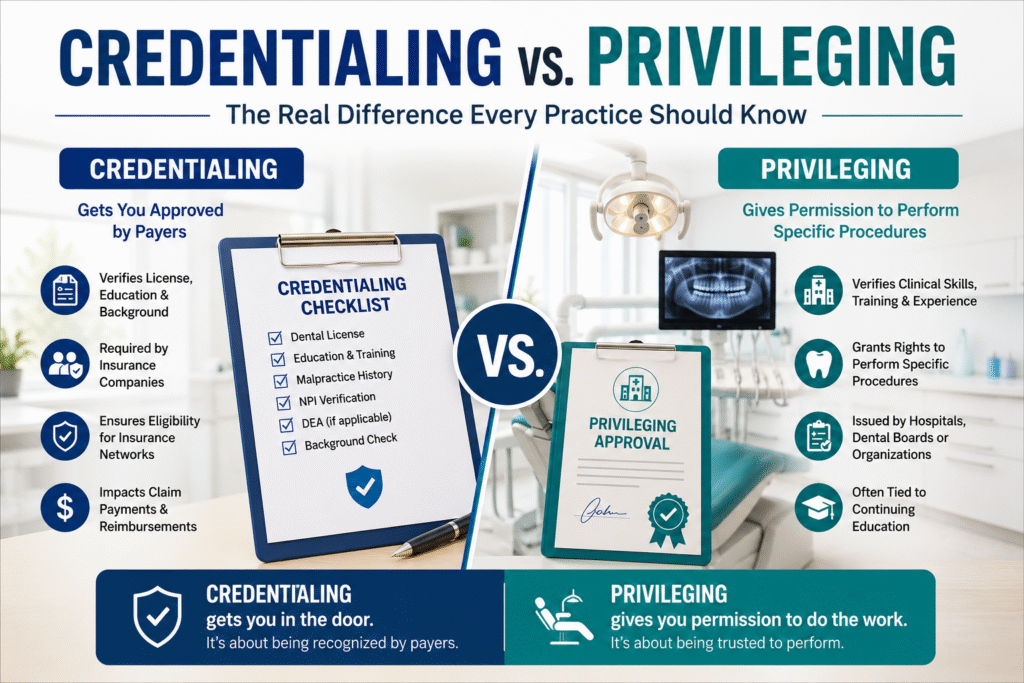
A practice manager we work with called in a panic last year. Her associate, sedation-certified, fully insurance-credentialed, had been treating patients for months. Then a claim got flagged, and it turned out his sedation permit had lapsed two states away from where she’d assumed the renewal deadline was. Insurance side, he was completely fine. It was the other paperwork nobody had been watching. That’s the confusion at the center of this whole topic. Dental credentialing gets a dentist approved to bill Delta Dental, Cigna, Aetna, whatever Medicaid plan applies in their state. Privileging is a separate, narrower thing, and it only matters once sedation, oral surgery, or hospital work enters the picture. Most articles online don’t even make this distinction, because they’re written for hospitals, not dental offices, so the dental version of this problem barely gets covered anywhere. What Dental Credentialing Actually Covers Credentialing is a qualification check. Nothing more dramatic than that. A payer needs proof a dentist is licensed, has a clean-enough malpractice history, and meets whatever bar that particular network sets before they’ll agree to pay for care under that plan. It says nothing about what procedures the dentist can perform. CAQH Profiles and Payer-Specific Application Requirements A CAQH profile has to stay current. License and education records need to be on file. NPI has to be attached correctly. Then there’s waiting, because every payer works through applications at its own pace and its own standard. Delta Dental’s process isn’t Cigna’s process. Medicaid runs on a completely different clock depending on the state. We’ve seen practices submit the exact same packet to three payers and get three different outcomes, not because anything was wrong, but because each payer wanted something formatted or documented slightly differently. How Provider Enrollment Connects to Dental Billing People lump enrollment in with credentialing constantly, and it’s not the same thing. Enrollment comes after credentialing clears, it’s the part where fee schedules and billing details get switched on for that specific payer. A dentist can be sitting on full credentialing approval and still can’t bill a plan, simply because enrollment hasn’t finished catching up. This is exactly where credentialing and dental billing intersect: a claim can’t go out clean if enrollment is still pending, no matter how solid the coding is. What Privileging Means for Dentists (It’s Not Just a Hospital Term) Hospitals do this differently than dental offices do, and it’s worth understanding why. A hospital’s medical staff office decides exactly which procedures a physician is cleared to perform inside that building, completely separate from their license. Dentistry has something similar. It’s just quieter, and a lot of general dentists go their whole career without running into it. State Board Sedation and Anesthesia Permits Routine fillings, cleanings, crowns, none of that touches privileging. Sedation does. Nitrous oxide, oral conscious sedation, IV sedation, each level requires its own permit from the state dental board, and a dentist has to apply and get approved before they’re legally allowed to sedate anyone. Years of general practice experience don’t substitute for that specific approval. Hospital Privileges for Oral and Maxillofacial Surgeons Oral and maxillofacial surgeons run into a version closer to the hospital model. If an OMS wants to operate inside a hospital, that hospital’s medical staff office puts them through its own review, separate from any dental license or payer credentialing already sitting on file somewhere. It’s the physician process, just borrowed for a dental specialty. Dental Credentialing vs. Privileging: A Side-by-Side Comparison Factor Dental Credentialing Privileging Question it answers Will a payer pay this dentist for treating members? Is this dentist cleared to perform this specific procedure, here? Who issues it Insurance payers (Delta Dental, Cigna, Aetna, Medicaid) State dental boards or hospital medical staff offices What it’s based on License, education, malpractice history, NPI Procedure-specific training, case volume, sedation certification Typical renewal cycle Every 2–3 years, varies by payer Often shorter, sometimes tied to continuing education What happens if it lapses Denied claims, dentist falls out-of-network Dentist legally cannot perform that procedure until renewed Who usually tracks it Billing or credentialing coordinator Practice owner, OMS, or compliance lead A lapsed credential is a cash flow problem. Annoying, fixable, usually recoverable within a billing cycle or two. A lapsed sedation permit is not a billing problem at all. It means the dentist can’t legally do the procedure, full stop, until the state board says otherwise. Why the Credentialing-Privileging Gap Matters for Dental RCM Most advice on this subject assumes every provider needs both processes managed with the same urgency, because that’s the hospital model. Dental practices don’t run like hospitals. A solo general dentist may never touch privileging in their entire career. An oral surgeon joining a multi-location DSO absolutely will, and so will a practice adding sedation services for the first time. Once a practice hits one of those situations, there are suddenly two calendars to watch instead of one. CAQH renewal dates get tracked fairly reliably almost everywhere we’ve seen. Sedation permit expiration dates, sitting on a completely separate timeline, get missed far more often, mostly because nobody assigned anyone to watch them. From a dental RCM standpoint, this matters because either gap, credentialing or privileging, eventually shows up as a stalled claim or a procedure that can’t legally be billed at all. How CEC’s Dental Credentialing Services Support Your Practice We run the full dental credentialing services process for practices we work with: CAQH setup and attestation, applications to Delta Dental, Cigna, Aetna, and state Medicaid programs, ongoing tracking so nothing expires quietly. For DSOs and multi-provider groups specifically, we also flag where privileging needs its own separate attention instead of getting buried inside routine insurance paperwork. Because credentialing, dental billing, and dental RCM all connect at the claims level, we handle them as one workflow rather than separate tasks handed to different people. None of this is about getting a dentist approved once and calling it done. It’s about keeping credentialing, enrollment, and any procedure-specific permits current, so
Understanding the Missing Tooth Clause in Dental Insurance

The missing tooth clause is one of the most misunderstood exclusions in dental insurance. When a patient’s tooth is lost before their current policy begins, many insurers refuse to cover its replacement, even if the procedure itself is a listed benefit. For dental practices, this means a bridge or implant case can be denied at the claim stage after treatment is already complete. This is because this clause is buried in the fine print of many insurance plans. It means it can block coverage for prosthetic treatments entirely, regardless of the patient’s current benefits. Verifying the dental insurance missing-tooth clause before treatment starts can save your practice from denials, payment delays, and frustrated patients. So, how to screen for it during dental insurance verification? Keep on scrolling to find out! What Is the Missing Tooth Clause in Dental Insurance? The missing tooth clause (MTC) is a provision in many dental insurance plans that limits or excludes coverage for replacing a tooth that was already missing before the patient’s current policy took effect. Even if the patient’s plan includes benefits for bridges, dentures, or implants, the clause can override that coverage entirely if the tooth loss pre-dates the policy start date. The insurance company will not pay to replace a tooth they were never insured. This is framed as a pre-existing condition exclusion, similar to the rules found in medical insurance. The key detail is always timing: when the tooth was lost versus when the coverage began. Why Does the Missing Tooth Clause Exist? Insurers use the missing-tooth clause to mitigate their risk by ensuring they will not be responsible for any condition present before their policy. They mention that a plan is designed to cover future dental needs, not pre-existing ones. If a patient enrolled specifically to get a bridge or implant they already needed, the insurer would be paying for a loss they never assumed risk for. From a practice perspective, the clause exists regardless of intent. A patient who lost a tooth years ago and never had coverage is treated the same as one who timed their enrollment to access benefits. The clause doesn’t account for circumstances, only dates. Which Dental Treatments Are Affected by the Missing Tooth Clause? The MTC applies to any prosthetic treatment that replaces a missing tooth. If a patient’s plan includes this clause and the tooth was lost before coverage started, the policy might deny it. Some treatments covered in this point are: Bridges and Fixed Partial Dentures Bridges are the most commonly affected treatment. In the case of a three-unit bridge to replace a tooth that was extracted before the plan became valid, the entire treatment will most likely not be covered, despite the plan’s coverage of the prosthetic benefit. Removable Partial and Full Dentures Partial and full dentures are also affected by MTC. If even one of the teeth being replaced was missing before coverage started, the entire prosthesis may be denied. Insurers often apply the clause to the full case, not just the specific tooth, making this particularly impactful for full-arch cases. Dental Implants If an implant is planned for a tooth that was lost before the policy began, the claim will be denied under the missing tooth clause. It happens even if implants are listed as a covered service under the patient’s current plan. However, keep in mind that congenitally missing teeth, which have never existed, are considered just like extracted teeth according to most MTC clauses. If the tooth was never there when the coverage began, then the clause applies. How the Missing Tooth Clause Affects Insurance Claims When a claim is submitted for prosthetic work, the date of tooth loss will be compared to the policy date by the insurers. The process occurs while claims processing is underway. That is why some dentistry practices having not screened for the MTC during dental insurance verification often struggle with the problem after treatment is complete. Scenario MTC Applies? Tooth lost before policy effective date Yes (claim may be denied) Tooth lost after policy effective date No (billed as normal) Congenitally missing tooth (never developed) Yes (same as pre-existing loss) Replacing an existing prosthesis (same tooth) No When the Clause Applies vs When It Does Not The clause applies when: It typically does not apply when What Happens When a Replacement Prosthesis Is Being Replaced If a patient is replacing an old bridge or denture and the original prosthesis was placed with continuous coverage, the missing tooth clause usually does not apply. However, other plan limitations often do. Frequency restrictions commonly require that 5 to 10 years have passed since the original placement before a replacement is covered. The claim should include the proper documents for Without these documents, the claim may be denied even if the patient is legitimately entitled to coverage. How to Handle Claims When the Tooth Loss Date Is Unknown When a patient doesn’t know when a tooth was extracted or when records aren’t available, the safest approach is to submit with a written narrative explaining the situation and request a preauthorization before treatment begins. Some payers will review available records and issue a determination. Others will require the tooth loss date before processing. Submitting blindly without this information increases the risk for claim denial. The Role of Dental Insurance Verification in Preventing MTC Denials Proper dental insurance verification is the most effective way to catch the missing tooth clause before it causes a denial. Instead of verifying general benefits, you need to specifically ask about MTC provisions, like policy effective dates, and prosthetic history during every verification call for prosthetic cases. Key Questions to Ask During Insurance Verification When calling payers to verify benefits for prosthetic treatments, include these questions: How to Screen for the Missing Tooth Clause at Patient Intake At intake, collect the patient’s full dental history, including any extractions with approximate dates. Compare this against the policy effective date obtained during verification. If any extraction happens before coverage, then the case
Dental Insurance Verification Checklist: A Complete Guide to Reduce Claim Denials
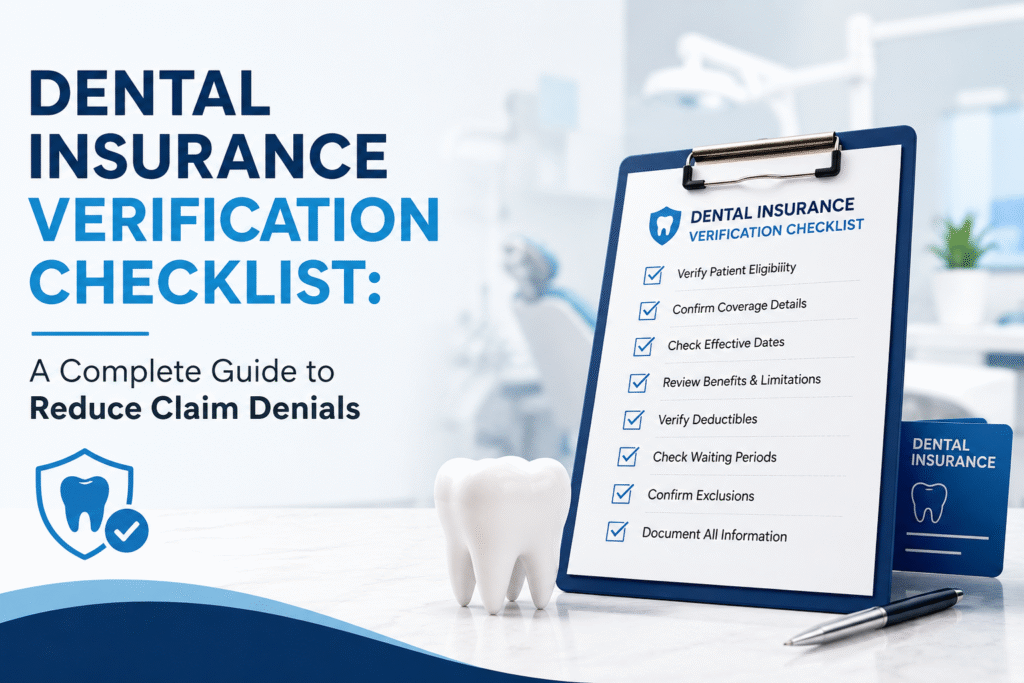
An incomplete or skipped insurance verification can be a major root cause of a dental claim denial. That means even a small missing detail or any inconsistency in dental insurance verification can lead to costly surprises that do not appear immediately, but after 30, 60, or 90 days in the form of denied claims, ageing AR, and collectable revenue that has quietly slipped past its recovery window. To address this issue, you don’t need more management or administrative staff; instead, you need a proper dental insurance verification checklist before every appointment. This checklist can help you eliminate a majority of eligibility-related claim failures before they reach the payer. According to industry research, practices that implement structured dental insurance verification services see first-pass claim acceptance rates improve by 25%-35% in the first month. Such revenue impact is direct: fewer denials mean faster payment cycles, lower rework costs, and a stronger net collection ratio for the practice. This guide covers everything you need to know about dental insurance verification, the full checklist, step-by-step workflow, measurement KPIs, and how outsourcing the process can benefit your team. Let’s find out! What Is Dental Insurance Verification and Why Is It Important? Dental insurance verification is the process of reviewing and confirming a patient’s insurance coverage details, which include the patient’s eligibility, benefits, financial responsibility, and limitations. The staff performs this verification process before offering the treatment and usually communicates directly (via online portals) with the payer and the insurance provider. Accurate dental insurance verification is important, as it helps: Without verification, the practice will not be aware of the lapsed coverage of a patient’s plan, or a plan that doesn’t cover the procedure, which results in claim denial. Who Should Perform Dental Insurance Verification? Verification is not one person’s job; it is a team responsibility. Front Desk Teams In most dental practices, front desk coordinators handle initial patient registration and collect the insurance data. They collect member IDs, group numbers, and coverage during check-in. Billing Specialists Billing staff confirm the eligibility of the patient based on the collected data, document frequency limitations, and identify procedures that require prior authorization. In practices with in-house billing teams, the team usually has a dental insurance verification sheet. Outsourced Verification Teams For practices using dental insurance verification services, third-party verifiers are usually responsible for conducting the whole verification process. They handle eligibility checks, documentation, and communication with patient responsibility. Complete Dental Insurance Verification Checklist for Practices Let’s take a look at the checklist for dental insurance verification that you need to confirm before a patient appointment. Patient Demographics Verification The staff verifies basic patient demographics, such that: Insurance Policy Details Confirmation Ensuring correct policy details is necessary to reduce the chances of denials. The verification process involves: Eligibility and Coverage Validation Verifying the patient’s eligibility under the plan. It involves: Benefits Breakdown — Deductibles, Co-Pay, Annual Maximum Benefits Item What to Confirm Annual Deductible Check the total deductible amount and how much the patient has already paid this year Annual Maximum Find out the highest amount the plan pays per year and how much is left to use Co-Insurance and Co-Pay Confirm how much the patient needs to pay out of pocket for each type of procedure Preventive Coverage Check if routine cleanings, exams, and X-rays are fully covered at no cost Basic Restorative Find out what percentage the plan covers for fillings, tooth removal, and similar work Major Restorative Check the coverage percentage for crowns, bridges, and dentures Orthodontic Benefit Confirm the lifetime dollar limit for braces and whether there is an age cutoff for eligibility Procedure-Specific Verification — Frequency Restrictions and Prior Authorizations Step-by-Step Dental Insurance Verification Workflow Here’s the step-by-step guide to follow the dental insurance verification at your practice: Step 1: Collect Patient Information Look at the schedule 48-72 hours prior to the patient’s appointment and gather the member ID number, the group number, the name of the carrier and the subscriber if they are an existing client; otherwise, request those from the new client. Step 2: Verify Eligibility Verify the eligibility involves connecting with the insurance company either through phone or via real-time portal options. Once verified, fill the verification sheet with details like date of verification, verification number and the complete coverage details. Step 3: Document Coverage Details Enter all the verified details into the PMS system. Ensure to input the details like annual maximum, deductibles, pre-authorization numbers, etc. Step 4: Inform the Patient Make sure to inform the patient about any additional expenses before they come for the appointment. This way, you can set clear expectations, eliminate the chances of any billing disputes, and ultimately improve same-day collections. Advantages of Outsourcing Dental Insurance Verification Some of the benefits of outsourcing dental insurance verification include: Key KPIs to Measure Verification Accuracy What gets measured gets managed, and verification performance is no different. Here’s what you need to verify: Verification Accuracy Rate The percentage of appointments where all coverage details were confirmed before the visit. First-Pass Claim Acceptance Rate The percentage of claims accepted by the payer on first submission without rejection. Denial Rate Due to Eligibility Errors The share of denials is tied to eligibility failures such as lapsed coverage, inactive subscribers, or missed authorizations. How CEC Improves Insurance Verification At CEC, dental insurance verification services play an important part in our dental revenue cycle management offering. Here’s how we stand out on insurance verification: Our trained team of professionals and modern tools help optimize the insurance verification process that boosts revenue and decreases the administrative load. Get a Free Insurance Verification Audit Find out how many of your denials trace back to a missed or incomplete eligibility check. Our experts will review your verification process and show you where first-pass claim acceptance is slipping. Get a Free Insurance Verification Audit → Conclusion Dental insurance verification is not an administrative task that sits at the edge of the revenue cycle. It is the foundation every clean claim is built on. When verification
What Is Dental Billing Outsourcing: Benefits, Costs & Complete Guide
Is your dental practice spending more time chasing unpaid claims than treating patients? You are not alone. Dental practices across the United States write off significant collectible revenue every year, not because they fail to render services, but because a broken, delayed, or understaffed billing process causes it. Dental billing outsourcing exists because CDT coding standards, payer-specific documentation rules, and insurance verification requirements make dental revenue cycle management genuinely complex—something most in-house front desk teams were never trained to manage. Dental billing outsourcing offers the most effective solutions for practices of every size, ensuring faster reimbursements, fewer claim denials, and a billing operation that runs without constant management oversight. According to the Ontario Academy of General Dentistry, claim denial rates in dental billing are around 12%, resulting in $262 billion lost revenue every year. The good news? Most of those denials are preventable with the proper billing outsourcing services. A right dental billing outsourcing company can help recover that revenue, reduce the administrative burden, and give your team the time to focus on patient care. What Is Dental Billing Outsourcing and How Is It Different from In-House Billing? Dental billing outsourcing means handing your entire revenue cycle or specific parts of it to an external specialist team. It involves contracting with a third-party company to manage the billing, coding, claim submission, and collections functions of a dental practice’s revenue cycle. On the other hand, in in-house billing, the practice hires and manages its own billing staff. Although with this process you can gain complete control over your billing services, you might also observe increased overhead costs and an increased risk of manual errors. In outsourcing, you can transfer those responsibilities to a team of billing specialists who work remotely on behalf of your practice. Here are some key differences: Area In-House Billing Outsourced Billing Who Handles It Your own staff, hired and managed by you An outside company takes care of all billing What It Costs Fixed salaries, benefits, and training fees A flexible fee based on what gets collected Skill Level Depends on your staff’s personal knowledge Trained experts who work only in dental billing Growth Friendly You must hire more people as you grow Grows with your practice — no extra hiring needed Rejected Claims Often slow to act, handled as issues come up Tackled quickly with a clear process and set timelines Software The practice buys and manages its own tools They link up with the software you already use Who Needs Dental Billing Outsourcing Services? Dental billing outsourcing can be useful for different types of practices, such as : Solo Dental Practices Solo practitioners are responsible for treatment planning, patient communication, and overseeing a small front desk team. In the end, billing accuracy and follow-up are the first things that go unnoticed. Outsourced dental billing gives solo practices access to the same level of billing expertise as larger groups, without the overhead costs. Multi-Location Dental Clinics Multi-location groups have to handle different payer mixes across locations, inconsistent coding practices between offices, and billing staff who might not share knowledge. An outsourced team creates a single billing operation across all locations, with unified reporting practices. Dental Support Organisations (DSOs) DSOs managing dozens or hundreds of affiliated practices that grow without adding headcount. A specialist dental billing outsourcing company provides the centralized expertise and technology to handle high claim volumes while maintaining compliance for every affiliated location. How Dental Billing Outsourcing Works in a Real Practice Setting Every stage of the revenue cycle follows a defined action and timeline. Here’s how it works in real settings: Patient Registration and Insurance Information Gathering The dental billing outsourcing team collaborates with the administration team to obtain vital information, such as group numbers, patient IDs, and benefit coordination, before the appointment. Insurance Validation and Eligibility Review The team carries out eligibility validation 24 to 48 hours before each appointment date to confirm active coverage and identify any approval requirements. Accurate Coding Using CDT Codes The dental claims include CDT codes developed by the American Dental Association. The billing professionals keep track of changes in these codes and also in each payer’s guidelines to minimize errors before filing claims. Claim Submission and Clearinghouse Processing Both a software system and a human reviewer check each claim before it is filed. Moreover, the team files clean claims within one to two business days following the visit. The team follows daily reports on clearinghouse activity and handles rejected claims right away. Payment Posting and Reconciliation The billing team enters each payment received from payers and reconciles it to its respective claim. This guarantees accuracy in posting while making it easier to detect underpayments and adjustments. Accounts Receivable (AR) Follow-Up and Denial Management The team analyzes and categorizes the unpaid and denied claims based on their cause and then refiles these claims within a specified time limit. A monthly analysis of denials allows us to find recurring denial types and address the root cause rather than repeat the same procedure again and again. Key Benefits of Dental Billing Outsourcing Here’s how dental billing outsourcing has a direct impact on the bottom line of your practice: More Efficient Claims Processing & Reimbursements The dental billing outsourcing company sends your claims one or two days after your visits, and sorts denials the same day. Payment cycles become faster, and you can see reductions in your accounts receivable days within the first three months. Fewer Claim Denials & Mistakes Coverage verification, code verification, and claim review eliminate the most common causes of denials even before you send out the claims. Once you track denials, you can easily pinpoint the root cause of the mistake and prevent it from recurring. Lower Operational and Staffing Costs If you bill your insurance in-house, you need to pay salaries and other benefits associated with billing employees. Outsourced billing usually costs less than one full-time billing employee while delivering better results. Access to Experienced Billing Specialists With sole focus, the outsourced staff
What Is Behavioral Health? A Complete Guide for Patients and Providers
Medical professionals now recognize that addressing the full range of patients’ health means more than just treating their physical health. They also recognize that mental well-being, behavioral habits, and psychological resilience significantly contribute to how well patients recover from an illness or injury; therefore, the term “behavioral health” is commonly used to refer to this integrated treatment approach. One in five adults in the United States has lived with a mental health disorder over the previous year, which equals an estimated 57 million people in the USA, according to the National Institute of Mental Health (NIMH). Mental health and substance use disorders increase the likelihood of developing chronic diseases and using other substances, and they shorten overall life expectancy. Value-based health care agreements recognize behavioral health as essential to improving patient outcomes and reducing avoidable hospital readmissions, while providing solutions to issues related to preventive care. This article provides a comprehensive guide for patients and health care providers regarding how to manage their own behavioral health appropriately and find suitable support/networks. What Is Behavioral Health? Behavioral health examines how people behave, their mental states, emotional states, and physical health. The definition includes: The two terms “mental health” and “behavioral health” share some similarity, but “behavioral health” covers more ground. It examines how various habits, coping methods, dietary choices, physical activity patterns, and substance consumption impact both mental and physical health. Healthline defines behavioral health as focusing on “how habits impact physical and mental well-being,” which includes prevention and intervention strategies. Behavioral health practices use psychological assessment together with counseling, medication management, and preventive education to enhance patient health outcomes in clinical environments. Why Behavioral Health Matters Healthcare usage and patient outcomes for extended periods depend on the effects of behavioral health. The cardiovascular disease risk increases by almost 40% because of depression. People who do not receive treatment for their mental health issues will develop chronic diseases, including diabetes and hypertension. The United States faces an annual economic burden of more than $740 billion due to substance use disorders, which results from decreased workforce efficiency, medical costs, and expenses related to the criminal justice system. The World Health Organization (WHO) states: “There is no health without mental health.” Behavioral health interventions decrease emergency department usage and hospitalization rates while helping patients with chronic diseases to take their medications as prescribed. Common Behavioral Health Conditions Behavioral Health includes a wide spectrum of conditions affecting individuals across age groups. 1. Anxiety Disorders The condition causes people to experience panic attacks, excessive worry, and social withdrawal. 2. Depression The condition leads to ongoing sadness, reduced energy levels, and disinterest in all daily activities. 3. Substance Use Disorders The condition causes people to depend on alcohol and opioids and other substances that harm their mental and physical well-being. 4. Bipolar Disorder The condition causes people to experience alternating periods of mania and depression. 5. Eating Disorders The condition involves problems with eating habits and body image perception. 6. ADHD (Attention-Deficit/Hyperactivity Disorder) People with this condition experience problems with attention control, and they show both impulsive behavior and hyperactive behavior. According to national data, anxiety disorders affect approximately 30% of adults at some point in their lives, making them among the most common behavioral health conditions. Behavioral Health Services for Patients CEC provides behavioral health services, which use organized treatment systems to help people who face emotional, psychological, and behavioral problems. We provide these common services: Behavioral Health Support for Providers Healthcare providers experience burnout together with emotional exhaustion, and they endure high levels of administrative pressure. Studies show that 63% of physicians experience burnout symptoms, which creates a demand for behavioral health programs that focus on healthcare providers. Provider support programs include: Health care organizations that use organized wellness programs for their providers achieve better staff retention, and they experience fewer medical mistakes. Clinicians who use behavioral health services develop resilience while they enhance their patient communication skills and decrease their turnover expenses. Behavioral Health in Multi-Specialty Practices Multi-specialty medical practices use integrated care models, which combine their medical staff with behavioral health specialists. The collaborative model enables the following activities: Research shows that collaborative care models improve depression treatment outcomes by nearly 20% compared to traditional referral systems. Multi-specialty practices that use behavioral health services report benefits, which include How Behavioral Health Impacts Overall Wellness Behavioral Health directly influences three essential areas Patients with strong emotional coping skills show better therapy compliance and preventive care adherence to their medical treatment plans. Behavioral Health and Physical Health Connections Behavioral Factor Physical Health Impact Chronic Stress Increased blood pressure, weakened immunity Depression Higher risk of heart disease Substance Use Liver damage, respiratory illness Anxiety Sleep disturbances, gastrointestinal issues Positive Coping Skills Improved recovery rates Behavioral health treatments provide better health results when they solve the main behavioral problems instead of just dealing with specific health issues. Tips for Patients Seeking Behavioral Health Care The first step for patients who need Behavioral Health services requires them to Early intervention provides better results for recovery while it decreases the chances of developing long-term health problems. The Bottom Line Behavioral health affects how one thinks, feels, copes, and connects. For patients, it means recognizing when something feels off and knowing that support is available. And for providers, it means looking beyond the symptoms to treat the whole person, not just diagnose the condition. Care is now integrated, and approaches such as therapy, medication management, lifestyle changes, and community support can help improve the outcomes. If someone is experiencing changes in mood, behavior, or coping patterns, it is important to know that seeking help is a proactive step to take towards long-term well-being. Behavioral health care can help individuals restore balance and lead a healthier and happier life. FAQs Is behavioral health the same as mental health? Not exactly. The definition of behavioral health includes mental health, together with other factors, which include lifestyle choices and substance abuse. Can behavioral health treatment improve physical
US Dental DSO Market to Exceed $300B by 2035: Trends Every Dentist Should Know
Dental service organisations (DSOs) have changed how dentists operate their businesses and provide patient care, which has led to major consolidation within the US dental market. The total market for dental support organisations in the United States will increase from USD 155.65 billion to approximately USD 302.54 billion by 2035, which represents a compound annual growth rate of 6.87% from 2025 to 2035. Major changes in dental practice have led to this growth, which includes rising operational costs and greater regulatory compliance requirements, and the need for digital transformation and new patient treatment methods. Dentists must consider DSO-related trends when they evaluate their career objectives and business ownership options because recent research indicates this trend constitutes an essential factor for developing long-term plans. The analysts identified two main factors which drove industry changes to DSOs through acquisitions and the development of technological capabilities, while DSOs provided essential technology resources which enabled doctors to concentrate on patient care instead of business management tasks. What are Dental Service Organisations (DSOs)? Dental Service Organisations (DSOs) are companies that focus on providing groups of dental practices with non-clinical, centralised services, including: The DSO model separates decisions that impact the practice from the rest of the business (administration), so dentists can do what they do best, which is care for patients while taking advantage of resources such as streamlined processes and shared facilities created through the shared operations with DSOs. Through centralised procurement of what a dental practice needs to operate on a day-to-day basis, in addition to applying the practices together, companies in DSO can achieve economies of scale and efficiencies that independent practices have a tough time achieving. Key Drivers of the U.S. DSO Market Growth There are many factors, some macro and some industry-related, that contribute to the DSO expansion in the USA. Ageing Population and Rising Oral Health Demand An increase in people reaching retirement age has caused a large increase in complex types of dental care, including root canals, implants, and restorative care. Industry Consolidation Because of a large number of private equity investment firms and other investment groups entering the dental market, there has been a large amount of consolidation within the dental industry. Technological Innovation As more DSO companies adopt AI to assist in processing insurance claims, there will be fewer denied claims through the DSO network. Rising Administrative Complexity Increased regulations regarding compliance, difficulty in staffing, and increasing overhead costs are driving some dental practices to outsource non-clinical functions to DSO companies. Major Trends Dentists Should Know The DSO landscape is changing quickly. Some of the top trends that are shaping the industry are: 1. Digital Dentistry Integration More than 60% of DSOs have adopted digital tools globally, like intraoral scanners and AI diagnostic technologies, to provide patients with accurate treatment and create a more engaged experience. 2. Roll-Up Acquisition Models Acquisition-driven growth makes up 41% of all DSOs, indicating that independent practices are continuing to consolidate into large DSOs. 3. Growth of Cosmetic and Implant Dentistry High margin specialty fields like implantology are experiencing higher levels of growth, making them appealing targets for DSO development. 4. Expansion into Underserved Markets Over the past couple of years, DSOs have been entering suburban and underserved markets in order to expand patient access and develop new revenue streams. Also Read- Guide for Dentists Considering a DSO Partnership in the United States Benefits of Partnering With a DSO Dentists who partner with DSOs typically receive operational/financial benefits, such as: Overall, industry data shows that by leveraging processes that allow automated workflows and creating more efficient scheduling, DSOs are reducing operational burdens for dentists, which allows them to spend more time providing clinical services. Challenges and Risks of DSO Partnerships While the DSO segment has been growing quickly, it has introduced some challenges to dentists who strive to partner with DSOs. A corporate structure may enforce standardised protocols and processes on individual practices that can limit the individual clinician’s flexibility when providing clinical care to patients. The large amount of investment required to purchase and implement the latest technology and create an environment that fosters innovation can place pressure on practice workflow systems. As the number of consolidations increases, various markets may witness increased competition from DSOs. Take this quick DSO-readiness assessment to identify operational gaps and see how prepared your practice is to scale, expand, or partner How DSOs Can Improve Practice Revenue? Traditionally, DSOs create better financial performance by providing operational efficiencies to their partner practices: Research suggests that when DSOs implement and use technological innovations, their partner practices can provide higher patient satisfaction levels. Operational Advantages of DSO-Affiliated Practices Metric DSO-Affiliated Practice Independent Practice Administrative Support Centralized Teams Dentist-Managed Technology Investment High Variable Procurement Costs Lower via Bulk Buying Higher Expansion Opportunities Multi-location Growth Limited Marketing Strategy Data-Driven Campaigns Local Efforts The efficiencies created by a partnership with a DSO can aid dental practices in growing more quickly while still providing patients with consistent service at all locations. Tips for Dentists Considering a DSO Partnership When considering DSO partnerships, dentists should follow a structured evaluation process: Experts emphasise that alignment between personal career goals and organisational culture is critical for long-term success within a DSO framework. The Bottom Line The trends in DSO transactions reveal a maturing market that rewards scale, performance, and efficiency. Consolidation is accelerating, private equity remains strong, and operational sophistication is becoming a competitive advantage rather than an option. For dentists, this is a time for strategic inflation because whether you are planning to go independent, exploring a DSO partnership, or thinking about the future transition, understanding the market forces will help in making proactive decisions that support your dental practice and personal finances. FAQs Q. What is driving the rapid expansion of DSOs within the United States? The primary contributors to rapid DSO Expansion are the consolidation of the industry profile, the ageing demographic of the community, rising operating costs, and increasing engagement in the use of Digital dentistry
The Complete Guide for Dentists Considering a DSO Partnership in the United States

The U.S. dental service organization industry is experiencing rapid expansion because market research indicates the market will reach USD 226.74 billion by 2026 and continue growing until it surpasses USD 942.56 billion by 2035. The current rapid industry expansion results from rising requirements for compliance, together with higher expenses for equipment and supplies, and the evolving needs of patients. Running a successful dental practice requires clinical excellence and strong business leadership. Balancing both can stretch even the most experienced practitioners. That’s why many dentists are opting for a DSO partnership to change their financial trajectory and day-to-day role. Dentists need to understand how to assess DSO partnerships together with DSO operations so they can select their career paths through their assessment of DSO partnerships. What is a Dental Service Organization (DSO)? A dental service organization (DSO) is the management entity (non-clinical) that provides operational support services to dental practices. The organization supplies support through its marketing work, accounting services, purchasing activities, compliance management, human resources functions, and IT infrastructure systems. The DSO model enables dentists to concentrate their efforts on delivering superior clinical care because it centralizes all business functions. The DSO model allows dental offices to decrease their operational costs, which helps them to implement modern technologies such as digital X-ray systems, AI-powered diagnostic tools, and centralized patient scheduling software. The ADA estimates that around 15% of all practicing dentists in the United States are affiliated with DSOs. The collaborative practice model of dentistry has gained wider acceptance in the dental field. Benefits of Partnering with a DSO Many dentists are now looking at DSO partnerships as a way to help them operate more efficiently and reduce overall financial pressures. The advantages of this system include: More than 39,000 clinics globally have partnered with DSOs to streamline operations. The reason is rising administrative burdens, including compliance, insurance processing, and patient-care documentation, with over 28% over the past five years. DSOs are managing HR, payroll, compliance, and procurement for more than 280,000 dental professionals worldwide. Also, several DSO-supported practices utilize digital charting, automated scheduling, cloud-based patient management solutions, and AI-based treatment planning tools, especially for orthodontic and restorative care. Types of DSO Partnership Models There is no specific type of DSO Partnership; however, there are numerous types of DSO partnerships based on structure and financial objectives. Each of these partnership types will affect the level of autonomy, revenue distribution, and strategic flexibility, so as a dentist, it is important to determine which of these partnerships will meet your objectives and your tolerance for risk. Key Considerations Before Partnering As soon as you have selected a DSO partner for your out-of-network, thorough due diligence will be performed across all aspects of this partnership. To complete your determination, the specific areas that you will want to focus on will include: While new DSO partnerships are increasing at a rapid pace, Dentists continue to resist establishing standardization within their treatment or developing performance metrics for evaluation. The financial model should include an assessment of marketing ROI and overhead reduction, as well as measuring patient retention rates. Revenue optimization is a core strategy for DSO partnerships; DSO partnerships offer revenue optimization through the following mechanisms: Dollars spent on DSO partnerships also lead to more profitable practice operations as DSO partnerships reduce administrative inefficiencies, increase patient volumes, and reduce the number of dental practices being purchased through DSOs. Risks and Challenges of DSO Partnerships While there are many benefits of working with DSOs, there are some challenges that dentists need to consider: The market continues to evolve with increased compliance costs, competitive pressures, and the need for continuous innovation by DSOs, which can impact clinical workflow. Steps to Evaluate a DSO Partnership If you are considering partnering with a DSO, there is a specific process for evaluating your partnership choice: Success Tips for Dentists Partnering With a DSO Dentists who continue to succeed with their DSO often do so through: The Bottom Line A DSO partnership affects ownership, income structure, leadership role, and long-term financial outcomes. If structured properly, it can provide operational relief, growth capital, and access to sophisticated management systems while you focus on delivering excellent patient care. However, misalignment can affect autonomy and long-term value. Hence, it is important to find a strategic DSO partner whose long-term strategy aligns with your vision. A well-negotiated DSO partnership should strengthen your practice and personal finances not just today, but over the next decade. FAQs Q. What is the main goal of a DSO partnership? The separation between clinical practice (i.e., dentistry) and administrative operation (i.e., management) to achieve greater efficiency and scalability. Q. Are DSOs growing in the United States? Yes, the DSOs are expected to experience double-digit growth over the next decade due to the effects of consolidation and technology. Q. Do dentists lose ownership in a DSO? Not necessarily. A DSO may offer some forms of partnership where the dentist will still have an ownership interest and share in profits. Q. Is a DSO partnership suitable for early-career dentists? Many new graduates choose DSOs for the tutorial style of practice, the structured income model, and lower financial risk.
What is Dental Insurance Verification & Credentialing Services?
Maintaining accurate and up-to-date records is essential for dentists and organizations providing dental care. Credentialing plays a key role in this process by verifying a practice’s qualifications and eligibility to participate in insurance networks. Completing credentialing across multiple insurance plans allows dentists to bill payers correctly and avoid claim delays. DMO, DHMO, PPO, Medicaid, and HMO are common types of dental insurance plans, each with different networks and reimbursement rules. Like, Medicaid is a government-funded insurance program with its own credentialing requirements. Are you still confused about the ins and outs of dental credentialing? We’ll cover everything from significant costs involved to the best software you can choose for a transparent and reliable process! What is Dental Insurance Verification? The process of verifying a dentist’s credentials and competence is known as dental credentialing. This means evaluating your skills, education, experience, and license to make sure they fulfill the requirements set forth by regulatory agencies and insurance companies. While being beneficial to uphold high standards of care, the credentialing procedure makes it possible for dentists to join insurance networks, which is essential for drawing clients and guaranteeing their ability to pay for care. Top Challenges In Manual Verification & Credentialing It takes a lot of effort to manage dental insurance verification at your clinic, and it may be highly frustrating for everyone involved, including your staff, patients, and the practice’s finances. A few challenges that you might encounter are: A dentist cannot treat insured patients while the credentialing procedure takes several months. For new clinics or those trying to rapidly grow their patient base, this can be a serious disadvantage. Office staff can become overburdened by managing credentialing in addition to routine practice operations, which could result in mistakes and delays. It can be challenging to keep track of all the required paperwork and processes manually because different insurance companies have different credentialing requirements. Why Does Dental Insurance Verification Matter? You can avoid issues with billing claims and payment procedures by taking the required actions for dental insurance verification. Here are a few other benefits of ensuring your claims are in line with the authorities. Features To Look For When Choosing The Right Verification & Credentialing Software A well-developed software increases productivity, strengthens compliance with regulations, and facilitates seamless operations throughout the business. A holistic and compliant software must offer: Reviewing The Cost of Dental Insurance Verification & Credentialing Services Since insurance billing accounts for 40% to 50% of dental business revenue, a provider who is not credentialed loses a substantial amount of money every day. For this reason, credentialing services have become increasingly popular among dentists. For example, a less costly dental insurance verification partner that does not comply with HIPAA regulations can incur significantly higher costs due to fines. Similarly, a partner with insufficient reporting systems won’t be able to provide practitioners with information about areas where revenue cycle management has to be improved. Remember, there is a startup fee that some dental insurance verification providers impose, but it is completely unnecessary. Expert businesses in this field have a setup ready and can begin delivering right away. In-house vs Outsourced Verification & Credentialing You are already aware of how laborious and prone to error this procedure may be if your front desk is in charge of manually confirming insurance for each patient. So, if you are confused, then here is the different between in-house and outsourced verification and credentialing services: Factor In-house Verification Outsourced Verification Setup cost High initial hiring and training cost Low upfront cost Ongoing expenses Salaries, benefits, and software Predictable monthly or per-case fees Turnaround time Slower during peak workload Faster due to dedicated teams Error risk Higher with manual billing and verification Lower with standardized processes Scalability Hard to scale quickly Easy due to automation Suitable for Large organizations with steady volume Both large and growing practices and hospitals Impact on Claim Accuracy & Revenue Getting claims reimbursed the first time around requires being equipped with the information and resources necessary to overcome any obstacles posed by insurance companies. With an expert provider, you can boost your revenue while preventing cumbersome manual processes. Change The Game With The Right Service Provider Running a dental practice comes with numerous responsibilities, one of which is ensuring that you and your staff are properly credentialed. That’s where a dental credentialing company comes into play. Go through this checklist to ensure that you make an informed decision. Bottom Line Dental credentialing is a critical process that verifies a dentist’s qualifications, experience, and professional standing, allowing them to participate in insurance networks and provide care to patients covered by those insurers. This process, while essential, can be complex and time-consuming. If reliable processes are not in place and regularly maintained, aging reports can spiral out of control very quickly. With tried-and-true, efficient insurance and aging report systems, CEC can help your clinic maintain cash flow, satisfied patients and staff, and scheduled treatments. Explore the full range of our medical and dental insurance verification packages today! FAQs Why should I outsource my Dental Insurance Verification? Spending hours on the phone with insurance companies can have a detrimental effect on staff’s emotional and mental health. Outsourced services concentrate on providing care for your patients and enhancing their overall experience if these time-consuming, tiresome tasks are eliminated. How often should I get my Dental Insurance verified? Dental insurance verification must, at the very least, take place before the initial appointment when a new patient is registered and scheduled, and it must be performed prior to every subsequent appointment for current patients. What does your Dental Insurance Verification process look like? First, we have time to get in touch with the patient and obtain proper information if the patient’s information is inaccurate or invalid. We get a comprehensive analysis of their advantages and notify your team. With this degree of information, you can accurately estimate your patient’s out-of-pocket expenses, reducing the possibility of unforeseen charges down the road.
Top Billing Challenges Faced by Dental, Medical, and Optometry Clinics Today Is your clinic losing thousands of dollars each month due to billing errors? Healthcare practices lose around $125 billion each year due to poor medical billing practices. Running a clinic means balancing patient care with complex administrative tasks. Billing has become your biggest headache, with claim denials piling up, coding errors delaying payments, and your staff drowning in paperwork. These challenges hurt your bottom line and steal time from what matters most: providing excellent care. In this guide, we will break down common billing challenges that you might encounter as a dentist or optometrist that could affect our practice’s revenue cycle. Common Billing Challenges and Their Solutions Your practice faces many billing problems that affect your profits and wear out your staff. Let’s look at the biggest issues and ways to fix them: 1. Insurance Claim Denials and Rejections You send in claims hoping to get paid, but they often come back rejected. Incomplete data, incorrect patient information, or eligibility problems result in rejected Insurance claims that must come back to your practice. As a result, you will be dealing with frustrating rework cycles and delaying revenue for weeks. Solutions: 2. Medical Coding Errors You are working with thousands of codes like CPT, ICD-10, and CDT. One wrong digit and the claim is rejected. Coding discrepancies are major causes of billing discrepancies, whether it is up-coding, under-coding, or using codes that are outdated. Solutions: 3. Slow Patient Payment Collection You’re providing the quality service, but it’s been tough to get payments. High-deductible policies mean that patients pay more themselves, yet you continue to experience challenges with your collection rates. Inconsistent communication about payments leads to outstanding balances. Solutions: 4. Regulatory Compliance and Documentation You find it hard to stay current with healthcare rules that change often, like HIPAA, and payer-specific guidelines. If you don’t follow these rules, you risk audits, fines, and claim rejections. Lack of proper documentation leads to lost funds and litigation risks. Solutions: 5. Time-Consuming Manual Processes You enter data by hand, check on claims, and record payments. These jobs take up a lot of time each week. Processing by hand is causing inaccuracies, longer wait times, and fatigue on the part of your staff. Your staff is spending too much time on paperwork and not enough on patient-centered activities. Solutions: How Outsourcing Billing Services Can Help Your Practice? Outsourcing gives you access to dedicated specialists who handle everything while you focus on patient care. Here’s how you can benefit from the services: Conclusion As a medical professional, the last thing you are passionate about is insurance billing. But because of the increasing challenges, you might be torn between delivering outstanding patient service and financial profitability. The good news is you don’t have to choose between. Choose the right billing partner and let them handle the complex billing work while you do what you love: helping people. Ready to take back your time and your revenue? At CEC, we offer billing solutions for dental, medical, and optometry offices. Let us ease your billing headaches so you can concentrate on your patients. Frequently Asked Questions Q: How much would outsourcing billings cost in general? Billing companies usually charge between 4-8% on all revenues recovered, which can be less than it costs to retain your own employees. Q: Can I lose control over billing when I outsource? No, you have complete visibility in your case with real-time reporting and updates, with better insight than you had before. Q. What is the time frame for achieving the benefits of outsourcing? In most cases, there is evidence of improvement within 30- to 60-day periods as a result of faster processing of claims and increased collection rates.
An End-to-End Approach to Revenue Cycle Management
A healthcare organization’s highest priority is to balance patient care while sustaining its financial health. However, with rising operational costs, evolving insurance models, and intricate compliance requirements, most healthcare providers fall behind on submitting medical bills, following up with denied claims. In fact, according to the Journal of AHIMA, on average, hospitals face a yearly loss of $5 million due to health care claim denials. So how do healthcare practices stay afloat and manage their revenue cycle? The healthcare industry is now adapting an end-to-end revenue cycle management approach. The strategy involved managing the entire patient care process, from pre-registration to reimbursement. The unified approach covers all the aspects of the revenue cycle, so you can improve your cash flow while providing better care to the patients. How do you implement the End-to-end RCM strategy in your practice? Keep on scrolling to find out! What Does End-to-End Revenue Cycle Management Include? End-to-end revenue cycle management involves overseeing a medical practice’s billing and revenue process, from the initial patient appointment and information collection to the completion of the treatment and all claims and payments. It tracks the patient information and bills while highlighting the areas that need improvement. For example, even if claims are submitted on time with accurate data, a missing prior authorization can still result in denials. That’s when end-to-end RCM services flag these issues early, provide the necessary payer requirements and help prevent avoidable issues. An end-to-end RCM has three steps: front-end, mid-revenue, and back-end. Front-End Include: Credentialing healthcare providers and practices to ensure they are qualified to provide specific services and eligible for insurance contracts. Verifying patient benefits and eligibility to confirm the specific services covered under their insurance plan. Prior authorization is required to ensure that the specific diagnostic services, like MRIs and CTs, are approved and covered by the patient’s plan. Mid-Revene Includes: Assigning and inputting the correct treatment and procedure codes for the services. Claim management tracks the payment processes and ensures the payers review and approve bills. Payment posting is used to keep track of payments, so that patients can see how much they owe after their insurance covers. Back-End Includes: Accounts receivable ensures that late payments from insurance companies are followed up on. Denial management helps medical practices to appeal incorrectly denied claims and correct any mistakes. Patient pre-collections help medical practices to reduce collection costs and increase their immediate revenue. Key Stages of the End-to-End Revenue Cycle Management The goal of end-to-end RCM is to streamline your medical billing process with minimal errors. Think of it as a guide that manages everything, starting from when a patient arrives for treatment until their bill is settled. To help you understand the entire cycle, we have compiled the fundamental stages of the process. Step 1. Patient Access & Pre-Registration Collect the patient’s insurance and personal information before scheduling their appointment. By doing this, you can save time and make patient check-in quicker. It is an important stage to initiate the payment process smoothly. Step 2. Insurance Verification Make sure you have all the right details about the patient’s insurance policy. Check the eligibility for coverage, what the insurance does and doesn’t pay for, along with any specific rules they have. Step 3. Charge Capture Ensure that to charge your services accurately. It means you need to pay close attention to every diagnosis and treatment patients receive. Keep a detailed record of these services to foster transparency and trustworthiness among all parties. Step 4. Coding and Code Review Medical coding is the translation of the services patients receive at the facility into a language that insurance companies understand for billing. It ensures everything is accurate and consistent while following the rules. Step 5. Claim Submission Claim submission is an important stage in end-to-end RCM where you have to compile and send claims to insurance payers for reimbursement. The process demands precision, as any errors can lead to denials or delayed payments. Step 6. Claim Adjudication Claim adjudication is where insurance payers assess and make decisions regarding the submitted claims. During this stage, they will review the claims for accuracy, completeness, and compliance with policy terms. Then they decide on payment or denial of the amount to be reimbursed. Step 7. Payment Posting Payment posting is when the payments received from insurance companies, patients, and third-party payers are recorded and applied to a patient account. The processes ensure accurate tracking of payments, adjustments, and patient balances. Step 8. Denial Management Denial Mamanget focuses on identifying, analysing, and resolving denied insurance claims. The stage investigates the reasons for denials, correcting errors, and submitting the claims. The process gives you insights to reduce denials in future claims. Step 9. Accounts Receivable Follow-Up Accounts receivable follow-up involves monitoring and the pursuit of outstanding payments from the insurance companies, patients, and third-party payers. Timely and effective follow-up helps you to accelerate cash flow and minimize bad debt. It requires consistent communication with payers and patients to resolve the claims. Step 10. Patient Statement Processing and Collection Patient statement processes empower patients to understand their medical expenses. With clear communication, the stage helps you to gain the patients’ trust while streamlining your revenue collection process. Step 11. Revenue Analysis and Reporting Revenue analysis and reporting are fundamental steps to gain information about the financial performance and overall health of the facility. You need to identify areas of improvement, follow the revenue trends to make informed decisions to optimize your revenue streams, Benefits of an End-to-End RCM Approach An end-to-end RCM approach helps you optimize your revenue cycle process, improve your financial performance, and promote patient experience. Let’s explore how the innovative approach can transform your practice. Improved Financial Performance You need a strong revenue cycle management strategy to improve your facility’s finances. By fine-tuning the RCM processes, you can capture more revenue, reduce debt, and improve the cash flow. Moreover, streamlining RCM reduces billing errors and minimizes claim denials, ensuring your facilities collect all revenue they owe, supporting sustainable