
Dental Billing Trends 2026: 78% Report More Denials, CDT-26 Brings 31 Code Changes
Dental billing in 2026 is being shaped by four things: more claim denials, a big CDT code update, a wave of new state insurance laws, and patients picking up more of the bill themselves. None of it is really about technology, even though that’s where most of the coverage lands. Everyone’s talking about AI and automation this year. Fair enough, it’s part of the picture. But it’s not what’s actually driving the changes underneath. That’s coming from payer policy, coding, and state legislation, and a lot of practices are still catching up. Key Takeaways What Are the Biggest Dental Billing Trends in 2026? Four things: claim denials, coding changes, state regulation, and patients paying more themselves. Each one is hitting a different part of the billing workflow, and they don’t stay in their own lane. Take a denial caused by a payer reading medical necessity more strictly. Now it also depends on whether the claim used the right CDT-26 code, and whether the patient’s state has a new downcoding rule that applies. Practices still handling these as four separate problems are already behind. Working with an experienced dental billing services partner tends to help here, mostly because tracking payer policy, coding, and state law all at once isn’t a part-time job anymore. Why Are Dental Claim Denials Increasing in 2026? Denials are up sharply this year. The reason isn’t what most people assume. What the Data Shows Zentist surveyed more than 160 dental revenue cycle and billing professionals for its 2026 report, and 78% said denials or payer scrutiny had increased over the past year. 71% named insurance verification as their biggest daily headache. And yet 63% of practices are still hitting net collection rates above 90%, which researchers are calling the “efficiency paradox,” good numbers propped up by a lot of manual effort that can’t really scale. Is It Billing Errors or Payer Policy? Turns out it’s mostly not staff mistakes. It’s payers reading medical necessity and frequency rules differently than they did a year ago. Same rules on paper, stricter application in practice. That means more documentation, more time spent building a case for something that used to be straightforward. Dental claim denial trends like this one are worth watching closely, because the fix isn’t cleaner claims, it’s understanding what changed on the payer’s side. What This Means for Appeals Here’s the part most practices miss: almost nobody appeals. Fewer than 1% of denied in-network claims get contested industry-wide. Yet appeals win more often than people expect, in at least one state, the overturn rate climbed from 38% in 2019 to nearly 53% in 2025, and for dental claims specifically, over half of appeals succeeded. That gap, between how rarely people appeal and how often it works, is probably the single biggest missed opportunity in billing right now. What Changed in CDT 2026 Codes? CDT 2026 code changes landed January 1: 31 new codes, 14 revisions, 6 deletions, 9 editorial tweaks. Change Type Count Practice Impact New codes added 31 New documentation options for procedures previously billed generically Codes revised 14 Includes restorative and anesthesia-related updates Codes deleted 6 Needs removing from claim templates and front-desk shortcuts Editorial actions 9 Clarifies existing code language and usage Why Some Payers Are Slower to Adopt Them Not every payer moves at the same speed. Some update their claim logic and portals fast, others lag, especially right after January. So a code that’s technically valid under CDT-26 can still get denied or downgraded depending on which plan you’re billing. Correct code, wrong timing, still a problem. Codes Practices Should Watch Closely A few payers rolled their own coverage changes into the CDT-26 update, particularly around perio evaluation, debridement, and ridge preservation grafting. Worth double-checking payer-specific rules on these rather than assuming the code alone guarantees payment. Getting ahead of it starts with tightening up dental insurance billing and verification before claims go out, since catching a coverage gap early is a lot cheaper than reworking a denial later. What New Dental Insurance Laws Are States Passing in 2026? This is probably the least-talked-about dental insurance regulation 2026 trend, and it deserves more attention than it’s getting. Dental Loss Ratio Legislation The American Dental Association tracked ten states considering dental loss ratio legislation this year. In plain terms: laws requiring insurers to disclose how much of every premium dollar actually goes to patient care. Downcoding and Retroactive Denial Restrictions States also looked at downcoding, retroactive denials, virtual credit card payment practices, network leasing, and assignment of benefits. All of it affects how and when a practice actually gets paid, separately from anything happening at the coding or payer level. What Mississippi’s Law Means for Other States Mississippi passed a law this year requiring dental insurers to report what share of premiums goes toward patient care. Given how many other states considered similar bills in the same session, it’s a reasonable bet more will follow before 2027. Why Are Patients Paying More Out of Pocket for Dental Care? Patients are covering more of the bill, and billing teams are the ones dealing with the fallout. What’s Driving the Shift 31% of the professionals Zentist surveyed said rising patient out-of-pocket costs were the single biggest concern heading into 2026, the top answer in the whole survey. How It Changes Billing and Collections When insurance covers less, the billing process doesn’t stop at claim submission anymore. It stretches into statements, payment plans, collections, all the stuff that used to be simpler when insurance picked up most of the tab. This tends to show up hardest near year-end, when patients rush to use whatever benefits are left before their annual maximum resets. Patient billing is turning into its own workflow now, not just a follow-up to insurance billing. Is Dental Billing Automation Actually Working in 2026? Yes, but not the same way for everyone. How Solo Practices Are Using It Smaller and solo practices are leaning into patient payment tools first, anything that helps lock
New Jersey Dental Insurance Verification: What NJ Practices Should Check Before Every Appointment
Dental insurance verification in New Jersey takes more than a quick eligibility check. NJ practices deal with a payer mix that includes large regional carriers, self-funded employer plans, state Medicaid managed care, and two separate public employee programs, and each one has its own rules about what’s covered, who administers it, and what the patient will owe. Miss one detail and the claim comes back denied weeks later. This guide is for New Jersey practice owners and office managers who want fewer surprises at checkout and fewer denials in the mail. It walks through what to confirm for each type of plan your patients are likely to carry and when it makes sense to bring in a New Jersey dental insurance verification service or a full-service dental billing company. Why Dental Insurance Verification Is Different for New Jersey Practices Most of the basics are the same everywhere: confirm the patient is active, check benefits, and note limitations. What changes in New Jersey is the mix of plans walking through the door and how many of them look alike on the surface. A Payer Mix Led by a Few Large Dental Carriers A handful of carriers cover a big share of NJ patients. Delta Dental of New Jersey describes itself as the state’s largest dental benefits company, and Horizon, Aetna, Cigna, MetLife, Guardian, and UnitedHealthcare all have a strong presence too. The catch is that the same carrier logo can sit on very different plans. Two patients with Horizon cards might have a fully insured small group PPO, a self-funded employer plan, a state employee plan, or Medicaid coverage through Horizon NJ Health. Each of those follows different rules, so the card alone tells you very little. Patients Covered by New York and Pennsylvania Plans Practices in Bergen, Hudson, and Essex counties see a lot of patients who work in New York. South Jersey offices see the same with Pennsylvania employers. Those patients often carry plans issued out of state, with different networks and fee schedules. Delta Dental is a good example: the Delta member companies in each state operate separately, so a patient’s plan may be administered by Delta Dental of New York or Pennsylvania rather than New Jersey. If your office is in-network with one and not the other, the patient’s estimate can be off by a wide margin. What to Verify for Commercial PPO Patients in New Jersey For commercial plans, the goal of dental insurance verification is to know what the plan will pay before you start treatment, not after the EOB arrives. Covering the standard items on a dental insurance verification checklist for front desk teams is the starting point. NJ practices should then pay extra attention to two areas. State-Regulated vs Self-Funded Employer Dental Plans Fully insured plans sold in New Jersey fall under state insurance regulation. Self-funded plans, which many larger employers use, are governed by federal ERISA rules instead, and the employer decides the benefit design. The carrier just administers it. That means two patients with the same carrier and the same employer size can have very different coverage. When you verify, ask whether the plan is fully insured or self-funded, and don’t assume a plan follows a benefit rule just because another plan from the same carrier does. Frequencies, Downgrades, and Waiting Periods That Vary by Plan These three details cause more surprise balances than anything else. Confirm whether cleanings are limited to two per calendar year or one every six months, since a patient seen in January and June may hit the limit differently depending on the wording. Check whether the plan downgrades posterior composites to amalgam fees, and whether crowns fall under a waiting period for new enrollees. Also note how much of the annual maximum is left, especially in the last quarter of the year when many patients schedule treatment before benefits reset. Verifying State Medicaid Dental Eligibility for NJ Patients If your practice accepts NJ FamilyCare, verification looks different. NJ FamilyCare is the state’s Medicaid and CHIP program. Most members are enrolled in a managed care organization, and dental benefits run through that plan. Some members still have benefits through the state’s fee-for-service Medicaid program instead. Confirming the Patient’s Medicaid Managed Care Plan The first step is finding out which managed care plan the patient is enrolled in, and then which dental administrator handles claims for that plan. Several MCOs use a separate dental vendor, so the payer ID and claim address may not match the health plan name on the patient’s card. Next, confirm that each treating provider in your office is actually enrolled with that specific plan. Being enrolled with one MCO doesn’t mean you’re in-network with the others, which is why the dental credentialing process for New Jersey providers needs to be current for every plan you accept. Eligibility can also change month to month. The state has announced changes to NJ FamilyCare qualification rules starting in fall 2026, so checking status close to the appointment matters more than it used to. Prior Authorization Rules for Medicaid Dental Procedures NJ FamilyCare uses a single clinical criteria policy that the state and all MCOs follow for frequencies and medical necessity reviews. Some procedures require prior authorization, and orthodontic treatment is generally limited to members under 21 with documented medical necessity. Pull the current criteria before scheduling anything beyond routine care. Keep in mind that NJ FamilyCare is the payer of last resort, so if the patient has any other dental coverage, that plan has to be billed first. Verifying New Jersey Public Employee Dental Plans State and local government workers, teachers, and school staff often carry dental coverage through the State Health Benefits Program (SHBP) or the School Employees’ Health Benefits Program (SEHBP). These plans come with a few details that trip up offices unfamiliar with them. Since January 2025, the Dental Expense Plan has been administered by both Horizon and Aetna, depending on which option the member picked. So you need to confirm which
How to Choose the Right Dental Billing Company for Your Practice
Most practices interview billing providers by asking what they do. Every dental billing company answers that question the same way: claims, verification, posting, appeals, and AR follow-up. The list is identical across the industry, which means it tells you almost nothing about who you are actually hiring. The difference between providers is not what they do. It is how they work. Who touches your account, what happens when a claim gets complicated, how quickly you hear about a problem, and what it takes to leave if it goes badly. Those things rarely come up in a sales call unless you raise them. Ten questions will surface most of it. Ask the same ten to every provider on your shortlist, get the answers in writing, and the differences become obvious fast. Why the Right Questions Matter More Than the Sales Pitch Billing is not a product you can inspect before you buy. You are hiring a process you cannot see, run by people you will probably never meet, on claims you will not review individually. By the time poor work shows up in your numbers, it has usually been happening for two or three months. That is why the selection conversation carries more weight here than in most vendor decisions. You are not comparing features. You are trying to work out whether a dental billing company in the USA will handle your claims the way you would handle them yourself, and the only evidence available before you sign is how they answer questions. If you are still weighing whether to outsource at all, it helps first to understand how outsourced dental billing works. 10 Questions to Ask Before Choosing a Dental Billing Company 1. What exactly is included, and what costs extra? “Full service” means something different at every company. Some quotes cover insurance claims only. Others include patient statements, payment plans, credentialing, and eligibility checks. A good answer comes as a written scope document listing what is in and what is out, with pricing for the add-ons. Worry if they describe the service verbally and move on. Anything not written down becomes a billable extra later. 2. How do you charge, and what does that work out to on our collections? Percentage of collections is the most common model, but flat monthly fees and per-claim pricing both exist and suit different volumes. A good answer includes a worked example using your actual monthly collections, plus any minimum charge. Worry if they quote a percentage without mentioning a floor. A monthly minimum can double your effective rate in a quiet month. Our guide on dental billing pricing models covers how the three compare on real numbers. 3. Which practice management systems do you work in? Most providers claim compatibility with everything. In practice, working daily in Dentrix is different from having seen it once. A good answer names your specific system and says how many current clients use it. Worry if the answer is “we work with all major systems” with no specifics. Ask how they access it, whether through remote login or a data bridge, and who holds the credentials. 4. Who handles our account, and can we speak to them? This is the question that separates providers more than any other. Some assign a named biller. Others use a pooled team where whoever is free picks up your claims. A good answer names a person, explains cover during leave, and offers a direct line. Worry if all contact routes go through an account manager who does not touch your claims. That layer slows every question down and usually means nobody owns the outcome. 5. What happens to our existing accounts receivable? Plenty of companies only work claims submitted after the go-live date. Everything older stays with your team, which is exactly the work you were trying to hand over. A good answer states clearly whether legacy AR is included, excluded, or priced separately and gives a plan for working it. Worry if they say they will “look at it” once you start. Aged claims lose value quickly past 90 days, and this needs settling before signature. 6. What does onboarding look like, and how long before we see results? A good answer is two to four weeks for setup covering system access, clearinghouse enrollment, and fee schedules, then 60 to 90 days before numbers stabilise enough to judge. Worry if they promise results in the first month. Claims submitted in week one do not pay until week five at the earliest, so anyone offering faster is describing activity rather than outcomes. 7. What do you report on, and can we see a sample? Reporting is where most dental billing service relationships quietly fail. You get a monthly summary that shows collections and nothing else, and you have no way to tell whether performance is good. A good answer is a sample report from a live client with the names removed, showing the clean claim rate, denial rate, AR aging, and days in AR. Worry if the only number they report is collections. Without the metrics underneath it, you cannot tell a good month from a lucky one. A provider offering proper dental revenue cycle management will report on the full cycle, not just the cash. 8. How do you handle denials and appeals? Submitting claims is the easy part. What happens to the 5% that come back is where the money is won or lost. A good answer describes a process: how quickly denials are worked, who writes appeals, how many attempts before a write-off, and what their overturn rate looks like. Worry if denial work is billed separately or capped. That creates an incentive to leave hard claims alone. Ask specifically how insurance verification feeds into this, since most denials are avoidable at that stage. 9. What are your data security arrangements, and will you sign a BAA? Your billing provider handles protected health information for every patient you treat. A business associate agreement is not optional;
Top 10 Dental Billing Companies in the USA (2026 Comparison)
Search for the best dental billing companies and you will find a dozen lists, almost all of them written by billing companies who put themselves at number one. That does not help much when you are trying to work out who actually fits your practice. This comparison takes a different approach. Instead of ranking companies against each other, it matches each one to the kind of practice it serves best. A solo office in its second year needs something very different from a 14-location group. We have also included what each company charges, which practice management software they work with, and what to check before you sign. Best Dental Billing Companies at a Glance How We Compared These Dental Billing Companies Six things were looked at for each company on this list: Two things were deliberately left out. Performance figures like clean claim rates are reported here as company claims, not verified results, because no independent body audits them. And pricing is compared by model rather than by exact rate, since almost every quote is built around your claim volume. Comparison Table Company Best for Pricing Model Works With Contract CEComputech Dental and medical billing Scope based PMS integrated Flexible eAssist Broad service range % of collections Most major systems Term contract Dental Claim Support Transparent pricing % of collections Dentrix, Eaglesoft, Open Dental Term contract Medusind Multi-specialty groups % of collections Enterprise platforms Term contract Wisdom AI-led workflow % of collections Open Dental, Dentrix Flexible Capline Billing plus credentialing Custom Most major systems No long lock-in Dental Claims Cleanup Aged AR recovery Project or hourly Most major systems Project based AnnexMed High claim volumes Per claim or % Most major systems Term contract Dynamic Dental Solutions Smaller practices Flat or % Dentrix, Eaglesoft Flexible Dental Billing Assist Fast onboarding Flat or % All major systems No contract Most outsourced dental billing companies work on a percentage of collections. For how those models compare on actual cost, see our guide on dental billing pricing models. The 10 Best Dental Billing Companies in the USA for 2026 CEComputech Best for: practices billing both dental and medical insurance Most companies on this list handle dental only. CEC runs both dental and medical billing, which matters for sleep apnea appliances, TMJ treatment, surgical extractions, biopsies and trauma cases, where the claim belongs with the medical payer and the coding works differently. Our dental billing services cover verification, claim submission, payment posting, denial work, AR follow-up and credentialing. Consider us if cross-billing is part of your case mix and you are tired of splitting it across two vendors. eAssist Dental Solutions Best for: practices wanting one company to cover everything eAssist is the largest name in outsourced dental billing and has been at it longer than most. Alongside insurance billing they offer patient billing, verification, credentialing support and coding help, so you are not stitching together three vendors. Consider them if you want scale and breadth more than a low rate, since percentage pricing gets expensive as collections grow. Dental Claim Support Best for: practices that want to see pricing before a sales call DCS publishes its pricing openly, which is rare in this space, and has a visible body of client reviews to check. They also lean heavily into training, so your front desk picks up knowledge rather than just handing work over. Consider them if you want your own team to get better at billing while someone else carries the load. Medusind Best for: DSOs and multi-specialty groups Medusind works across medical and dental and is built for organisations with real volume. They publish target numbers such as days in AR under 40, which gives you something concrete to hold them to. Consider them if you are running multiple locations and need reporting that rolls up across all of them. Wisdom Best for: practices open to an automation-first approach Wisdom is one of the newer, venture-backed platforms pairing automation with human billers. The pitch is catching claim problems before submission rather than chasing denials afterwards. Consider them if you like the idea of a modern workflow and are comfortable with a younger company. Capline Dental Services Best for: practices where credentialing keeps causing delays Capline keeps billing, credentialing and eligibility verification under one roof, which matters because revenue usually breaks at the handoff between those three. They also promote no long-term lock-in. Consider them if your denials trace back to enrolment gaps rather than coding. Dental Claims Cleanup Best for: practices sitting on an aged AR backlog This one is narrower by design. Rather than taking over your billing permanently, they work through old claims that nobody has chased. Useful as a one-off recovery project. Consider them if you have a pile of claims past 90 days and need someone to work it before writing it off. AnnexMed Best for: high claim volumes where cost per claim matters AnnexMed runs offshore delivery across medical and dental, which brings the rate down for practices submitting large numbers of claims. Consider them if volume is your main cost pressure. Ask directly about data handling and whether a BAA is in place. Dynamic Dental Solutions Best for: smaller practices wanting a named contact A smaller operation focused on dental revenue cycle work, which usually means you speak to the same person rather than a rotating queue. Consider them if you have been through a large vendor and disliked the lack of a direct line. Dental Billing Assist Best for: practices that need something running quickly They promote short onboarding, no setup fee and no contract, which suits a practice that cannot wait weeks or has just lost a biller. Consider them if speed matters more than a long track record. How to Choose the Right Dental Billing Company If you are still deciding whether to hand billing over at all, start by reading what outsourced dental billing actually involves. Once you are past that point, the shortlist depends on your situation. Solo and small
How Front-Desk Intake Errors Create Downstream Dental Billing Problems
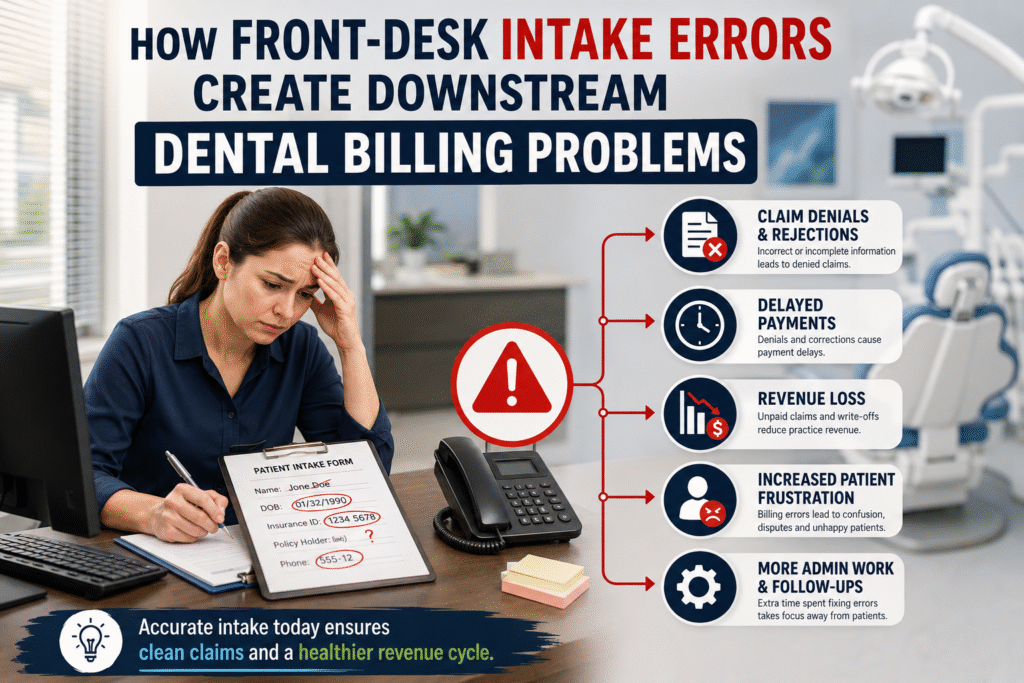
Nearly 1 in 5 dental claim denials trace back to administrative errors. A misspelled name. A wrong date of birth. An outdated policy number, entered at check-in, nowhere near a dental chair. By the time that denial lands on a billing team’s desk six weeks later, someone’s usually blaming the payer, or the coding, or “the system.” Almost nobody traces it back to what it actually was: a ten-second data entry mistake at intake. The Front Desk Runs the Whole Cycle, Whether Anyone Admits It or Not People talk about the front desk and billing like they’re two departments. One greets patients and runs the schedule. The other chases claims and yells at insurance companies on hold. But every claim your billing team submits is built entirely on what got typed in at check-in: name, birthdate, insurance ID, plan details, coordination of benefits. Both sit inside the same revenue cycle management process, whether your org chart says so or not. Get that first data point wrong, and billing candetails, andthe claim all they want. They can’t fix what’s already broken underneath it. The Mistake Almost Everyone Makes: Verifying Too Late Ask a handful of people who’ve worked in dental billing for a while what the biggest recurring problem is, and you’ll hear a version of the same answer more than once: insurance verification, done at the last minute, or skipped outright. It’s not because staff are lazy. Verification takes real time between patients, and it’s easy enough to assume coverage checked three visits ago is still good. Then the patient leaves after treatment, and if that plan had lapsed or changed, that revenue might be gone for good. The fix here isn’t complicated. Confirm coverage at least two days before the appointment, not the morning of, definitely not once the patient’s already sitting in the chair. Two days gives someone enough runway to catch a lapsed policy and actually talk to the patient about it before the drill starts, not after the claim bounces. Where the Damage Actually Comes From Typos in the basics. A misspelled name, a transposed birthdate, a wrong digit in a member ID. Small stuff. Enough on its own to bounce an otherwise clean claim before a payer even looks at what was done clinically. Happens most when staff are working off an old intake form or rushing between patients with a waiting room filling up. Insurance info nobody rechecked. People switch jobs. Plans change. Dependents get added. None of that shows up automatically unless someone asks. A verification from six months back tells you nothing about today. Guessing at coordination of benefits. Patient hands over two insurance cards, staff bills whichever one’s on top. That’s not how it works, and it’s one of the more common reasons a payment shows up wrong later, or a secondary claim denies for a reason nobody in the office can immediately explain. Skipped pre-authorization. Some procedures need payer sign-off first. Miss that step at intake, and the claim gets denied regardless of how good the clinical notes are. Half-filled new patient forms. A missing signature, a skipped medical history question. Small gaps that turn into real delays once a claim needs supporting documentation. Six Weeks Later, Nobody Remembers Where It Started A wrong field at intake doesn’t usually stay one problem. It moves. An unverified COB question becomes a claim billed to the wrong primary insurer weeks later. A missed plan change becomes a denial that shows up long after the appointment’s forgotten. A skipped eligibility check becomes a payment that simply never arrives, because coverage had already lapsed by the time anyone submitted anything. Whoever ends up untangling that isn’t the person who made the original call at the front desk. They’re reconstructing a ten-second decision from six weeks ago with a fraction of the information the front desk actually had, sitting right there with the patient. The Cost Isn’t Just the Denied Claim Days in A/R go up, because a rejected claim has to be corrected and resubmitted, and that resubmission cycle adds weeks a clean claim wouldn’t have needed. Cash flow gets harder to plan around, since a practice can’t predict its own collections well when a chunk of claims keep getting kicked back for reasons that were preventable in the first place. Staff time gets eaten by rework instead of anything new. And then there’s the patient side of it. Someone gets an unexpected bill because their coverage wasn’t checked properly, and that damages trust more than the dollar amount alone would suggest. Patients don’t parse the difference between “your insurance denied this” and “we didn’t verify your coverage correctly.” They just remember the surprise bill. What Actually Fixes This A checklist that doesn’t rely on memory. Verification, demographic confirmation, COB question, pre-auth flag, run the same way for every single patient, so it’s not riding on whoever happens to be at the front desk that day. Real-time eligibility checks instead of trusting last visit’s notes. Coverage changes more than practices want to believe. A direct COB question asked out loud, not an assumption based on which card came out of the wallet first. Verification software that flags problems before a claim goes out the door, rather than catching them after a denial comes back. A lot of practice management systems already have this built in and just aren’t configured to use it. And a feedback loop that actually goes somewhere. When billing sees the same type of denial three times in a month, that needs to get back to the front desk fast, specific, no finger-pointing, or it just keeps happening to new patients. Why This Post Sits at the Start of Everything Else A lot of what looks like a separate, unrelated billing problem traces back to this exact starting point. Coordination of benefits sequencing mistakes, the kind that end with a claim going to the wrong primary insurer, almost always start with a COB question that never got asked clearly at
How to Calculate the Net Collection Rate for a Dental Practice
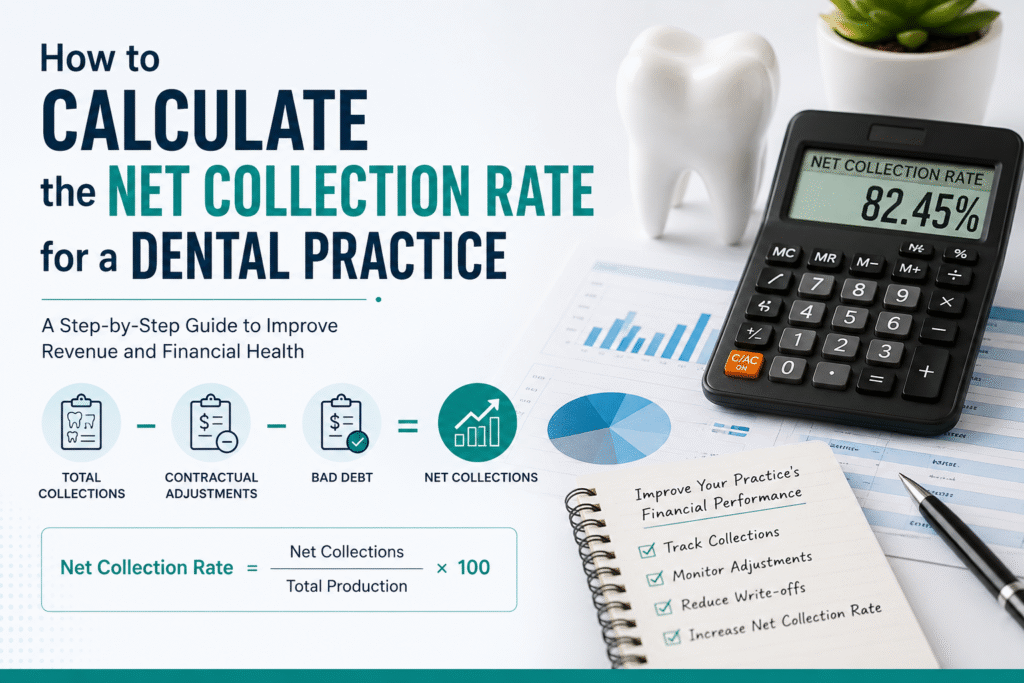
The average U.S. dental practice collects somewhere between 91% and 95% of what it’s actually owed. Top-performing practices sit at 98% or higher. That gap, three to seven points, translates into real money: on a practice collecting $1 million a year, it’s the difference between $30,000 and $70,000 in revenue that was contractually earned and never actually collected. The metric that reveals exactly where a practice falls on that range is net collection rate, and most owners have never sat down and calculated their own. What Is Net Collection Rate in Dental Billing? Net collection rate, or NCR, measures how much of the revenue a dental practice is genuinely entitled to collect, after contracted insurance write-offs, it actually receives. It’s the number that reflects real financial performance, separate from how busy the schedule looked or how much dentistry got produced. Net Collection Rate Formula for Dental Practices Net Collection Rate = (Total Payments Received ÷ (Total Production − Contractual Adjustments)) × 100 Here’s the formula run against a real example. Say a practice bills $500,000 at full fee, has $220,000 in contractual write-offs from PPO participation, and collects $273,000. Gross collection rate on this same practice, payments divided by the full $500,000 billed, comes out to a discouraging-looking 55%. Run the net collection rate instead: $273,000 ÷ ($500,000 − $220,000) = $273,000 ÷ $280,000 = 97.5%. That’s the same practice, the same collected dollars, and two wildly different-looking numbers. The gross figure makes it look like a struggling office. The net figure shows a practice performing above the industry benchmark. This is exactly why PPO-heavy dental practices should never evaluate themselves on gross collection rate alone, it’s measuring against a fee schedule no in-network payer was ever going to fully pay. What’s a Good Net Collection Rate for a Dental Practice in 2026? Current benchmarks: net collection above 96% is where high-performing dental practices sit today. The broader industry average runs 91-95%. Anything below 90% is generally treated as a signal of real, structural revenue cycle management services, not just normal variation. This usually travels alongside other slipping numbers too, denial rates above 3%, clean claim rates below 97%, or A/R aged past 90 days creeping above 10% of total receivables. It’s worth calculating this on a rolling 12-month basis rather than any single month. Dental practices see genuine seasonal swings, a slower January looks very different from a strong Q4, and a rolling average keeps the number honest rather than reactive to normal monthly noise. Run the Numbers on Your Own Practice Doing this calculation by hand takes three figures pulled from your practice management system and a few minutes. We’re building a free RCM calculator that does it instantly; enter your production, contractual adjustments, and total payments, and get your exact NCR benchmarked against current industry standards. One Mistake That Skews the NCR Calculation Bad debt and charity care write-offs should never be subtracted from the denominator the way contractual adjustments are. Only the negotiated difference between your fee and a payer’s contracted rate belongs in that subtraction. Pulling out bad debt too makes the number look artificially healthy and buries real collection failures that deserve investigation instead of quiet removal from the math. Why a Busy Practice Can Still Have a Low Net Collection Rate A full schedule and strong production numbers don’t guarantee strong collections. Three specific problems tend to show up as a declining NCR well before they show up anywhere else on a practice’s dashboard: Coordination of benefits sequencing errors A claim billed to the wrong primary insurer gets delayed, reduced, or denied until the sequencing is corrected, and every one of those outcomes drags collections down relative to production. Unmatched or misapplied payments A payment posted to the wrong claim makes one account look paid while the correct one still shows outstanding, feeding a distorted number into the NCR calculation. Underpayments that never get caught A claim marked paid that was actually paid below the contracted rate still counts as collected in a naive calculation, but it’s revenue the practice was owed and never actually received. How to Check NCR by Payer, Not Just Overall A single blended NCR across your whole payer mix can hide a real problem. Calculate it separately for each major payer. If one insurer’s NCR consistently runs below the others, that’s rarely coincidence; it usually points to that specific payer underpaying claims, processing slowly, or denying more than your contract should allow. A blended average will never surface that pattern on its own. Steps to Improve Net Collection Rate How CEC Supports Net Collection Rate NCR reflects everything happening upstream in the revenue cycle: intake accuracy, coordination of benefits, payment posting, and underpayment recovery. That’s why CEC treats it as the outcome of the full billing process rather than an isolated number to chase in a vacuum. Through CEC’s Accounts Receivable Management Services, collections get tracked against what’s genuinely owed, and when a practice’s NCR starts to slip, the cause gets investigated specifically rather than left as an unexplained dip. Get a Free Net Collection Rate Review Find out your practice’s real NCR, by payer, not just as a blended number. Our experts will pull your production, adjustments, and payment data, benchmark it against industry standards, and flag exactly where collections are slipping. Get a Free Net Collection Rate Review → The Bottom Line Net collection rate is the number that tells the truth a production report can’t. Calculate it on a rolling basis, break it down by payer, and investigate the moment it starts to slide rather than waiting for a full quarter to confirm the trend. If you don’t currently know your own practice’s NCR, that’s worth finding out this month. Contact CEC to have your collections data reviewed, or do a quick self-check on our free RCM calculator to run the numbers yourself. FAQs What’s the difference between gross collection rate and net collection rate for a dental practice? Gross collection rate compares payments
How Dental Practices Can Identify and Recover Insurance Underpayments
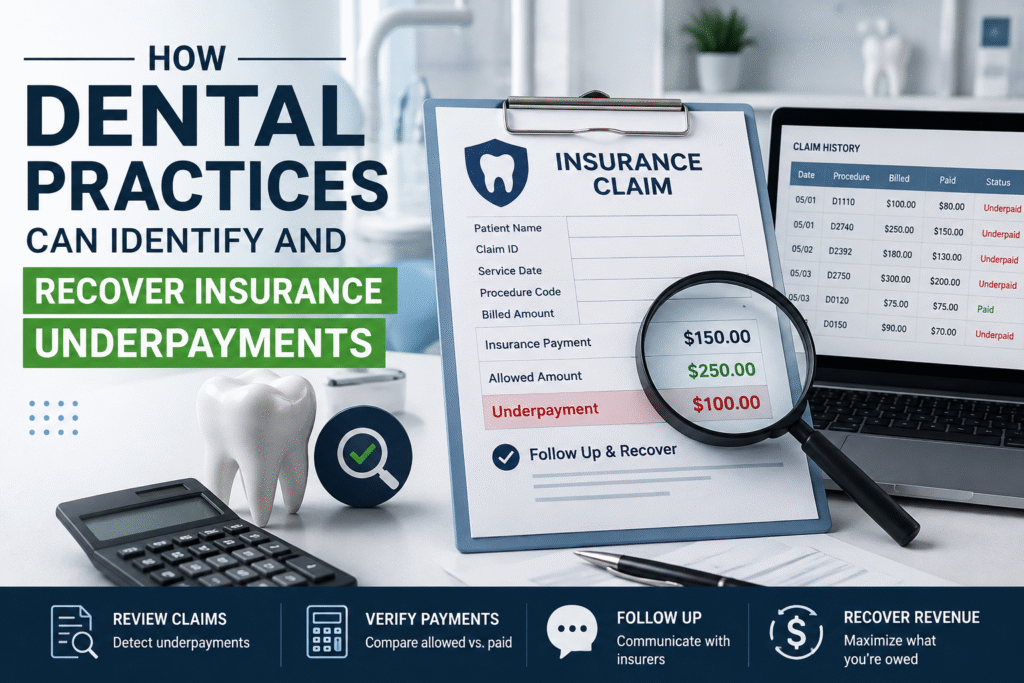
Pull up your last five posted claims from any payer and compare the allowed amount on the EOB against your actual contracted rate for that procedure code. There’s a real chance at least one of them paid less than it should have, and unless someone has recently done exactly that comparison, nobody in your office knows it yet. The Habit That Lets Underpayments Survive Most billing teams have a solid process for denied claims. Something gets flagged, someone works it, it either gets appealed or written off with a reason attached. Paid claims almost never get that same scrutiny, because a paid claim looks finished. That asymmetry is exactly why underpayments survive as long as they do: a practice’s entire follow-up process is built around the assumption that “paid” means “correctly paid,” and most of the time nobody’s specifically testing that assumption. What an Underpayment Actually Looks Like on an EOB An underpayment rarely announces itself. It shows up as a few dollars less than expected, with a reason code attached that looks routine enough to skip past. A payment coded as a standard contractual adjustment can be exactly that, or it can be a downcoded procedure quietly paid at a lower rate than what was actually performed and billed, a composite filling reimbursed at an amalgam rate, or a more involved crown procedure paid out as if it were a simpler one. Treating every adjustment reason code as self-explanatory, without checking it against the actual CDT code billed, is one of the most common ways underpayments get waved through without anyone noticing. Signals Worth Watching For Unexplained adjustments showing up repeatedly on EOBs. A one-off adjustment might be nothing. A pattern of them, especially from the same payer, is worth a closer look. One specific insurer consistently paying less than expected. If a particular payer’s payments run lower than your fee schedule suggests they should, that’s rarely a coincidence. It usually points to either a contract misalignment or a processing issue on that payer’s end that keeps repeating. Accounts receivable that stays high even when patient volume is steady. A growing AR balance despite a consistent schedule often means claims are being partially paid and never followed up on afterward, not that fewer patients are being seen. No process that actually compares billed amounts to received payments. If reconciliation happens, but nobody’s specifically checking the payment amount against the fee schedule, underpayments will keep passing through undetected no matter how thorough the reconciliation otherwise is. How to Actually Identify an Underpayment The mechanics here aren’t complicated, they’re just easy to skip when a billing team is already stretched. Pull your contracted fee schedule for a specific payer, then compare the allowed amount on a handful of recent EOBs against the negotiated rate for each CDT code billed. Anything where the EOB allowable falls below the contracted rate is a candidate for appeal. This is worth doing payer by payer, since fee schedules and their update cycles differ from one insurer to the next, a rate comparison that’s accurate for one payer tells you nothing about another. It’s also worth being honest about where this doesn’t apply. A Medicaid claim paid well below your standard fee isn’t automatically an underpayment, state Medicaid programs set their own reimbursement rates, often significantly below commercial insurance and below your own fee schedule, and that’s simply the contracted rate for that program. The real underpayment question for a Medicaid claim is whether the payment matches what the state’s own published schedule says it should, not whether it matches your general fee schedule. Recovering an Underpayment Once It’s Found Why Speed Matters More Than It Seems An underpayment caught the week it happens is a quick fix: pull the fee schedule, confirm the gap, submit a correction. An underpayment discovered eight months later, buried in an aging report, is a much harder recovery, the appeal window may already be closed, the documentation is harder to reconstruct, and staff turnover means the person untangling it wasn’t the person who originally posted the payment. The gap between “recoverable” and “gone” is usually just how quickly someone looked. Underpayments Are Not Denials, and Treating Them the Same Way Loses Money It’s worth being precise about this distinction, because the two get billed and tracked completely differently. A denial is a claim the payer refused to pay and flagged as such, it shows up on a denial report and typically triggers a defined appeal process. An underpayment is a claim the payer did pay, just for less than the contracted amount, and it often never touches a denial workflow at all because nothing about it was technically rejected. A practice with a strong denial management process can still be losing real money to underpayments simply because they were never built into the same follow-up system. How CEC Helps With Underpayment Recovery Underpayment recovery genuinely benefits from the same infrastructure most practices already have in place for denials, defined follow-up timelines, documentation discipline, and someone actually tracking outcomes by payer. CEC’s Denial Management and Credentialing service extends that exact discipline to underpayments specifically, treating a short payment with the same structured follow-up as a denied one, rather than letting it disappear simply because it was technically paid. This connects directly to the broader Accounts Receivable (A/R) Management Services CEC provides as well, since an uncaught underpayment is, at its core, an A/R accuracy problem: revenue the practice is contractually owed that isn’t reflected correctly in what’s actually been collected. Comparing posted payments against fee schedules on a recurring basis, rather than only when something looks obviously wrong, is what catches these before they age past the point of recovery. Get a Free Underpayment Recovery Audit Find out how much of your paid revenue was actually paid correctly. Our experts will compare your recent EOBs against your contracted fee schedules, payer by payer, and flag every underpayment worth appealing before the recovery window closes. Get a Free Underpayment Recovery Audit
The Dental Payment Posting Problem: How Unmatched Payments Create Hidden A/R
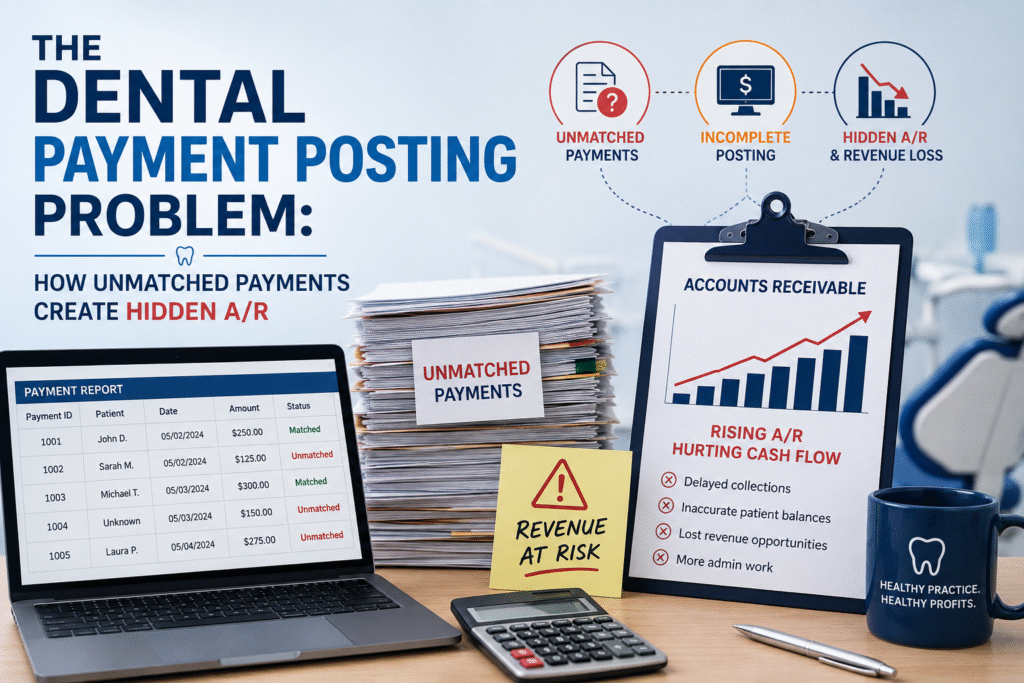
A deposit lands in the bank. Everyone sees it. The claim it was meant for, though, might still be sitting open in your system, untouched, because the payment got applied somewhere else or nowhere at all. That gap between money received and money correctly recorded is where a surprising amount of dental accounts receivable quietly goes to hide. What “Unmatched” Actually Means, and Why It’s Not the Same as Late An unmatched payment isn’t a payment that hasn’t arrived. It’s a payment that has arrived and hasn’t been applied correctly to the wrong claim, the wrong patient, or the wrong procedure line. That distinction matters because a late payment is visible; it shows up on an aging report as something still owed. An unmatched payment can do the opposite: it can make a claim look resolved when it isn’t while quietly inflating a completely different account at the same time. Duplicate payments and unapplied credits create exactly this kind of confusion, and without a solid reconciliation process, a practice can end up overstating its own collections without anyone noticing. The report says one thing. The reality is something else, and the two only get reconciled when someone specifically goes looking. How This Actually Happens on a Normal Billing Day ERA files that don’t import cleanly. When an electronic remittance file fails to import correctly, staff often end up posting that payment manually instead, which is exactly where posting errors tend to creep in. A busy Tuesday with a stack of manual postings is a very different error rate than an automated import running clean. Multi-procedure claims that get split incorrectly. When several procedures are billed under the same encounter, payers don’t always allocate the payment consistently across payer liability, patient responsibility, deductible, and coinsurance, and the leftover residual balances often sit on an account that otherwise looks closed. This is dental billing’s version of a very common problem in any specialty with bundled same-day procedures. COB and secondary payment timing. When a secondary claim is processed on a different cycle than the primary, or a crossover payment lands before the corresponding primary EOB has been posted, the payment sometimes gets parked in the wrong place while staff wait for the rest of the picture to arrive. This is the direct downstream cousin of the coordination of benefits sequencing problem covered separately, get the primary/secondary call wrong at intake, and the payment that eventually comes back has a real chance of landing somewhere it shouldn’t. A deposit with no matching remittance. When an insurance payment hits the bank account without a corresponding ERA on file, that claim is effectively stuck open until someone requests the missing remittance and closes the loop. Left alone, it just sits. Why an Unmatched Payment Is More Dangerous Than a Denial A denial gets flagged. Someone works it. An unmatched payment doesn’t announce itself, because on paper, money came in. Detailed remittance reconciliation is actually one of the few ways to catch payer underpayments that never triggered a denial code at all, hidden precisely because nothing about them looks wrong at a glance. This is the mechanism that quietly separates a practice’s real financial picture from what its own reports show. Unapplied payments sitting in a practice management system are, by definition, revenue that hasn’t been matched to the account it belongs to, and tracking that unapplied balance regularly is one of the more overlooked ways to catch revenue before it ages out entirely. What This Costs, With an Actual Number It’s worth being concrete about scale here rather than vague. If a payer reimburses $80 for a procedure with a contracted rate of $95, that $15 difference stays lost unless someone specifically flags and appeals it. Now multiply that by every claim a mid-sized practice processes in a month. Individually, these are small enough to overlook. In aggregate, across a full patient panel, they add up to a genuinely material amount of revenue a practice has already earned but never actually collected. Where the Silo Between Front Desk and Billing Makes This Worse Front desk teams typically collect patient payments while billing teams manage insurance payments, and without coordination between the two, discrepancies slip through that neither side is positioned to catch alone. A patient payment posted without visibility into what the insurance side already applied, or vice versa, is exactly how the same balance ends up double-counted, or a legitimate payment ends up misclassified as an overpayment. Catching Unmatched Payments Before They Compound How CEC Approaches Payment Posting and A/R Accuracy This is where CEC’s Payment Posting Services and Accounts Receivable (A/R) Management Services work as two sides of the same problem rather than two separate offerings. Payment posting accuracy is what prevents a misapplied payment from happening in the first place, weekly deposit reconciliation, ERA cross-checking before batch posting, careful handling of split multi-procedure payments. A/R management is what catches it if it slips through anyway, identifying accounts where the reported balance doesn’t match the underlying claim history and tracing the discrepancy back to its source. A meaningful share of what shows up looking like a stuck or stale A/R account traces back to a coordination of benefits sequencing issue at intake, which is exactly why CEC’s Dental Insurance Billing and Verification Solutions work upstream of this problem too, verifying coordination of benefits and eligibility before treatment, so fewer payments arrive with nowhere correct to land in the first place. Get a Free Payment Reconciliation Check Find out how much revenue is hiding behind unmatched or misapplied payments in your system. Our experts will reconcile your deposits against posted payments, trace the discrepancies back to their source, and help you recover what’s already been earned. Get a Free Payment Reconciliation Check → The Bottom Line The most dangerous accounts receivable problems aren’t the visible ones sitting openly on an aging report. They’re the ones hidden behind a payment that technically posted, just not to the right place. A weekly reconciliation habit and
Dental Coordination of Benefits Explained for US Dental Practices

Ask a front desk coordinator how they decide which of a patient’s two insurance plans to bill first, and you’ll often get an honest answer: whichever card was on top. Nobody ever walked them through the actual rule, and an insurance card doesn’t come with instructions printed on the back. That rule has a name: coordination of benefits, or COB. Getting it backwards rarely looks like a mistake right away. The claim goes out, weeks pass, and then a payment comes back wrong or a secondary claim gets denied for reasons that don’t make sense, and by then nobody remembers the ten-second decision at check-in that caused it. Not Every Dual-Coverage Patient Actually Needs COB Here’s a detail that trips up a lot of billing teams: coordination isn’t universal. Only group or employer-sponsored plans are required to coordinate benefits, so if one of a patient’s two policies is an individual plan, that plan generally isn’t obligated to coordinate at all. Treating every dual-coverage patient as a standard COB case, without first checking whether both plans are actually group plans, means some claims get processed under an assumption that never applied in the first place. The Rules That Actually Decide Who Pays First When the patient is the named enrollee on both plans. If someone is a primary policyholder, not a dependent, on two separate plans, the tiebreaker usually comes down to tenure. The plan that has covered the patient longer is generally treated as primary, which is easy to miss if staff assume the plan with better-looking benefits should lead. When one plan is tied to active employment, and the other isn’t. A plan through current employment is primary over a COBRA plan or a retiree plan, even if the COBRA coverage happens to be the one that’s been active more recently. When a child is covered under both parents’ plans. This is the birthday rule: whichever parent’s birthday, month and day only, falls earlier in the calendar year has the primary plan. If both parents share a birthday, tenure becomes the tiebreaker, the same logic as above. When parents are separated or divorced. A court order naming one parent responsible for coverage overrides everything else. Without one, the order generally runs the custodial parent’s plan first, then the plan of the custodial parent’s spouse, then the non-custodial parent’s plan. The birthday rule only reappears if custody is genuinely joint with no court decree. The honest problem with all four of these rules: none of that information, plan type, tenure, employment status, custody arrangement, shows up on a standard eligibility check or an insurance card. The only reliable way to get it is to ask the patient directly at intake, with specific questions rather than a general “do you have other insurance,” and to document whatever they state as the working COB determination until an EOB either confirms or contradicts it. Non-Duplication and Carve-Out: Where Secondary Coverage Stops Meaning What Patients Expect Say a procedure costs $1,000. The primary plan covers 80%, paying $800. If the secondary plan would normally have covered 75% as if it were primary, that’s $750. Under a non-duplication clause, the secondary doesn’t pay the gap between $800 and $750, because there is no positive gap. The primary payment already met or exceeded what the secondary would have paid on its own, so the secondary pays nothing at all. To a patient, that feels like the second plan didn’t do its job. To the payer, it’s the contract working as designed, not a processing error, which means it isn’t something to appeal, only something to anticipate before the claim goes out. Carve-out plans calculate differently: the secondary works out what it would normally pay, then subtracts whatever the primary already paid from that figure. This usually produces a smaller secondary payment than non-duplication would, and without knowing which method a specific secondary plan uses in advance, it’s easy for a biller to mistake the result for an underpayment. Worth knowing too: these calculation methods aren’t standardized nationally, they vary by carrier and are further complicated by differing state laws. The NAIC has drafted model COB regulation and the ADA supports states adopting it, but adoption isn’t uniform, so a rule that holds firm with one payer in one state isn’t guaranteed to apply identically elsewhere. The Timely Filing Trap Most COB Advice Gets Backwards A lot of billing guidance says to hold the secondary claim until the primary EOB arrives. In practice, that’s exactly the habit that causes missed payments. Best practice is to submit the secondary claim before the filing window closes even without the primary EOB in hand, and if it comes back denied for that reason, appeal it citing the wait. Most secondary carriers do extend their own clock once they see a documented COB delay, but only if the practice can show when the primary EOB was actually received. Many secondary carriers calculate their filing deadline from the date the primary’s EOB was received rather than the original date of service, which effectively extends the window, but this isn’t universal across every carrier. The safer habit is getting the secondary claim on file early and tracking the primary EOB date carefully, rather than assuming there’s unlimited time to wait. Where This Actually Breaks Down: The Software Layer Understanding the rules is one thing. Getting a practice management system to apply them consistently is another. In Open Dental, for example, the COB rule has to be manually selected on each secondary insurance plan, and creating a claim automatically generates a primary claim marked “Waiting to Send” alongside a secondary claim held at “Hold until Pri received” until that status is changed. If that field was never set correctly when the plan was entered, or if staff clear the hold status manually out of habit, the software’s protection against premature submission disappears. Dentrix and Eaglesoft handle this with their own version of claim holds and payment-table logic, but no PMS handles coordination of
Where Dental Accounts Receivable Gets Stuck (And How to Collect More of It in 2026)
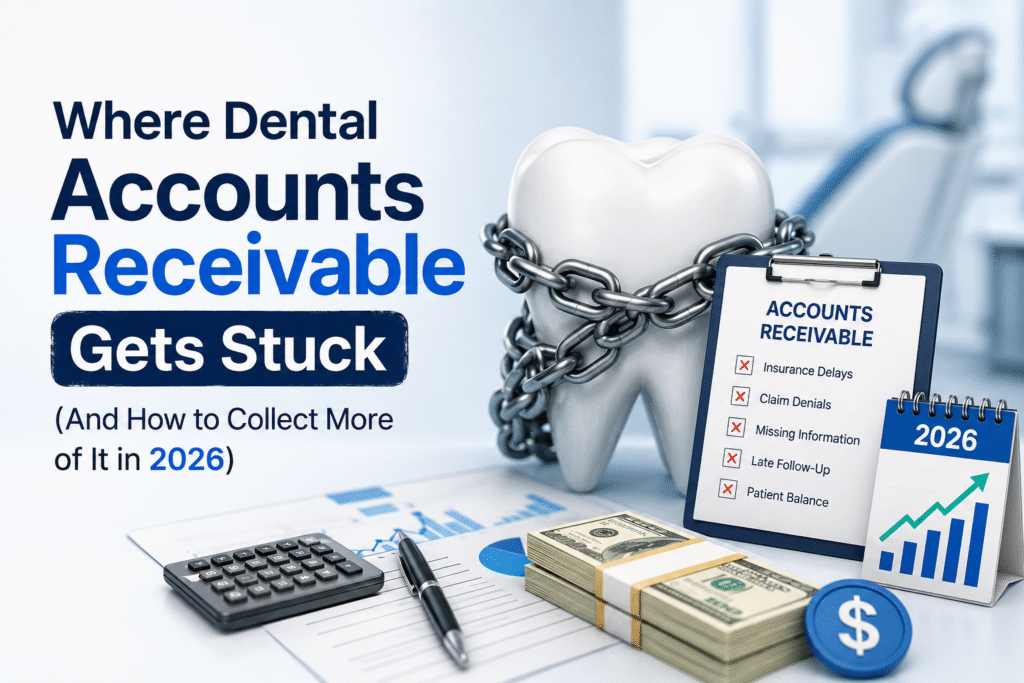
A practice can be booked solid for weeks and still be scraping to make payroll. That contradiction usually traces back to one report nobody’s opened in a while: dental accounts receivable. Treatment was already delivered, money already earned on paper, just sitting there aging past the point where it’s realistic to collect it. Production isn’t usually the problem in 2026. Collection is, and it hides well right up until someone actually pulls the aging report and looks at the buckets. Here’s what dental AR aging looks like once you’re actually staring at it, why balances drift into the 60, 90, and eventually 120-day range, and what tends to pull them back. What Counts as Dental Accounts Receivable Dental AR is everything owed to a practice for work that’s already been done. Two very different flavors of it exist, and lumping them together is where a lot of practices go wrong. Insurance AR vs. Patient AR Insurance AR sits with the payer, a claim still working through processing, or stuck because something in the documentation didn’t line up. Patient AR belongs to the person in the chair, co-pays, deductibles, whatever their plan didn’t touch. Insurance AR ages because payers are slow or a claim got denied. Patient AR ages for a different reason entirely, usually because nobody followed up, or the patient never actually understood what they’d owe. One follow-up process for both categories is a fast way to let both age longer than they should. Reading a Dental AR Aging Report Without Getting Lost in It The report itself splits balances into time windows, current through 30 days, then 31-60, 61-90, and past 90. Which window a dollar sits in tells you almost everything about whether you’ll ever see it. AR Days and Collection Ratio, the Two Numbers That Actually Matter Average AR days is how long, on average, it takes to get paid, total AR divided by average daily production. Collection ratio is the percentage of what’s owed that actually comes in. A practice can be running at full capacity and still be quietly failing both of these. Dental AR Benchmarks Every Practice Should Know Metric Healthy 2026 Target What Falling Short Usually Signals Average AR days 30–45 days Slow claim submission, delayed follow-up, or payer-side processing issues Collection ratio 96%+ Underpricing, missed patient collections, or excessive write-offs AR aged 31–60 days Under 15% of total AR Follow-up happening reactively instead of on a set schedule AR aged 61–90 days Under 10% of total AR Claims or balances slipping past a first and second follow-up attempt AR aged 90+ days Under 5% of total AR A structural gap somewhere in eligibility, coding, or collections Stop letting aging accounts reduce your dental practice revenue CEC helps dental practices recover outstanding accounts receivable with proactive insurance follow-ups, patient collections, denial management, and structured AR aging workflows that improve cash flow and reduce overdue balances. CONTACT US → Past 90 days, the odds of collecting in full start dropping fast. Past 120, a good chunk of that money is basically gone, it just hasn’t been written off yet. These numbers are worth checking against your own report monthly, not once a quarter when someone remembers to look. CEC’s insurance aging A/R calculator makes that comparison quick if you don’t want to pull the full report manually every time. Why Dental AR Ages in the First Place Most articles on this topic skip straight to the fix, verify insurance, follow up faster, without asking why the balance got old to begin with. That’s backwards, honestly, because it’s usually the same three or four things happening over and over. Somebody assumes coverage instead of checking it, so the claim goes out built on outdated benefit info. A claim sits in someone’s queue for a day, sometimes two, before it actually gets submitted, and that delay compounds through everything after it. A patient hears a vague number at checkout, or hears nothing at all, and leaves without really knowing what they’ll owe. And follow-up on older balances happens whenever there’s a free hour, not on any real schedule, which means the oldest, hardest accounts get the least attention instead of the most. None of this is exotic. It’s also why the AR aging report and the dental billing workflow are basically describing the same thing from two different angles. Closing the Gaps: What Actually Moves Dental AR in 2026 Verify Insurance Before Every Visit, Returning Patients Included Checking coverage, deductibles, and remaining benefits 48 to 72 hours out catches most denials before they exist. A lot of practices only verify new patients on the assumption returning ones haven’t changed plans, and that assumption misses plan-year resets, job changes, lapsed coverage, constantly. Get Claims Out the Same Day Every extra day a claim sits before submission gets added onto everything downstream of it. Submitting same-day, with coding and documentation right the first time, shortens the whole cycle without a single collections call being made. Actually Work the Aging Report, on a Schedule Weekly, oldest and biggest balances first. That’s really it. Skip the schedule and follow-up becomes whatever’s easiest that day, which tends to mean newer, simpler balances get chased while the 90-day accounts just keep sitting there. Set Patient Payment Expectations Before Treatment, Not After Patients should hear their estimated portion before the appointment, not in a statement three weeks later. A financial policy that is genuinely enforced, not just drafted and then silently forgot, helps reduce the number of patients who sort of go off the grid on their statements. Automate the Patient Side Text reminders, email, an online payment link, card on file. These remove the friction that keeps a $150 balance unpaid for months. Paper statements alone are, frankly, one of the slower ways to collect from patients at this point. Get EFT Set Up With Every Major Payer It cuts out the check-clearing wait, which adds real days to every single insurance payment. One-time setup, permanent improvement on every claim